Showing posts with label Russia. Show all posts

21 November 2025

Ukraine and the "peace plan"

It looks like Ukraine is facing a very bad choice in the next week or two. Either accepting a humiliating peace deal or face the loss of US support at a time where it can ill-afford such loss.

It is clear to me that Ukraine is nowhere near being able to expel Russian forces from its territory. It can throw as many Flamingo missiles at oil refineries as it likes, but that is not going to make Russia collapse. A concerted campaign of sanctions and economic isolation would be more likely to do so, but like a game of Jenga, you cannot predict with certainty when the tower is going to collapse.

Accepting the deal would likely just be an armistice for a few years until Russia can reconstitute then attack again on some dubious pretext. But continuing to fight risks a Ukrainian collapse.

Europe is not going to commit actual ground troops to liberate Ukraine. It is too reliant on Russian gas.

There is a danger of pride overcoming common sense - but it might not be common sense. I wouldn't like to make this decision anymore than Zelenskyy.

Let's hope he makes the right one.

24 February 2025

Three years of war between Ukraine and Russia

It feels longer in a way to me. I imagine it must feel like an entirety for those involved in one war or the other, including the refugees that I know are in my area.

I don't think anyone wants this war to go on; Ukraine just wants a peace that will keep its country secure in the long-term, because it seems that Putin wants at the least a client state and at most to end Ukrainian independence. They might want to do a mineral deal, but not at the price of becoming an American vassal.

Trump has done vast damage to European security in his first month in office. It appears that we will now have to defend Europe from Russia largely on our own, with implications for public spending in other areas, not to mention taxation.

In any event, it seems Putin is not willing to compromise on anything meaningful and produce a peace deal that Ukraine should accept, so I guess the suffering will continue on both sides for a while longer sadly. Many more people will die or suffer life-changing injuries because one man wants to recreate an empire, regardless of cost.

I just wish more people would accept that, on both far-right and far-left.

17 March 2023

Vladimir Putin wanted for war crimes

The ICC wants Putin to face charges of war crimes for the abduction of children

It's clear that there is an attempt to ethnically alter Ukraine, or at least the parts that Russia controls, to make it more Russian - and putting these children in Russian families is just a part of that. Putin has many crimes to answer for, although I am not sure whether he will answer for them in any earthly court. If he is overthrown, Russia handing him over will likely be a condition of normalising relations, but he may end up dying first - and facing a more perfect judge.


11 December 2022

Looks like it might be a cold winter

Snow is outside my house right now and I may end up having to work from home on a day that I normally go in.

With the current energy price situation - and the government needs to do all it can to get them down - this is going to be a tough winter for many poor people and we'll likely see a lot of "excess deaths".

It will be even worse for those in Ukraine, who are dealing with Russian attacks on the electricity supply designed to demoralise them. But those sort of attacks will likely motivate their soldiers even more. 

In any event, the best way to end this situation is to end that war  - with a Ukrainian victory, because we can't give Putin a chance to rearm for a second go.

12 March 2022

Ukraine #3: The suffering of civilians

Russia is engaging in medieval style siege tactics around Mariupol and other cities, trying to pulverise the places into surrendering. If they want to control Ukraine, taking it over via massive bloodshed is not going to work very well. You'll have a lot of deep resentment against an occupying force as countless examples demonstrate throughout history.

Putin might be thinking that he can make Ukraine surrender if the civilian death toll is that bad, but currently they show no sign of doing that. It's also a rare thing to have happen. Russia had to wreck Grozny and Aleppo.

We could still have a lot more bloodshed to come, sadly.

05 March 2022

Ukraine #2: The Paper Tiger, or rather Bear

We used to fear the Russian military. The events of the past two weeks have radically changed opinions. It appears they have massive issues with logistics, communications security and morale. The fact that Su-34s, the most modern strike aircraft in their inventory, are being shot down, and they haven't gotten control of the air yet is massively telling.

Meanwhile, the sanctions seem to be causing real pain as company after company is terminating their operations and the ruble is plummeting in value.

Putin seems either completely unhinged or doing a very good impression of it. We cannot rule out a palace coup at this stage. We also can't rule out the use of nuclear weapons, but that would require a lot of other people to be crazy.

But until he's gone, a lot of people are going to suffer from his delusional folly.

26 February 2022

Ukraine

Russia's invasion of Ukraine is a blatant act of aggression without justification. Strong sanctions are needed, along with material help to the people of Ukraine.

The fact that Russia's attack is not going as well as they clearly hoped is a good thing.

But many people will still suffer and I encourage you to donate to charities that are helping those caught up in a war not of their marking.

Слава Україні!

25 March 2019

The Mueller Report

I'd very much like to see the whole thing (or as much as gets released) before I can fully conclude on it, but I can believe that much of the Russian interference operation was conducted independently with the aim of weakening Clinton and electing Trump, whose views were much closer to the Russian world view.

Not exonerating Trump of obstruction of justice is the key finding, but I'd like to see why a decision wasn't made to charge him. If it was made by the Attorney General himself, then... well... the corruption is obvious.

09 August 2015

Well that was a slog (Review: "War and Peace", 1869)

Well, I've finally managed to do it - I've completed a read through of Tolstoy's literary door stopper. It's not the longest novel ever written; not even in the top ten in fact - but I can only imagine that the original Russian text is even longer due to the greater length of Russian words.

Did Tolstoy have an editor?

****
Voyna i mir, to quote its Russian title, is (primarily) an epic about a group of rich Russian families in the period between 1805 and 1820; with particular focus on the Napoleonic Wars, specifically the Corsican's invasion of Russia, which saw him capture Moscow (getting a bit further than Mr. One Testicle), which promptly ended up being mostly destroyed in a big fire before having to retreat due to the Russian winter.

The "war" is better than the "peace" by a good margin; Tolstoy did extensive research on the period and captures the intrigues, politicking etc. of the Russian high command very well. In addition, Tolstoy (having served in the Crimean War and ended up a pacifist as a result) exposes the chaos and difficulties of fighting a war before the invention of radio communications brilliantly, not to mention the horrors that exist eternally.

That's not to say that the non-battle stuff is poor; there's some good character arcs, with Pierre Bezukhov's quest for meaning in life being particularly key. The life of Russian aristocracy (parties, gossip and marrying for money) and general Russian customs is insightful; also an insight into days when if someone went on a trip, you had no idea when they might actually return... if at all.

Where the novel really runs into problems, however, is when Tolstoy takes a break from it to have a moan at historians he doesn't like; especially those who thought that the events were all driven by the 'great man' Napoleon Bonaparte; he argues that many thousands of individual wills were involved. Some of this may be OK, but when he devotes an entire second epilogue of 12 chapters to a discussion of free will versus inevitability, you're really just desperate for it to end. In addition, the first epilogue actually just kind of stops.

Conclusion

While definitely a good book and certainly worth a read, Tolstoy's habit of going on long diatribes knocks this down considerably. The story is interesting, but if I wanted a discourse on the nature of historiography, I would have read a different book.

Personally, I prefer Crime and Punishment.

7/10

18 February 2015

Ukraine 'ceasefire'

The continued violence despite a so-called ceasefire agreement in Ukraine suggests one of two things:
1. The Russians are unwilling to rein their proxies
2. The Russians can't rein in their proxies.

I'm not sure which of the two is more alarming.

18 July 2014

MH17

The crash of Malaysian Airline flight MH17 in eastern Ukraine is a deep and shocking tragedy... but I don't believe it was an act of terrorism.

From the evidence that the Ukrainians have released; it seems to have been a case of gross incompetence by the separatists and those training them. Misidentification of an airliner as a military cargo jet is easy when you don't know how to use your equipment properly... and when you're not given clear orders about engaging hostile aircraft.

There needs to be an impartial investigation, those responsible need to be dragged through the courts on manslaughter charges, there needs to be a long-term peace in Ukraine... and the ICAO needs to re-evaluate how it handles civilian flights over warzones. I myself flew over Iraq in 2009 on my way to Dubai; the insurgents there didn't have any high altitude capable SAMs... but people clearly thought that this wasn't the case in Ukraine.

For 296 people, that view was fatally incorrect. May they rest in peace.

18 March 2014

Crimea


Today saw the first actual death in the 'war' between Russia and Ukraine, with a Ukrainian warrant officer killed when Russian forces stormed a base in Simferopol. One hopes that there isn't any more - I doubt either country really wants a proper war, but what people want and what they get are often not the same thing.
There is a valid case for a referendum on Crimea becoming part of the Russian Federation. However, when that referendum is conducted under what is basically a Russian occupation and with no international monitors present, it is completely invalid. The annexation of Crimea is illegal and invalid.

This said, I do wonder how far the West is prepared to go with sanctions... the EU economies are closely interlinked with Russia and cannot just cut them like what happened with Iran (the jury is still out on the effectiveness of those sanctions until any final deal is reached). Until something major happens in Moscow, Crimea is now a de facto part of Russia.

Oh, well, I needed to buy a new atlas anyway.

28 February 2014

The Crimea situation

Today the situation in Ukraine has gone several stretches up the escalation scale. The movements of the Russian forces and the actions of very organised pro-Russian militia are starting to look an awful lot like a seizure of power in Crimea, with the possible aim of that territory returning to Russia.

Kyiv must make sure that it does not provide the Russians with a valid pretext for full-scale military action; while they have capable armed forces, they are no much for those of Russia and a war would merely kill a lot of people. The NATO governments have made no commitment to join in and I doubt that they would want to.

Everyone needs to stay calm and not do anything stupid.

04 July 2012

Battlefield 3: Further posts

Just completed another SP mission for this game - "Comrades". I won't spoil this one for those who haven't played, but it's plot-critical. While there's an interesting story here, single-player shooters all get a bit samey after a while.

30 June 2011

The Biggest War in History, Part Eight: The past as present

The Soviet War Memorial in Treptower Park, Berlin, Germany (from Wikipedia, taken by "Victorgrigas")
Part Seven
Aftermath and Legacy

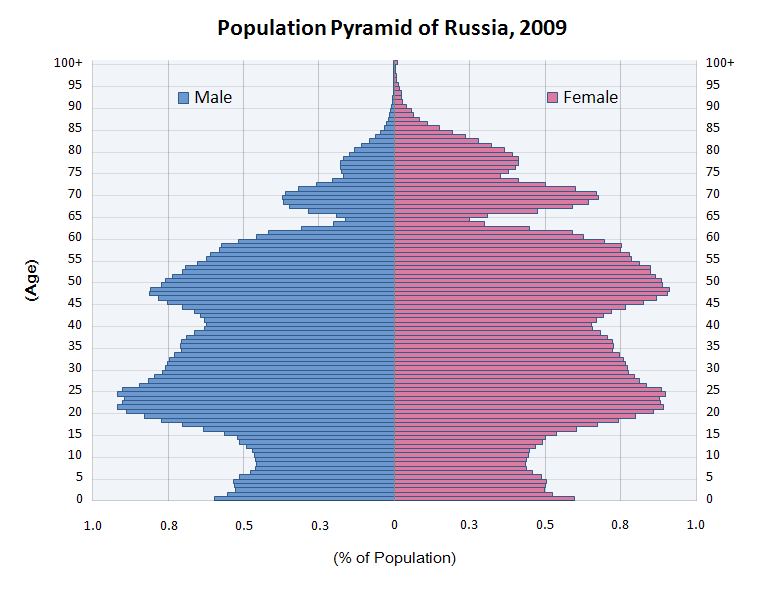
The population pyramid says it all. Even today, the Great Patriotic War continues to have a demographic effect on Russia and the other 14 nations that comprise the former Soviet Union. The male/female balance in the USSR tilted decisively in favour of women as a result of the huge numbers of men killed in the war - even today, there is still a noticeable imbalance between men and women, worsened by lower male life expectancy due to widespread alcohol abuse.

Everyone in the country was touched by the war in some way even if they survived; particularly those who liberated the death camps. The biggest and bloodiest war in history had devastated large parts of the country. If the Second World War still resonates even among young children in the UK today, then the effect must be just as large in Russia and the other republics.

A large number of war films and TV series were produced (and are still produced) by Soviet/Russian companies; most of these are not particularly well-known in the West. I've only heard of a few (Seventeen Moments of Spring, for example) and seen none of them - my Russian is only basic at best and I'd need subtitles to watch them.

Stalin's victory in the war led him to a wave of popularity that lasted until the Secret Speech in 1956 - he still remains pretty popular in Russia today, much to the puzzlement of Western commentators, including myself. His well-known paranoia remained and only his death in March 1953 prevented another major purge.

The USSR gained a considerable amount of territory from the war - including parts of Germany, Poland, Romania and Finland, as well as ending the independence of the three Baltic republics that had gained their freedom in 1918. It also retained a fear of attack from the West - with Germany now replaced by NATO, led by the United States. The retention of very large military forces, as well as the large-scale naval build up under Gorshkov, all stemmed from a desire to defend the Motherland, rather than wanting to take over the world (not that spreading communism wasn't part of Soviet foreign policy).

Of course, the large Soviet military meant that the West, fearing an attack itself, spent considerable amounts of money on weaponry itself.

It can only be said that if Hitler had never come to power, the world would be a much better place.

Reflections

The sheer scale of the Great Patriotic War boggles the mind. I visited Auschwitz a few years ago and saw one of the rooms they had where the pile of shoes that had been found when the camp was liberated. That's the moment that the sheer scale of The Holocaust hit me fully. Ten million was only really just a number until then. 26.6 million (and those were just the people in the USSR) is now a far realer number.

There was a casual indifference to human life on both sides during this conflict. I've yet to mention the Soviet tactics of NKVD commissars shooting retreating forces and the use of penal units to clear minefields by running across them. The latter sounds more like something someone would do in a computer game. Of course, the Germans were far worse - Hitler's lack of grip on military realities doomed millions.

I think the memories of this war, combined with the threat of nuclear destruction, has helped us ensure broad levels of peace in Europe for over 60 years. Hopefully, the memories will not die with the veterans.

I will close with one simple word in Russian to those who helped bring down the most evil man in history:

Spasiba.

20 June 2011

The Biggest War in History, Part Three: One step forward, two steps back

Soviet troops counter attacking in 1941 (via Wikipedia)

Part Two

During one of the coldest winters on record (the 1940s was a particularly cold decade), the Red Army launched a counter-attack against the German forces that had invaded their homeland. While this succeeded in removing Moscow from direct danger, it wasn't the spectacular success of the initial German invasion and eventually stalled as the weather improved.

The counter-offensive should be better remembered for two new weapons that fully arrived on the scene during it - the T-34 medium tank, considered to be one of the best tanks of the war and the Katayusha (although both had featured in combat earlier). The latter deserves further discussion.

The BM-13 truck-mounted rocket artillery system isn't the most accurate weapon on earth by any stretch of the imagination. Chucking a load of small rockets at a large area does not cause a lot of property damage or a huge number of casualties.

What it does cause is a lot of fear, because you never know where the next one is going to land. This leads to the troops on the receiving end being rather ineffective at best as they're too busy trying to stay alive.

The psychological effect of Multiple Launch Rocket Systems is apparent even today - far more Israeli children have suffered mental problems than actually being killed by Hamas and Hezbollah rocket attacks.

I would not like to come under attack from them, that's for sure.

****
On 28 June 1942, the Germans launched another offensive - called Case Blue by them - aimed at Stalingrad and the Caucasus region. The area contained vast reserves of oil and other important resources needed for the German war effort; an effort that was rapidly consuming the materials that Germany had available to it.

In hindsight, the entire offensive was a stupid idea - it was too ambitious by half.

The offensive initially went well - the Germans took the areas of the Crimea that they'd not got the previous year and advanced rapidly towards what is now Azerbaijan, Armenia and Georgia. If Hitler could get through those, he could open the door to Turkey and the Middle East, causing Britain problems in Egypt.

He didn't though - the Red Army had plenty of reserves available and threw them in to the massive battles that unfolded. German progress stalled in the Caucasus and stalled badly. The new target of the Wehrmacht now became Stalingrad - the fall of that, it would believe, would be a massive blow to Soviet prestige.

That battle will be covered tomorrow, but it is fair to say that the Soviets had taken one step forward near Moscow and two steps back in the Caucasus. They weren't out by any means, but much of their territory remained under German occupation and their casualties were still huge. They had the men to spare, but that's of course no comfort to the families.

It would be another miserable winter for the citizens of the western USSR, especially the Jews.

Part Four

19 June 2011

The Biggest War in History, Part Two: Sowing the Wind

Part One
Soviet gun crew in action at Odessa, 1941 (via Wikipedia)

The Book of Hosea in the Old Testament has this famous passage:

"They that sow the wind, shall reap the whirlwind"

Hitler's invasion of the Soviet Union in June 1941 was definitely a case of this - the decision to launch "Fall Barbarossa" (Operation Barbarossa) would cost Germany the war and millions of Germans their lives.

Yet, it could have succeeded had not Hitler made some massive mistakes.

The invasion gained complete surprise; the Soviet Union completely ignored the signs. Forces were in the wrong place (while they were aligned for an invasion of Ukraine, they still would have had a problem against Panzer spearheads), training was poor and tanks weren't used properly. However, they did get something right elsewhere; they correctly figured Japan was not going to attack them in the Far East and were able to transfer troops that made a key difference.

It is no surprise that the Red Army was thrown back reeling, with industry dismantled in a rush and millions affected by scorched earth policies. Admittedly this was a major help for the Soviets in preventing Germany from gaining key resources, but the human cost was still huge.

In two months, the Germans and their allies had advanced hundreds of miles. Millions of Soviet troops were dead or captured (which in many cases the latter meant you were becoming the former fairly quickly). However, this progress was illusory. Hitler did not focus on one single target - the best one, in military terms, was probably the Caucasus (where the oil was). Instead he tried to get that, Leningrad and Moscow. He would get none of them. Key delays, including the assault on Kiev that took several key weeks, despite the huge Soviet losses during what was ultimately a German victory, cost the Germans time and prevented them from finishing the campaign before winter hit - rendering the roads impassable and turning life for the Wehrmacht into absolute frozen misery.

Also the Germans vastly underestimated the numbers and tenacity of their opponents; they were not weak sub-humans by any stretch of the imagination - and they were fighting on their own turf.

However, there is one more important reason why Barbarossa failed - the Nazi policy of extermination. A significant percentage of the people of the Western USSR initially viewed the Germans as liberators from repressive Russian rule. When local nationalists and SS Einsatzgruppen started massacring Jews, such as at Babi Yar, and those also they suspected of being "Commissars", this made things worse for the Germans. Not only did these acts of mass murder take up German forces that could actually be on the front, they created a partisan movement that caused the Germans even more problems, especially when the Germans reacted to said partisans in their usual vicious manner.

As December 1941 began, both sides were heavily battered, suffering massive losses. While the Germans were now stuck, the Soviets had their "breadbasket" (Ukraine) under enemy occupation, Moscow under threat and Leningrad under siege.

The last thing you would expect under these cold winter conditions was for the Soviets to launch an offensive.

Which is precisely what they did. I'll cover this tomorrow.

Part Three 

18 June 2011

The Biggest War in History, Part One: A Delaying Deal with the Devil

This Wednesday, 22 June, marks the 70th anniversary of the start of the biggest conflict that has ever happened on this planet: the Eastern Front of the Second World War between Nazi Germany and the Union of Soviet Socialist Republics.

As a man with a keen interest in things Russian, I could let this anniversary go by without making some comment on my blog. This series will be in seven parts, hopefully one a day:
  • Part One: 1939 and 1940 - the lead-up to the war
  • Part Two: 1941 - the initial invasion
  • Part Three: 1942
  • Part Four: 1943 - with a focus on Stalingrad and Kursk
  • Part Five: 1944
  • Part Six: 1945 - with a focus on Berlin.
  • Part Seven: The consequences then and now.
(15 August 2014 - it became eight)
****
Part One: A Delaying Deal with the Devil

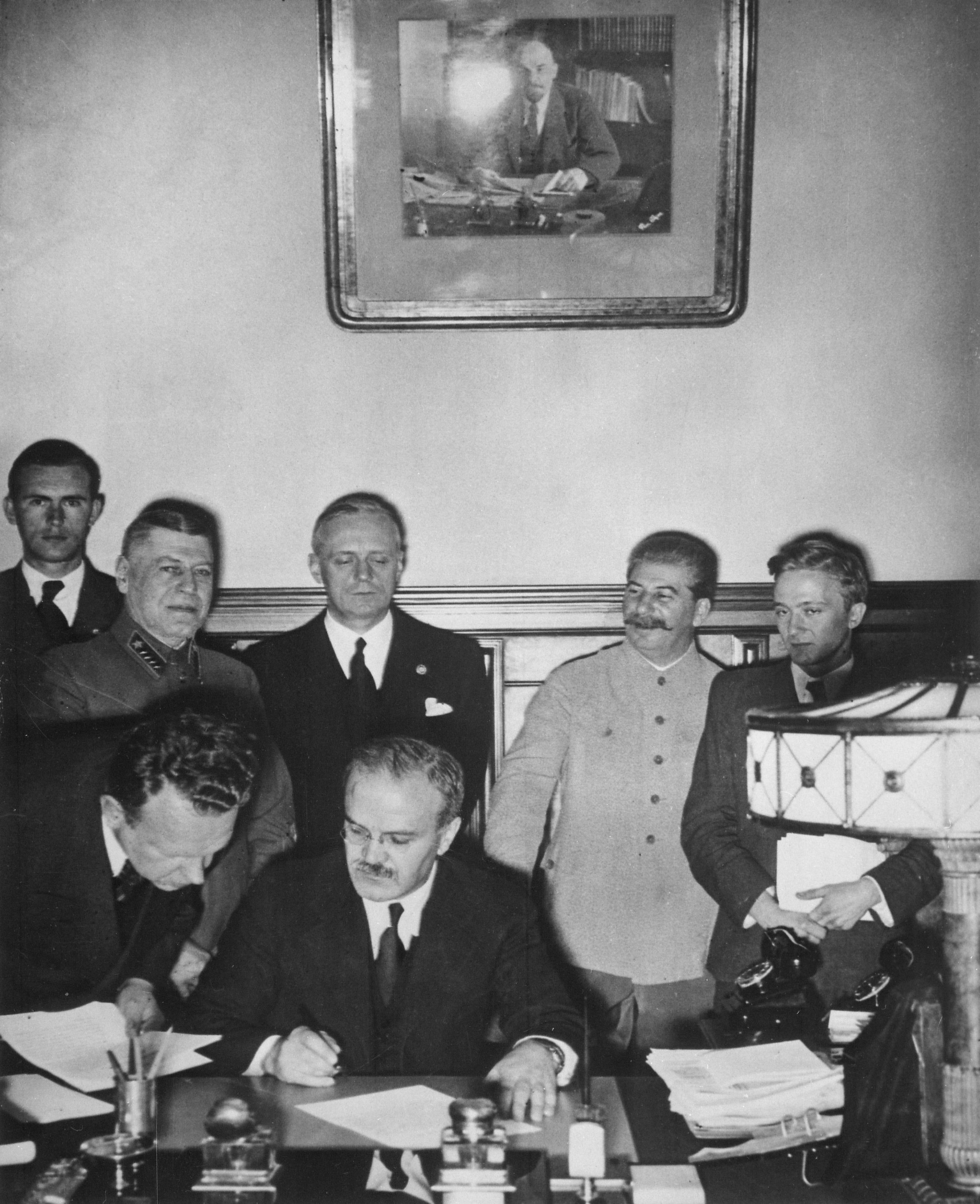
Soviet Foreign Minister Molotov signs the German-Soviet non-aggression pact; Joachim von Ribbentrop and Josef Stalin stand behind him, Moscow, 23 Augst 1939 (via Wikipedia, original German photo)

It's fair to say that the Soviet Union was viewed with a great deal of suspicion by much of the world very much since the October Revolution. The Communist system naturally had very negative implications for the ruling elites of the West; reports of atrocities going on in the USSR (as it turned out later, pretty well founded) naturally must have made people afraid of what Marxism- Leninism would mean if it were to become the governing ideology of their country. Many of the Fascist groups that took power in Central and Eastern Europe in the 1920s and 1930s played on the fear of this to get votes and retain power; it can be argued that Hitler would never have gotten anywhere near the Reichs Chancellery without the USSR.

Many, to their later shame, decided to try and deal with the "devil they knew" - even Churchill himself was keen to have good relations with Fascist Italy until the Abyssinian invasion of 1935-6, which showed the clear lack of power of the League of Nations. It seemed to be a decent alternative to the economic chaos of the Great Depression - despite the fact that Hitler's hatred of Jews was clear from the off.

If the West had made better relations with the USSR earlier, the entire war could have been prevented.

****
The Molotov-Ribbentrop Pact of 22 August 1939, in which Germany and the Soviet Union agreed not to attack each other (all while the former at least was secretly planning to do so anyway) is rightly considered a nasty, grubby deal that resulted in massive, unprecedented suffering for the peoples of Poland, Estonia, Latvia and Lithuania. As a historian, I do not seek to justify it - only to understand why the deal was made.

We know why Hitler did it - he wanted to be able to invade Poland without fear of Soviet intervention. The Soviet reason is a bit more complex.

There's a saying: "it's not paranoia if they're really out to get you". While Stalin was not the sanest man around, he had good reason to be paranoid - British forces had been involved in the Russian Civil War; there had been plots to oust him (dealt with by "Operation Trust", a Soviet intelligence operation that had basically created a fake plot so they could control any plotters) and Hitler's comments about Lebensraum were a clear statement that he was "out to get" the USSR.

It's also not like the Red Army was exactly in brilliant form - the Great Purges had crippled its command structure, with large numbers of senior officers ending up dead or in the gulags. The Red Army's embarrassing stalemate against Finland in the Winter War of 1940 only served to show up its failings quite clearly.

Moscow needed time to prepare (so for that matter, did Germany, as their weapons programmes were tied to a war in 1945, not 1939). Arguably that delay did the trick and may well have saved the USSR.

Yet, one can only feel that if Russia had come to the defence of Poland or at least threatened to do so, a lot of lives could have been saved. Mind you, it's very unlikely the Poles would have let Soviet forces in - they didn't when Hitler occupied Czechoslovakia in March 1939 and indeed took a part for themselves. Perhaps a threat to their own existence might have changed their minds... we'll never know.

Edit: The evidence regarding plans by the USSR for an attack on Germany is highly disputed. I have revised the paragraph appropriately.

Part Two

26 September 2009

"The whole point of the doomsday machine is lost if you keep it a secret!"

I knew about this already, but still it's interesting reading.

There's actually a system of similar purpose in British service, known as the Last Resort letters. These letters from the PM are placed in a safe on each Vanguard missile submarine. In the event that the UK ceases to exist, the letters are opened and the crew follow his or her instructions, which are probably one of four options.

1. Take out Moscow (or whoever)
2. Contact the Americans or the Australians (if they're still around)
3. Do nothing
4. Use your own judgement.

I'm sure other nuclear powers have their own systems.

13 February 2009

Basic ideas for a post-STARTarms treaty

You might have heard already, but the Strategic Arms Reduction Treaty (START) is due to expire soon and so President Obama has proposed reducing stockpiles to 1,500- 2,000 nuclear warheads.

I have some basic ideas for this new treaty and would like your opinions.

Overall aims

I would aim for a reduction in deliverable nuclear warheads to a total of 800 for the United States of America and 1000 for the Russian Federation. Those precise numbers would be tweaked about, but reflect the differences in technological capabilities, as well as other things.

This number would allow for effective mass destruction of either country without ensuring complete "breakdown" of their countries.

No strategic weapon systems with increased capability from present would be permitted.

Nuclear long-range bombers

The US has the B-52 and B-2s as their sole aircraft tasked for strategic nuclear weapons, with 1,080 such warheads. Russia has the Tu-22M "Backfire", the Tu-95 "Bear" and the Tu-160 "Blackjack".

I propose that the B-52 fleet is reduced to a total of about 30 and completely denuclearised. The B-2 will become the sole US nuclear bomber, along with the "2018 bomber" and these two together limited to a total of about 40. These would only carry free-fall bombs.

Russia would de-nuclearify the "Backfire" and the "Bear", reducing their numbers to 100 of the former and 50 of the latter. The "Blackjack" could go up to 40 in numbers too, retaining the air-launched cruise missile capability..

Stealth would balance out stand-off capability.

Tactical nuclear weapons

Eliminate the lot of them- on both sides. They are not needed in any likely war scenario. This includes sub-launched cruise missiles.

ICBMs

Eliminate the R-39M/SS-18 and UR-100N/SS-19 from Russian service immediately. Allow Russia a total of 400 ICBM mounted warheads, on Topol, Topol-M and RS-24 missiles.

Reduce the US Minuteman III force to 150 missiles, with two warheads each.

SLBMs

The US would convert three more of the fourteen Ohio-SSBNs to SSGNs and eliminate a further four, leaving seven.

Russia would be allowed nine Borey SSBNs, with everything else going.

Anti-Ballistic Missiles

Now, this is where things will get a little more controversial.

Basically, the US will be allowed to continue development of NMD, if President Obama decides to do so. However, its deployment will be limited to a total capacity to intercept 150 warheads and limitations would be placed on BMD-capable ships (10 in total as a figure I'm throwing out there), which would be clearly marked (paint the launchers orange or something).

In return, Russia would be permitted to have intercept capability of 200 warheads, either expanding A-135 or converting S-400/SA-21 missiles for an ABM role.

Other thoughts

The inspection regime would continue as is with appropriate modificiations.

China and the other nuclear powers, as well as potential ones (like Iran and Saudi Arabia) should be brought into a global agreement on the ultimate elimination of nuclear weapons

Personally, I'd like to see one each of the Ohio and "Typhoon" SSBNs as museum vessels.

So, your thoughts.