Showing posts with label Warfare. Show all posts

08 December 2024

Exit Assad

When this latest offensive began, I doubted that Assad would be in power at the next Islamic New Year in June.

He has now fallen faster than anyone really expected; his army deserting, his allies in Russia and Iran abandoning him. His current fate is unknown; at best he'll be living his remaining days in exile - there is a French warrant out for his arrest in any event.

Syria now faces an uncertain future; one hopes that the new government will be democratic and tolerant of religious minorities.

In the meantime, Assad's fate should serve as a warning to all tyrants, active or wannabe; when the fall comes, it can come very quickly indeed. 

Mene, Mene, Tekel, Parsin.

24 June 2012

TOAW III Turn 27: Dragon Fire

As Turn 25 came around, the UN advanced en masse north, destroying many of my North Korean units and forcing others into retreat. I dug in some of my key cities as they rolled north. As soon as they reached the outskirts of Pyongyang, the Chinese came to my aid.

With six armies, no less. With an entire army group at my disposal, I'll be able to launch a lot of attacks on the UN forces.

25 May 2012

30 Years since HMS Coventry and Atlantic Conveyor

Today marks 30 years since the sinking of HMS Coventry and Atlantic Conveyor in the Falklands campaign.

I'm going to do a fuller Falklands post next month, but in the meantime let us remember all who perished in that war on both sides.

07 March 2012

TOAW III: A nice little diversion.

Turn 13 in my Korean War game. I've been hardening up my defensive line SE of Seoul, but have taken offensive action elsewhere. Particularly down in the SW of the map, where my forces have made a thrust for a city and triggered a flood of refugees. I doubt I'll be able to help them out and they will inevitably crumble, but I've still got plenty of VPs at the moment.

28 January 2012

After Pearl Harbor - Part Seven: So Near To Defeat

Part One

I've done six previous posts on the subject of the Japanese campaigns in the six months or so after Pearl Harbor and learned quite a bit in the process. So I'm going to list a few thoughts and reflections that have come to mind during all of this.

  1. The forces of the Allies were seriously under-prepared and ill-equipped. The British had already been fighting a war for two years thousands of miles away. Not only were their resources and attention focussed there, it would take a couple of months to get reinforcements into theatre in any significant numbers - remember that most Allied convoys to Egypt would have to go the long way round Africa due to the Axis naval threat in the Mediterranean and that's just part of the journey. However, none of this excuses the multi-level disaster that was Singapore.
  2. The Japanese got seriously far in their empire acquisition in a relatively period of time. Berlin to the outskirts of Baku is just shy of 2,000 miles as the crow flies. Tokyo to Singapore, not even the furthest the Japanese went, is about 3,300 and it's almost 600 from south Vietnam to the latter. Japan got from Indochina to Singapore in under two months - through pretty thick jungle. This says something about Japanese martial skill.
  3. It was only really luck and good intelligence that stopped the Japanese assault in its tracks. If Nimitz hadn't found out that the Japanese were going to target Midway - or Yorktown had gone up earlier than it actually did, it is hard to see the Japanese not taking that island. The United States at worst would have sued for peace.
  4. The Japanese were just as barbarous as the Germans in the way that they fought their wars. Some of the things that I read during the course of the research for this shocked me. The Nazis generally did not leave dead British soldiers hanging on the sides of roads or force them to engage in brutal manual labour. Of course, the Japanese did not exterminate ten million people in concentration camps and ghettoes, but some of their other stuff was just as brutal i.e. using prisoners for chemical warfare experiments. The world is well rid of both of those regimes.
  5. The environs in the Pacific were worse in many ways than in Europe. I watched The Pacific a while back and the unpleasant environments that war was fought in are clear to see - hot, sweaty and damp. Sanitation was a real problem - especially for Americans and Brits who weren't necessarily used to it.
  6. Morale must have been pretty bad for the Allies in the early months of 1942. How many Allied victories were there from 1939 to mid-1942? A couple at best. In the meantime, the Axis powers won victory after victory. With the U-boats wreaking havoc on Allied shipping, I can see why some people were thinking about a negotiated peace.
I hope that you have found this series as interesting and enlightening as I did while I've researched it. I also hope that you've got a deeper appreciation of what the men and women in that conflict went through - because at the end of the day, we're the ones who have to pass the stories and ensure something like this never happens again.

I know I have.

20 January 2012

After Pearl Harbor Part Six - The Second Battle: Midway

The Japanese aircraft carrier Hiryu maneuvers to avoid bombs dropped by USAAF Boeing B-17E Flying Fortress bombers
Part One

The Battle of Midway from 4 June to 7 June 1942 is arguably the most important naval battle in the Pacific War. With one fell swoop from the forces of two US carriers, Japan lost three of its aircraft carriers - a fourth would follow later. The United States only lost one. Japan's naval supremacy in the Pacific entered a downward path that they would never recover from.

As the story of Midway is well known, I'm going to take a different tack on this post. I'm going to discuss carrier operations c. 1942 with some of my computer game experiences helping in the analysis of this. I find that war games can be very educational in this regard.

Pre-launch

I don't imagine the air conditioning on US Navy warships was all that good back in 1942. I guess key components could be kept cool, but for many you're basically in a large metal can that has the sun shining on it the whole time. In the Pacific in mid-summer it wouldn't be pleasant.

It'd also be cramped. Sailors have long faced a lack of privacy and a tiny living area - sometimes having to "hot-bunk", which I really wouldn't want to do.

Take off

Launching from an aircraft carrier wouldn't be all that hard. Just push the throttle forward to maximum power and use the wind speed generated by a combination of the carrier's own engines and the prevailing wind to get airborne. Of course, if your engine didn't work properly, you could drop into the sea, facing the chance of either being run over by your own carrier or drowning trapped in your aircraft.

I've never had any particular problems with carrier take-off in the Battlefield games at all (it's a bit harder in Il-2) - in fact it's easy in all walks of life to "take off". The question is staying airborne and landing safely.

Transit and return from target

The ocean is a big place and finding a small ship is not easy, especially when you don't have radar. Even then, you might misidentify your target in some form.

In addition, a spotter plane that found an aircraft carrier would need to call the report in. You couldn't do it like today with an encrypted satellite phone and your own voice. I may be wrong, but for distance transmissions you were having to rely on Morse - which takes time to send. It was not unheard of for a spotting aircraft to be destroyed before it get a contact report off.

Navigation was a lot harder back then as well. You were basically relying on a compass, a stopwatch and sometimes the stars - no real landmarks at sea. A small error could quickly mount up and result in you missing your target by miles. Or even worse, failing to find your carrier before you ran out of fuel. This can be demonstrated in particular by the early performance of Bomber Command over Germany where the vast majority of bombs didn't even get within five miles of their target. That's a big miss.

Attacking the target

No fancy stand-off weaponry back then. There were two basic ways to attack a carrier - dive-bombing or torpedoing.

Dive-bombing basically involves swooping down on the carrier and releasing your bombs so that they hit the deck. This is harder than it sounds. I've had enough problems in Battlefield trying to get bombs to drop accurately onto target - I usually just do lay-down and hope, with little success so far.

You've got to come in at a steep angle against a moving ship that is shooting at you. With a lot of guns - US carriers had a large number of AAA guns on board up until the missile age. One hit in the right place and you're either going to explode or not be able to pull out of the dive.

Torpedo attacks involved coming in straight and low, so the torpedo (which ran straight) would not go straight down when it hit the water. Again, you've got flak coming at you from the ship, with some small arms fire for added "effect". A hit here and you have little room for manoeuvre before plunging into the sea.

Landing

"Trapping" on a carrier is regarded as one of the most scary things to do in aviation, especially at night. You have to find the carrier in the first place and then come in at the right angle and approach to catch one of the four arrestor wires on a deck moving in three dimensions, which will bring you to a screeching halt. There were none of the optical landing systems back then - they would be invented after the war. You were reliant on eyesight and the landing officers waving you in. Come in too low and a "ramp strike" was a distinct possibility or having your landing gear collapse on you.

If you miss the wires today, you just slam the engines on afterburner and go around - as the landing area is at an angle to the rest of the ship to prevent a "bolter" from hitting aircraft parked forward and allowing for a safe fly-off. Back during the war, you'd either hit the aircraft, hit a safety net and have your aircraft badly damaged, or go off the side.

I've never made an arrested carrier landing in any game, so I can't comment on this.

Leaving your aircraft

Ditching from an aircraft over the sea is not something that any pilot would ever want to do. If you landed close to an enemy carrier, you were going to end up a POW or dead - considering the Japanese, some might have preferred the latter. If you landed in the open ocean and managed to avoid drowning by being pulled under by your own chute if you failed to release it on landing (a distinct possibility if you were injured), you had to hope someone found you...

Conclusion

It's a simple one really - it takes skill and bravery to be a carrier aviator. I don't think I could do it.

17 January 2012

TacOps PBEM Part Four - Hide and Seek

0730 to 0739

If you're not willing to shell your own position, you're not willing to win.

One of my favourite web comics, Schlock Mercenary, revealed another maxim from its “Seventy Maxims of Maximally Effective” – number 20, the above mentioned gem (my calendar for this year is the Schlock one featuring the first 12). There was a fair bit of that going on in this battle, even if it wasn’t intentional.

I cleared Objective B at 0732, thanks to the Hummers arriving and dealing with the foot sloggers rather than the helicopter. In that same term, a Red MLRS attack killed three of my soldiers and cost me another unit. Nasty things – have been since the Second World War…

I cleared C two minutes later, leaving Coyote with only three squads on the entire map, only one of which was actually parked in an objective – Objective E. To try and find the remaining holdout, my choppers circled around over E and then two (one not over E) were bagged by a pair of Floggers conducting airstrikes [So they’re good for something – Ed.]

Somehow I managed to miss a unit less than three hundred metres away from me from a helicopter…

15 January 2012

TOAW III - eventually you run into a problem

So, I'm eight turns in to my invasion of South Korea.

 So, the forces of Kim il-Sung have run a considerable way into South Korea, but have now run into problems.

Firstly, the Americans are starting to arrive in numbers and have managed to halt my advance to a certain extent, throwing me back in others.

Secondly, I lack decent air coverage.

Thirdly, with the main railway line to the west of the country broken and only one lot of rail engineers, I can't bring massive lots of reinforcements down and my supplies are naturally effected.

Finally, that's a dangerous looking weak bit of my line to the east.

So, I guess this - or slightly further back - is going to be my temporary stop line.

31 December 2011

After Pearl Harbor: Part 4 - The Worst Defeat - Singapore

Lt. Gen. Percival leading the surrender party at Singapore

Part One Part Two Part Three


The British, it is often said, maintain a stiff upper lip in even the worse circumstances. These gentlemen certainly look like they're doing so.

That must have been utterly hard considering what had just happened - and what would happen.
****
One of the best ways to understand why British Empire had all these outposts in far-flung obscure places is to plot some of them on a map. Gibraltar, Malta, Cyprus, Suez, Aden, Diego Garcia, Singapore, Hong Kong. As you can see, they all provide coverage of key trade routes to China and India.

Singapore, today a very prosperous limited democracy, covers a key route between the Indian Ocean to the west and the South China Sea to the east. It's one of the world's busiest ports and its strategic value from a purely geographical point is obvious. Therefore, the British invested large amounts in its naval defences, believing that it would be impenetrable from a seaborne invasion. Nobody, from the lowest ranking officer up to Churchill himself (who said in The Second World War that someone, himself included, should have seen it coming), thought that the Japanese would attack from the north, as surely the Malayan jungle was impenetrable.

Of course it wasn't.

****
On 1 February 1942, the Japanese reached the shore opposite Singapore after riding their bicycles through the Malayan jungle. The British were again woefully unprepared - they hadn't even implemented rationing - but still had superior numbers.

The first Japanese move was a feint attack by Yamashita's badly depleted forces (he was, in fact, outnumbered three to one) on 5 February against the island of Pulau Ubin to the north-east of Singapore island - a move that led Percival to move his key ammunition stores to the east. The Japanese then attacked from the northwest on 8 February. Australian forces from the 22nd Brigade fought off the initial landing attempts, but eventually succumbed to Japan's superior artillery and air support - the limited Allied fighter force did not last long against greater Imperial Japanese numbers. Percival believed that further landings would came from the north-east and so did not reinforce them - the Brigade were routed on 10 February.

Percival (told by Churchill to fight to the end) also started destroying docks and fuel dumps - while this stopped the Japanese from getting them, the effect on morale was highly negative, but worse was to come. A million people, mostly civilians crowded into the increasingly small area that the Allies controlled and food and water began to run out. Boats trying to leave were strafed by Japanese fighters, who now dominated the sky.

Percival was urged to surrender by his senior officers on the 13th but decided to fight on while he still had water, although he did ask for authority to surrender from London - which he eventually got.

14 February would see the Japanese commit another bloody massacre, killing 321 people in the Alexandra Barracks Hospital, usually by bayoneting them. Only five people were known to have survived. When Yamashita had about this, he had the soldiers responsible executed. This was just one of the atrocities committed.

The following day, Percival's forces were running out of ammunition and only had enough for two more days of fighting - although he didn't know the Japanese weren't much better on this front. At 1400 local time, deciding not to risk any further civilian casualties, he surrendered his forces unconditionally to Yamashita. 80,000 Allied soldiers became POWs, where most would spend four years in horrific conditions - many would never return. Thousands of Indian soldiers would switch sides and fight alongside the Japanese - but most of that army stayed loyal.

It was the biggest capitulation in British history. Part by bluff, part by superior fire power, Singapore had been taken by a numerically smaller force. The Australians were now worried about their own territory and rightly so - the Japanese seemed unstoppable.

****
But they weren't. As we shall see in the next post, Japan was to suffer two massive reverses in the following months.

19 December 2011

After Pearl Harbor, Part Two: The Philippines

US and Filipino troops surrendering at Bataan
Part One

Barely ten hours after the strike at Pearl Harbor, Japanese forces attacked the Philippines. While the defeat of American and Filipino forces, so far away from reinforcement and home in the former case, was inevitable, it certainly wasn't easy for the Japanese.

For the Allied POWs afterwards, it was horrific.

****

The Philippines consists of 7,107 islands in the Western Pacific, forming the eastern edge of the South China Sea and a valuable springboard for any force going from China to Indonesia and Malaysia. When I think of the islands and their people (who are currently dealing with a horrific typhoon), I think of the large number of merchant mariners that hail from the country and also of au pairs - the Philippines is a country that a lot of people leave to get work and then send money back to. I also think of Imelda Marcos and her shoes.

Of course, much of this was in the future. When war broke out, the Philippine Islands, as they were then, were an American-ruled autonomous territory, having been gained from Spain in 1898 in a war perhaps best remembered for William Randolph Hearst's sensationalising and "yellow journalism". A Commonwealth at this point, the islands were heading for independence, which was going to get rather delayed.

****
Certainly there had been an idea that an attack on the islands was possible in the light of US sanctions on Japan. Certainly far more possible than an attack on the United States proper at Oahu. Douglas MacArthur was called out of retirement, given $10m and 100 B-17s, then got told to prepare for an attack. He parked his bombers on the northern part of the islands, where US politicians believed they would deter Japanese aggression and allow an attack on Tokyo if required, recovering to Soviet airbases around Vladivostok.

Not a smart move, that one. Even less smart was the delay in moving the B-17s out of Japanese attack range so the bomber pilots could have a party. As they were recovering, the Japanese attack arrived and took out half of MacArthur's air force on the ground. Bad hangover doesn't quite cut it.

On the same day, the Japanese landed at three sites (Lingayen, Lamon Bay and Mindanao), taking airbases to support their drive south. The American response, which should have been a delaying action and arguably guerilla warfare, basically started off by putting inexperienced Filipino troops on the beaches against combat-hardened (in China) Japanese. Naturally, they got routed.

The advance was quick. On Boxing Day, the capital Manila was declared an open city, not that it stopped Japanese bombing and the city fell on 2 January 1942.

The Americans and Filipinos eventually retreated down the Bataan peninsula on Luzon to Corregidor, fighting delaying actions along the way including the last cavalry charge in US history. They tried to hold out for a relief force which would not show up. They certainly fought valiantly, but to no avail. 9 April 1942 would see the largest surrender of US forces in history and another month of bloody fighting saw the rest of the islands taken.


****
For the Americans and Filipinos that surrendered, it was the start of hell on earth. 76,000 POWs were forced to march 60 miles in what became known as the Bataan Death March. Travelling in high humidity, with little food or water, those who collapsed were often killed by bayonets, shot or even driven over. Thousands died, viewed by the Japanese as not human just because they had surrendered. It was rightly judged a war crime.

Just one of many that Imperial Japan would commit in South-East Asia, as we shall see.

20 November 2011

An Infinite Supply of Sidewinders: Battlefield 3 thoughts

I've been playing Battlefield 3 lately on the PS3, mixing between the single-player story and the more enjoyable multi-player.

This is not to say that the SP game isn't interesting, but after the superlative Half-Life 2, I've seen better. One particular area of comment is the fourth mission, "Going Hunting".

Essentially a rail-shooter, you play a female F/A-18 WSO who has to shoot down Iranian Fulcrums (not "Flankers" as IGN says - no tail booms), take out radar sites and mark targets for JDAMs. While enjoyable, having an infinite supply of AIM-9Xs to hand does damage the realism some what.

Although not as much as getting from the Persian Gulf to Tehran in under ten minutes...

Anyway, I'm glad to see Glenn Morshower (Agent Aaron Pierce from 24) in both voice and face form as one of the cut-scene people.

29 June 2011

The Biggest War in History, Part Seven: Reaping the Whirlwind

Soviet soldiers hosting the Soviet flag on the balcony of Hotel Adlon in Berlin after the Battle of Berlin.(Bundesarchiv, Bild 183-R77767 / CC-BY-SA), via Wikipedia
Part Six

As 1945 began, any sensible military commentator on either side (if there had been any publicly writing on the German side) could see that the Thousand Year Reich was not going to survive the year, especially as it was outnumbered six to two million on the Eastern Front, while running out of fuel and ammunition.

Many of the German High Command knew that and that the best thing to do was make peace, although the chances of a negotiated peace treaty had now gone out of the proverbial window, especially after the liberation of Auschwitz on 27 January 1945. In fact, some of them had tried to remove the biggest obstacle to peace, namely Hitler himself, the previous July in the failed Valkyrie plot.

Adolf Hitler had lost it by this point. He still believed that he could win the war with the new wonder weapons he was bringing into service. Some of these weapons, such as the Me-262 jet fighter, would have been good had there been sufficient numbers of them. Others, like the V-2 short-range-ballistic missile, were just sucking up increasingly diminishing resources as the strategic bombing efforts of the Allies took their toll of German manufacturing - and civilian lives.

Now hiding out in a bunker under the Reichs Chancellery (one that wasn't really up to a command and control job due to lack of communication equipment), Hitler tried to give orders to units that when they still existed could not hope to fulfil them.

Until Hitler was eliminated, by one means or another, a good number of Germans were going to fight on. For others, there was another reason - it was a matter of defending their own country. In the east, it seemed for many to be a choice between Red or dead.

As the Soviet forces advanced, they began to loot, rape and murder on a massive scale, taking their revenge for what the Germans had done to them. Of course, most of them didn't and historian David Jones suggests that only 10-15% got up to this sort of thing. My response to that is: 10-15% is very high by any normal standards. A massive flight of refugees ensued as Germans fled west to try and escape the Soviets - 425,000 refugees were evacuated by sea, the biggest such evacuation in history.

In one case, a cruise liner packed with refugees, M.S. Wilhelm Gustlof, was misidentified as a troop ship by a Soviet submarine and sunk. It is estimated that 9,400 people drowned - making this the worst maritime disaster of all time. It's also one of the least remembered.

Lead up to Berlin

The Soviets launched another massive offensive on 17 January 1945 from bridgeheads on the Vistula river in Poland. The forces soon entered pre-war German territory and by 31 January, they were less than 40 miles from Berlin on the Oder river; soon to form part of the post-war border of East Germany. The fortress cities were generally surrounded by Soviet forces. Some of these cities would end up with different names after the war, such as Danzig (Gdansk) and Breslau (Wroclaw).

By April, Vienna and Budapest were under Soviet control; the final target, Berlin was now in sight.

The Final Battle - Berlin

The reasons for the Western Allies not getting to Berlin first are both clear and unclear. Certainly, there had been a hard slog through the Ruhr area - indeed, all the way from Normandy. There was still a lot of "mopping up" to do and concerns about a "National Redoubt" forming in the Bavaria area, where the die-hards would make their final stands. However, in an environment where it was increasingly clear that the USSR was not playing ball with regards to freedom post-war, Eisenhower's declaration of Berlin as a secondary target when he tended to link military action to political objectives is strange. Churchill disagreed, but the US stuck to their guns.

Stalin wanted the glory as well. He told the Western Allies that the offensive on Berlin would be in the second half of May and would only involve secondary forces; as the Allies cleared the Rhine and the Weser, he moved up the attack into late April. The stuff about "secondary forces" was a lie, because the forces who would attack were led by Marshals Zhukov and Koniev, two of his two commanders.

The 1st Belorussian (Zhukov) and 1st Ukrainian Fronts were basically allowed by Stalin to race for the city; whoever got to Lübben on the Spree river would have first crack at the city. It was clear from the force dispositions that the former would have the easier job.

Berlin's defence fell to Generalleutnant Helmuth Reymann; the eventual "plan" involved three defensive rings and various obstacle areas. It was a good plan - it just completely lacked the materiel and the men to put it into effect, even when the elderly Volksturm and juvenile Hitler Youth brigades were thrown in.

As mentioned, Zhukov had the easier job of the two relevant Soviet commanders - he almost managed to mess it up.

On 16 April, a massive artillery barrage kicked off Zhukov's part of Operation Berlin around the Seelow Heights, the last major defence line before reaching Berlin itself; 10,000 guns fired for 20 minutes, before 143 searchlights turned on to help the attacking Soviet troops, with the artillery moving its aim forward to the German positions.

Unfortunately for Zhukov, confusion ensued as marshy terrain caused coordination to break down and a massive traffic jam ensued as bridging units were moved up. Zhukov threw in his tank armies and just made things worse. The German defences eventually cracked - but it took four days and a lot of casualties.

On 18/19 April, the final RAF raid on Berlin took place. On 20 April, bombing of the city by Soviet artillery began, while elements of the German 9th Army launched desperate counter-attacks at Frankfurt-an-Oder. The German leader celebrated his 56th birthday and was seen for the last time in public.

Two days later, the Red Army was in the suburbs of Berlin. At this point after discovering a counter-offensive he'd ordered of the SS units Army Detachment Steiner (basically a big corps in reality) had never been launched and his worst enemies were in the capital, Hitler decided to stay in Berlin until the end; the concept of Hitler fleeing abroad has been explored in some works of fiction, but he'd just be too recognisable (maybe).

Berlin's taking was a much faster, but ultimately more successful version of Stalingrad. The fighting took on a house-to-house, room-to-room nature, particularly in the final assault on the Reichstag. It could take hours just to cross a street.

On 23 April, Hermann Goering, at Berchtesgaden, told Hitler that if he hadn't heard from him by 11.00pm that night, he was going to take over as he assumed that the Fuhrer was not free to act. Hitler was enraged and promptly sacked the overweight Luftwaffe head from all his positions.

25 April was marked by three developments of note, the linking up of US and Soviet forces at Torgau, the encirclement of Berlin entirely.

Over the next seven days, facing intense resistance but still with overwhelming numbers, the Soviet forces pushed their way through Berlin. The narrow streets were dangerous for tanks - there could be a Panzerfaust-carrying German in any window - and just as unpleasant for the infantry. Civilians just had to survive as best as they could.

An attempt to relieve the city by the Germans was launched on 26 April and completely failed; large elements of the 9th Army were surrounded the same day near Halbe. 9th Army, desperate to surrender to the Western Allies instead of the Soviets launched a desperate breakout west that actually succeeded and got them to 12th Army's lines on 1 May.

On the night of 28/29 April, the Soviets had reached Anhalt station, a major rail terminus in central Berlin (it no longer exists - it was closed in 1952 and knocked down in 1960, although an S-Bahn station of that name remains present). This was half a mile from Hitler's bunker, where he would marry his mistress Eva Braun that morning and write his will.

On that same day, Hitler heard the news of Mussolini's death at the hands of Italian partisans and was informed of just how bad the situation now was. With the Red Army beginning to attack the centre of the city, the man who had once ruled an empire running from Brest to the outskirts of Moscow decided that he would take the easy way out. The next day, Adolf Hitler, quite possibly the most evil man in history, shot himself, his wife taking poison. The SS did a botched job on cremating his body - it would take the Soviets to finish the job properly. In 1970, they dumped his ashes in the Elbe river.

The Red Army launched a massive assault on the Reichstag that afternoon - a decision to go into a pretty worthless building (as it was largely damaged due to the 1933 fire), albeit one that was heavily defended, was largely for propaganda reasons - a false report of the Soviet flag being raised there had led to large numbers of war correspondents turning up and the local commander did not want to disappoint them. With the clock running down to May Day, it was a race to get a flag onto the roof, but it was duly done so with 70 minutes to go. Then promptly taken down again by the Germans again. It would take a further two days to fully clear the building.

[The famous Reichstag flag-raising photo is actually a re-enactment with the flag in a different position and taken during the day as it was too dark at the time for a decent photograph.]

On 3pm on 2 May, General Weidling surrendered the remaining forces in Berlin, although resistance continued for a few hours afterwards.

The Soviet and Polish forces took over 300,000 casualties in the assault (based on the usual 1 in 4 deaths as was common at the time, we're looking at nearly 100,000 dead); the German and civilian figures are estimated at approximately 22,000 dead each. In addition, a million Berliners were now homeless.

The Final Days

The Germans essentially completely collapsed after this point as forces began to surrender en masse. In the West, British Field Marshal Montgomery launched an attack into Denmark to liberate that country before the Red Army could get there and got the surrender of forces facing him at Luneberg Heath on 4 May, promptly nicking the original of the surrender document for his own collection.

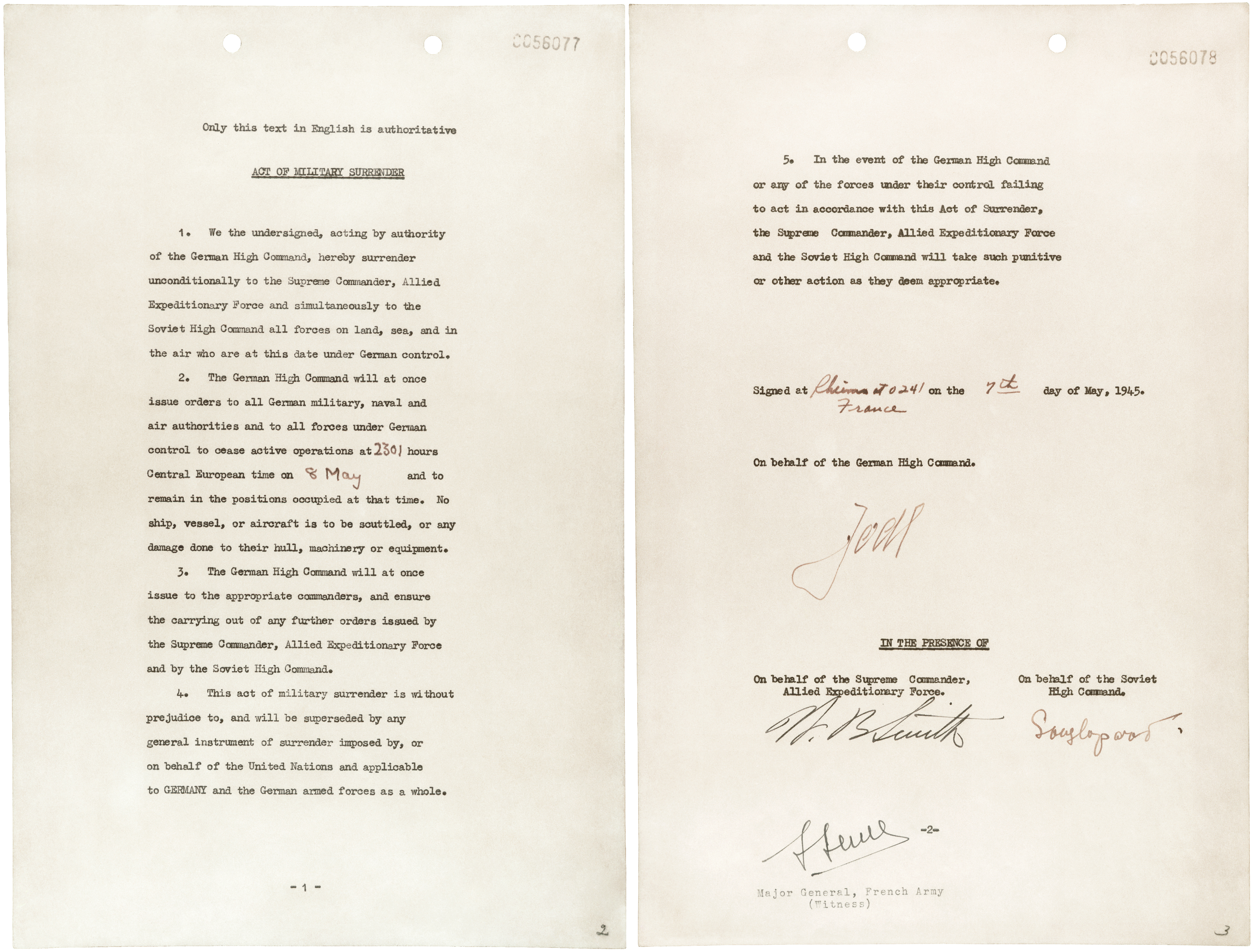
On 7 May, General Jodl went to Rheims offered to surrender all forces facing the Western Allies to Eisenhower. Ike told him that he would only accept the surrender of all German forces and negotiations would be broken off otherwise. The Germans had no choice to accept and it was agreed that the war would end at 2301 Central European Time on 8 May. This would be 0101 Moscow time, which is why they mark the end of the war on 9 May instead.

Some fighting would continue in the east until 13 May as the last elements of German resistance were suppressed - on a Dutch island called Texel, Georgian soldiers in a German unit revolted and a battle between them and the Germans with Dutch help on the former side continued until 20 May.

For most citizens of the Soviet Union, on 9 May 1945, the bloodiest war in history that had killed 26.6 million of their fellow countrymen and women, leaving every family with at least one family member dead, the war was over.

The impact, though, had only just begun.

Part Eight 

22 June 2011

The Biggest War in History, Part Four: The beginning of the end

Soviet forces storm a factory in Stalingrad

Part Three

I have decided to move Kursk until tomorrow, to avoid an overly long post.

After the British victory at El Alamein ended Rommel's dreams of conquering Egypt and started a long retreat that would end up with the complete destruction of Axis forces in North Africa, Winston Churchill, always a man with a great turn of phrase, said this:

"This is not the end. It is not even the beginning of the end. But it is, perhaps, the end of the beginning".
If El Alamein was the end of the beginning, Stalingrad has a strong case that it was the beginning of the end of the Second World War. After this, the Germans never gained another strategic victory (Operation Market Garden, for all the attention focussed on the failures at Arnhem, cannot be called one, as the Allies had still made a considerable advance).

It's been said before, but it's best to say it again: Hitler was a useless military commander. His military experience was spent entirely as a messenger; he never commanded a platoon, let alone an army. His micro-management proclivities cost the Wehrmacht dear, much like his (very brief in time) successor Karl Doenitz did with the Kriegsmarine's U-Boat forces, which suffered the highest casualty rate of any arm in any side in the entire war. Churchill, who had some more command experience and had previous naval leadership knowledge as First Sea Lord during the First World War, generally left his generals to get on with the job. Also, Hitler generally refused to countenance any form of withdrawal to more defensible lines and sacked a number of commanders for doing so without authorisation.

All of this resulted in the decision to draw up and then launch Case Blue; an attack by Army Group South, now split into Army Groups A and B, on Stalingrad and the Caucasus oil fields, as well as cutting the Volga river. This (so Hitler hoped) force the Soviet Union to sue for peace. The offensive was launched, over some pretty strong objections from Wehrmacht officers (including Fedor von Bock, who was dismissed for objecting to the splitting of Army Group South)  who knew what they were doing a bit more than Hitler, on 28 June 1942.

The Germans ran into resistance at Voronezh, but the Red Army forces there eventually withdrew - and this is the important bit - in good order. While a "tactical withdrawal" is sometimes mocked by wargamers as "running away", it has a significant difference from a disorderly rout (like the Old Guard at Waterloo) as it still leaves your forces in a relatively good condition.

With Voronezh captured, the Germans were feeling confident of victory. At this point Hitler made a fatal mistake. He diverted 4th Panzer Army from Stalingrad and retasked it with attacking the oil fields. In the process, it crossed the line of march of the 6th Army - and caused a massive traffic jam. One must remember that most of the roads of Europe at this time were single-lane paved highways at best and muddy tracks at worst. If a tank breaks down, or runs out of petrol; it's going to take a while to get it out of the way. Speaking of petrol, an army marches on it as much as food today. In the process of this giant jam, 4th Panzer Army had taken most of 6th Army's fuel... The whole mess delayed the Germans by two weeks - giving the Soviet Southern Front time to withdraw in good order to Stalingrad.

The Germans were advancing towards the Volga and meeting little resistance. At Army Group B, they were realising, to use the old cliché, that things were quiet... too quiet. You know what generally happens after that.

The Main Battle

German forces arrived in the Stalingrad area in late August, starting off with heavy bombing raids. Civilians started to flee across the Volga - with the ferries being used to bring reinforcements in, so naturally said ferries became targets. However, the ferries kept running.

By 1 September, things were becoming rather reminiscent of a game of Warhammer 40,000 (the Imperial Guard in said game bear strong resemblances to the Red Army, right down to the Commissars who shoot 'deserters'). Fighting ended up literally room-to-room in some cases. The rubble from shelling created more hiding places for the defenders.

The battle dragged on and on, turning into a bloody game of attrition. Individual acts of heroism stand out here - most notably Sgt Yakov Pavlov, whose platoon defended a key strong-point for 59 days. Famous snipers like Vasily Zaitsev and Tanya Chernova wreaked havoc (although there is very little evidence for the story depicted in Enemy at the Gates). T-34s went straight from the Krasny Oktyabr (that's Red October for non-Russian speakers) factory into battle. We haven't even mentioned the female fighter pilots.

The Soviet forces were having supply problems - they needed to hold out long enough for the Volga to freeze over completely and the Germans now controlled 90% of the city. When ice floes started to form, rendering the river temporarily unusable, supplies were air dropped, but most ended up in German hands.

The Germans having rather exposed flanks as a result of their advance (the Soviets had moved away and so they weren't too worried about them initially), guarded by weaker forces from other Axis powers like Romania, who weren't too keen to die in someone else's war of expansion. On 19 November, they launched a counter-attack (Operation Uranus) and a day later, a second one from the south (Operation Saturn). The attack routed the Romanians and rapidly cut off 6th Army's supply lines.

General von Paulus, commander of 6th Army, knew he was in trouble. He asked for permission to withdraw twice and was refused. Eventually 6th Army was surrounded - their horror was only just beginning.

Ill-advised attempts to re-supply by air and a failed attempt to relieve 6th Army just cost the Germans a lot of men and equipment. 6th Army was trapped in a Russian winter, starving to death. Ammo and medical supplies were running out.

As disaster loomed, Hitler evacuated everybody else from the Caucusus region. von Paulus asked for permission to surrender and was instead promoted to Field Marshal (so if he died, Hitler could use the fact that no German Field Marshal had ever been taken alive as propaganda). Eventually, he decided to surrender anyway on 31 January 1943. 90,000 Germans were captured - only 5,000 would return to Germany, some spending twelve years as POWs. von Paulus remained as a "guest" of the East Germans until his death in 1957.

The battle of Stalingrad was over.

After an ill-advised attack that claimed well over a million lives on both sides and devastated a city, Germany's martial reputation was gone. The Soviet army was now starting its long journey to Berlin.

Part Five

19 June 2011

The Biggest War in History, Part Two: Sowing the Wind

Part One
Soviet gun crew in action at Odessa, 1941 (via Wikipedia)

The Book of Hosea in the Old Testament has this famous passage:

"They that sow the wind, shall reap the whirlwind"

Hitler's invasion of the Soviet Union in June 1941 was definitely a case of this - the decision to launch "Fall Barbarossa" (Operation Barbarossa) would cost Germany the war and millions of Germans their lives.

Yet, it could have succeeded had not Hitler made some massive mistakes.

The invasion gained complete surprise; the Soviet Union completely ignored the signs. Forces were in the wrong place (while they were aligned for an invasion of Ukraine, they still would have had a problem against Panzer spearheads), training was poor and tanks weren't used properly. However, they did get something right elsewhere; they correctly figured Japan was not going to attack them in the Far East and were able to transfer troops that made a key difference.

It is no surprise that the Red Army was thrown back reeling, with industry dismantled in a rush and millions affected by scorched earth policies. Admittedly this was a major help for the Soviets in preventing Germany from gaining key resources, but the human cost was still huge.

In two months, the Germans and their allies had advanced hundreds of miles. Millions of Soviet troops were dead or captured (which in many cases the latter meant you were becoming the former fairly quickly). However, this progress was illusory. Hitler did not focus on one single target - the best one, in military terms, was probably the Caucasus (where the oil was). Instead he tried to get that, Leningrad and Moscow. He would get none of them. Key delays, including the assault on Kiev that took several key weeks, despite the huge Soviet losses during what was ultimately a German victory, cost the Germans time and prevented them from finishing the campaign before winter hit - rendering the roads impassable and turning life for the Wehrmacht into absolute frozen misery.

Also the Germans vastly underestimated the numbers and tenacity of their opponents; they were not weak sub-humans by any stretch of the imagination - and they were fighting on their own turf.

However, there is one more important reason why Barbarossa failed - the Nazi policy of extermination. A significant percentage of the people of the Western USSR initially viewed the Germans as liberators from repressive Russian rule. When local nationalists and SS Einsatzgruppen started massacring Jews, such as at Babi Yar, and those also they suspected of being "Commissars", this made things worse for the Germans. Not only did these acts of mass murder take up German forces that could actually be on the front, they created a partisan movement that caused the Germans even more problems, especially when the Germans reacted to said partisans in their usual vicious manner.

As December 1941 began, both sides were heavily battered, suffering massive losses. While the Germans were now stuck, the Soviets had their "breadbasket" (Ukraine) under enemy occupation, Moscow under threat and Leningrad under siege.

The last thing you would expect under these cold winter conditions was for the Soviets to launch an offensive.

Which is precisely what they did. I'll cover this tomorrow.

Part Three 

08 May 2011

VE Day - 66 Years On.

It's the 66th anniversary of the end of the Second World War in Europe today.

Over the last year, I've been reading through Winston Churchill's six-volume account of the war and am now on the final book, covering D-Day to the end of the war. In particular, he pays attention to the Italian campaign.

Italy was by no means the "soft underbelly" that people thought it might have been. It was a hard slog up the country - Germany wasn't reached from that direction until very near the end. Few major roads, narrow passes and at times very cold temperatures.

Today, I'm thinking about all those veterans of the Italian campaign and all the others. You truly were the greatest generation.

18 March 2011

Libyan 'ceasefire'

Either Gaddafi has seen the possibility of Typhoons destroying his air bases and blinked, or he's just trying to buy time.

I personally think it's the latter.

17 March 2011

UN Resolution #1973

The United Nations Security Council has authorised a no-fly zone in Libya.

Let's hope this is a short war.

Libya: Hopefully this will be enough.

The United States has finally come around to supporting a No Fly Zone over Libya and in fact now wants to go further, with a no-drive-zone. Gaddafi is using his artillery and tanks far more than his (rather antiquated) air force, so this would help the rebels quite a bit more than an NFZ.

I think that an NFZ (at least) is necessary to protect the people of Libya from a massacre. If Gaddafi attacks Benghazi, possibly next week, thousands of people are going to die in the attack and in the reprisals afterwards. Gaddafi has publicly executed people in the past and would likely do so again.

There are concerns about us being sucked into a war in Libya; however, we are being asked by the rebels to help. If we allow Gaddafi to win, we will not only have failed as an international community, we will have to deal with another rogue state; because there is no way "normal" relations with Libya can now be restored. Libya could well restart its WMD and long-range missile programs. I don't want that.

I don't like the idea of entering this war, but it is the lesser of two evils.

06 March 2011

The Libyan Civil War

Libya is in what is now arguably a state of a civil war and there have been calls for intervention in the form of a no-fly-zone.

If it is necessary to protect the people of Libya, I would support this. However, I hope it doesn't come to that and Gaddafi falls quickly.