26 July 2011


23 July 2011
The death of Amy Winehouse
Amy Winehouse was a huge musical talent and she'll be deeply missed by her many fans.
I'm going to hold off commenting on certain issues until the cause of death is determined.
22 July 2011
Oslo bombing
I'm watching the footage of the aftermath of the Oslo bombing; if people had actually been in work at the time, this would have been far worse - it's already pretty bad.
How to win a Fighting Flattops game
Battle of Midway scenario, playing the US. A group of enemy aircraft are detected heading for the Midway base. They turn back due to lack of fuel. I reckon that there is a carrier along their return route and sent a Catalina over, which duly finds one.
I then launch 70 dive bombers from my carriers, form them into one group and send them to attack. Result: four carriers hit, one of which sunk.
The other player concedes.
It was my first victory as well.
21 July 2011
The end of the Shuttle programme
The final Space Shuttle flight has now finished - ending a 30 year programme. It's a sad moment, but hopefully other reusable spacecraft will follow.
It was always a rather cool concept and long may it be remembered.
17 July 2011
The coolest Doctor Who fan collaboration I've ever seen
The Doctor Who Fan Orchestra play "I Am The Doctor", The Eleventh Doctor's leitmotif
(hattip: Gallifreyan Embassy and @wilcantrell)
16 July 2011
Review update
I didn't get the pilot of Falling Skies watched in time - but may well do a "Grand Review" of that. It's a very interesting show.
Just watched the first episode of Torchwood: Miracle Day. Again, this will get a Grand Review. Opener was average mostly, but improved vastly near the end. Didn't like the stupidly long trailer at the end though.
14 July 2011
2011 Emmy Nominations
While I haven't taken media gongs exactly seriously since my experience with Crouching Tiger, Hidden Dragon (or more recently Avatar), I still maintain an interest in the subject.
The 2011 Emmy nominations came out today.
It's interesting to see multiple nominations for The Good Wife; it's one of those critical successes that these sort of bodies like as opposed to the more populist stuff like NCIS. Peter Dinklage's nod for his role as Tyrion Lannister in Game of Thrones is also well-deserved; he was the best thing in a work that really overdid it on the old Language/Sex/Violence/Other.
Mad Men also gets a good number of nominations; it still remains an excellent show.
07 July 2011
The end of News of the World
The news of the imminent ending of News of the World came as a bit of a surprise to me; I don't think I'd expected that. All I can say is good riddance.
A comprehensive investigation into "phone hacking" must take place, ideally under oath. Those responsible for it must be punished; if true, it went far beyond any responsible journalism and was in many cases utterly wrong.
I hope we do not see a Sunday Sun, but I doubt it.
05 July 2011
30 June 2011
World of Warcraft becames subscription free
BBC news story.
Very interesting. Now if they did it for EVE Online, I'd be there faster than you could say "explosion in a girder factory".
The Biggest War in History, Part Eight: The past as present
 |
| The Soviet War Memorial in Treptower Park, Berlin, Germany (from Wikipedia, taken by "Victorgrigas") |
Aftermath and Legacy
The population pyramid says it all. Even today, the Great Patriotic War continues to have a demographic effect on Russia and the other 14 nations that comprise the former Soviet Union. The male/female balance in the USSR tilted decisively in favour of women as a result of the huge numbers of men killed in the war - even today, there is still a noticeable imbalance between men and women, worsened by lower male life expectancy due to widespread alcohol abuse.
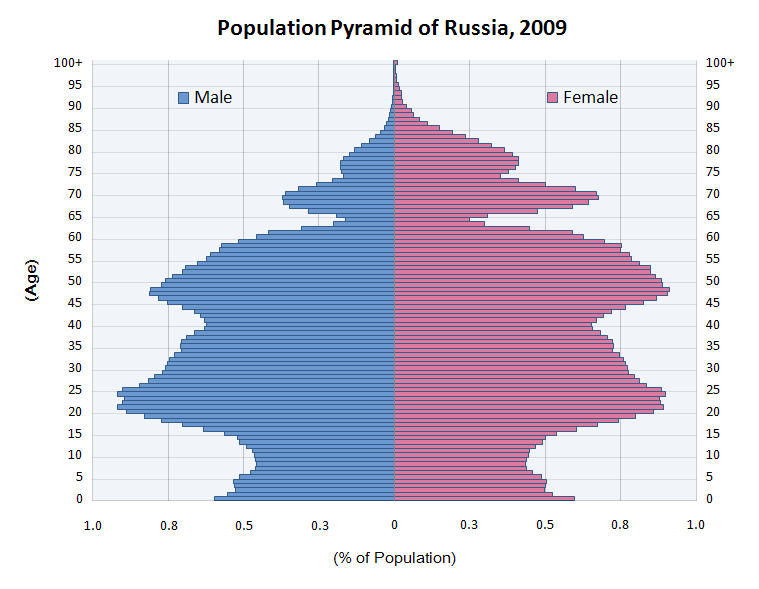
Everyone in the country was touched by the war in some way even if they survived; particularly those who liberated the death camps. The biggest and bloodiest war in history had devastated large parts of the country. If the Second World War still resonates even among young children in the UK today, then the effect must be just as large in Russia and the other republics.
A large number of war films and TV series were produced (and are still produced) by Soviet/Russian companies; most of these are not particularly well-known in the West. I've only heard of a few (Seventeen Moments of Spring, for example) and seen none of them - my Russian is only basic at best and I'd need subtitles to watch them.
Stalin's victory in the war led him to a wave of popularity that lasted until the Secret Speech in 1956 - he still remains pretty popular in Russia today, much to the puzzlement of Western commentators, including myself. His well-known paranoia remained and only his death in March 1953 prevented another major purge.
The USSR gained a considerable amount of territory from the war - including parts of Germany, Poland, Romania and Finland, as well as ending the independence of the three Baltic republics that had gained their freedom in 1918. It also retained a fear of attack from the West - with Germany now replaced by NATO, led by the United States. The retention of very large military forces, as well as the large-scale naval build up under Gorshkov, all stemmed from a desire to defend the Motherland, rather than wanting to take over the world (not that spreading communism wasn't part of Soviet foreign policy).
Of course, the large Soviet military meant that the West, fearing an attack itself, spent considerable amounts of money on weaponry itself.
It can only be said that if Hitler had never come to power, the world would be a much better place.
Reflections
The sheer scale of the Great Patriotic War boggles the mind. I visited Auschwitz a few years ago and saw one of the rooms they had where the pile of shoes that had been found when the camp was liberated. That's the moment that the sheer scale of The Holocaust hit me fully. Ten million was only really just a number until then. 26.6 million (and those were just the people in the USSR) is now a far realer number.
There was a casual indifference to human life on both sides during this conflict. I've yet to mention the Soviet tactics of NKVD commissars shooting retreating forces and the use of penal units to clear minefields by running across them. The latter sounds more like something someone would do in a computer game. Of course, the Germans were far worse - Hitler's lack of grip on military realities doomed millions.
I think the memories of this war, combined with the threat of nuclear destruction, has helped us ensure broad levels of peace in Europe for over 60 years. Hopefully, the memories will not die with the veterans.
I will close with one simple word in Russian to those who helped bring down the most evil man in history:
Spasiba.
29 June 2011
The Biggest War in History, Part Seven: Reaping the Whirlwind
 |
| Soviet soldiers hosting the Soviet flag on the balcony of Hotel Adlon in Berlin after the Battle of Berlin.(Bundesarchiv, Bild 183-R77767 / CC-BY-SA), via Wikipedia |
As 1945 began, any sensible military commentator on either side (if there had been any publicly writing on the German side) could see that the Thousand Year Reich was not going to survive the year, especially as it was outnumbered six to two million on the Eastern Front, while running out of fuel and ammunition.
Many of the German High Command knew that and that the best thing to do was make peace, although the chances of a negotiated peace treaty had now gone out of the proverbial window, especially after the liberation of Auschwitz on 27 January 1945. In fact, some of them had tried to remove the biggest obstacle to peace, namely Hitler himself, the previous July in the failed Valkyrie plot.
Adolf Hitler had lost it by this point. He still believed that he could win the war with the new wonder weapons he was bringing into service. Some of these weapons, such as the Me-262 jet fighter, would have been good had there been sufficient numbers of them. Others, like the V-2 short-range-ballistic missile, were just sucking up increasingly diminishing resources as the strategic bombing efforts of the Allies took their toll of German manufacturing - and civilian lives.
Now hiding out in a bunker under the Reichs Chancellery (one that wasn't really up to a command and control job due to lack of communication equipment), Hitler tried to give orders to units that when they still existed could not hope to fulfil them.
Until Hitler was eliminated, by one means or another, a good number of Germans were going to fight on. For others, there was another reason - it was a matter of defending their own country. In the east, it seemed for many to be a choice between Red or dead.
As the Soviet forces advanced, they began to loot, rape and murder on a massive scale, taking their revenge for what the Germans had done to them. Of course, most of them didn't and historian David Jones suggests that only 10-15% got up to this sort of thing. My response to that is: 10-15% is very high by any normal standards. A massive flight of refugees ensued as Germans fled west to try and escape the Soviets - 425,000 refugees were evacuated by sea, the biggest such evacuation in history.
In one case, a cruise liner packed with refugees, M.S. Wilhelm Gustlof, was misidentified as a troop ship by a Soviet submarine and sunk. It is estimated that 9,400 people drowned - making this the worst maritime disaster of all time. It's also one of the least remembered.
Lead up to Berlin
The Soviets launched another massive offensive on 17 January 1945 from bridgeheads on the Vistula river in Poland. The forces soon entered pre-war German territory and by 31 January, they were less than 40 miles from Berlin on the Oder river; soon to form part of the post-war border of East Germany. The fortress cities were generally surrounded by Soviet forces. Some of these cities would end up with different names after the war, such as Danzig (Gdansk) and Breslau (Wroclaw).
By April, Vienna and Budapest were under Soviet control; the final target, Berlin was now in sight.
The Final Battle - Berlin
The reasons for the Western Allies not getting to Berlin first are both clear and unclear. Certainly, there had been a hard slog through the Ruhr area - indeed, all the way from Normandy. There was still a lot of "mopping up" to do and concerns about a "National Redoubt" forming in the Bavaria area, where the die-hards would make their final stands. However, in an environment where it was increasingly clear that the USSR was not playing ball with regards to freedom post-war, Eisenhower's declaration of Berlin as a secondary target when he tended to link military action to political objectives is strange. Churchill disagreed, but the US stuck to their guns.
Stalin wanted the glory as well. He told the Western Allies that the offensive on Berlin would be in the second half of May and would only involve secondary forces; as the Allies cleared the Rhine and the Weser, he moved up the attack into late April. The stuff about "secondary forces" was a lie, because the forces who would attack were led by Marshals Zhukov and Koniev, two of his two commanders.
The 1st Belorussian (Zhukov) and 1st Ukrainian Fronts were basically allowed by Stalin to race for the city; whoever got to Lübben on the Spree river would have first crack at the city. It was clear from the force dispositions that the former would have the easier job.
Berlin's defence fell to Generalleutnant Helmuth Reymann; the eventual "plan" involved three defensive rings and various obstacle areas. It was a good plan - it just completely lacked the materiel and the men to put it into effect, even when the elderly Volksturm and juvenile Hitler Youth brigades were thrown in.
As mentioned, Zhukov had the easier job of the two relevant Soviet commanders - he almost managed to mess it up.
On 16 April, a massive artillery barrage kicked off Zhukov's part of Operation Berlin around the Seelow Heights, the last major defence line before reaching Berlin itself; 10,000 guns fired for 20 minutes, before 143 searchlights turned on to help the attacking Soviet troops, with the artillery moving its aim forward to the German positions.
Unfortunately for Zhukov, confusion ensued as marshy terrain caused coordination to break down and a massive traffic jam ensued as bridging units were moved up. Zhukov threw in his tank armies and just made things worse. The German defences eventually cracked - but it took four days and a lot of casualties.
On 18/19 April, the final RAF raid on Berlin took place. On 20 April, bombing of the city by Soviet artillery began, while elements of the German 9th Army launched desperate counter-attacks at Frankfurt-an-Oder. The German leader celebrated his 56th birthday and was seen for the last time in public.
Two days later, the Red Army was in the suburbs of Berlin. At this point after discovering a counter-offensive he'd ordered of the SS units Army Detachment Steiner (basically a big corps in reality) had never been launched and his worst enemies were in the capital, Hitler decided to stay in Berlin until the end; the concept of Hitler fleeing abroad has been explored in some works of fiction, but he'd just be too recognisable (maybe).
Berlin's taking was a much faster, but ultimately more successful version of Stalingrad. The fighting took on a house-to-house, room-to-room nature, particularly in the final assault on the Reichstag. It could take hours just to cross a street.
On 23 April, Hermann Goering, at Berchtesgaden, told Hitler that if he hadn't heard from him by 11.00pm that night, he was going to take over as he assumed that the Fuhrer was not free to act. Hitler was enraged and promptly sacked the overweight Luftwaffe head from all his positions.
25 April was marked by three developments of note, the linking up of US and Soviet forces at Torgau, the encirclement of Berlin entirely.
Over the next seven days, facing intense resistance but still with overwhelming numbers, the Soviet forces pushed their way through Berlin. The narrow streets were dangerous for tanks - there could be a Panzerfaust-carrying German in any window - and just as unpleasant for the infantry. Civilians just had to survive as best as they could.
An attempt to relieve the city by the Germans was launched on 26 April and completely failed; large elements of the 9th Army were surrounded the same day near Halbe. 9th Army, desperate to surrender to the Western Allies instead of the Soviets launched a desperate breakout west that actually succeeded and got them to 12th Army's lines on 1 May.
On the night of 28/29 April, the Soviets had reached Anhalt station, a major rail terminus in central Berlin (it no longer exists - it was closed in 1952 and knocked down in 1960, although an S-Bahn station of that name remains present). This was half a mile from Hitler's bunker, where he would marry his mistress Eva Braun that morning and write his will.
On that same day, Hitler heard the news of Mussolini's death at the hands of Italian partisans and was informed of just how bad the situation now was. With the Red Army beginning to attack the centre of the city, the man who had once ruled an empire running from Brest to the outskirts of Moscow decided that he would take the easy way out. The next day, Adolf Hitler, quite possibly the most evil man in history, shot himself, his wife taking poison. The SS did a botched job on cremating his body - it would take the Soviets to finish the job properly. In 1970, they dumped his ashes in the Elbe river.
The Red Army launched a massive assault on the Reichstag that afternoon - a decision to go into a pretty worthless building (as it was largely damaged due to the 1933 fire), albeit one that was heavily defended, was largely for propaganda reasons - a false report of the Soviet flag being raised there had led to large numbers of war correspondents turning up and the local commander did not want to disappoint them. With the clock running down to May Day, it was a race to get a flag onto the roof, but it was duly done so with 70 minutes to go. Then promptly taken down again by the Germans again. It would take a further two days to fully clear the building.
[The famous Reichstag flag-raising photo is actually a re-enactment with the flag in a different position and taken during the day as it was too dark at the time for a decent photograph.]
On 3pm on 2 May, General Weidling surrendered the remaining forces in Berlin, although resistance continued for a few hours afterwards.
The Soviet and Polish forces took over 300,000 casualties in the assault (based on the usual 1 in 4 deaths as was common at the time, we're looking at nearly 100,000 dead); the German and civilian figures are estimated at approximately 22,000 dead each. In addition, a million Berliners were now homeless.
The Final Days
The Germans essentially completely collapsed after this point as forces began to surrender en masse. In the West, British Field Marshal Montgomery launched an attack into Denmark to liberate that country before the Red Army could get there and got the surrender of forces facing him at Luneberg Heath on 4 May, promptly nicking the original of the surrender document for his own collection.
On 7 May, General Jodl went to Rheims offered to surrender all forces facing the Western Allies to Eisenhower. Ike told him that he would only accept the surrender of all German forces and negotiations would be broken off otherwise. The Germans had no choice to accept and it was agreed that the war would end at 2301 Central European Time on 8 May. This would be 0101 Moscow time, which is why they mark the end of the war on 9 May instead.
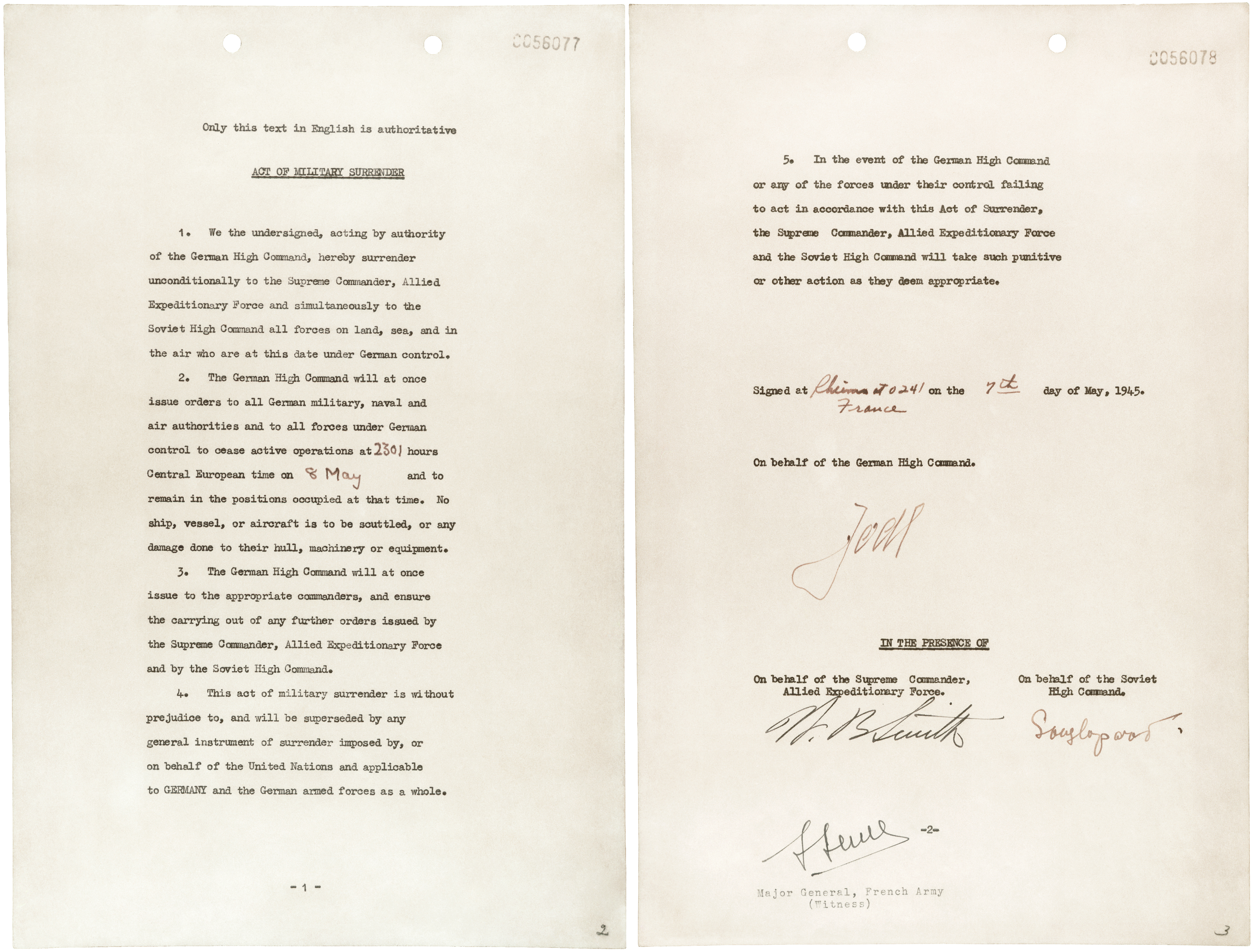
Some fighting would continue in the east until 13 May as the last elements of German resistance were suppressed - on a Dutch island called Texel, Georgian soldiers in a German unit revolted and a battle between them and the Germans with Dutch help on the former side continued until 20 May.
For most citizens of the Soviet Union, on 9 May 1945, the bloodiest war in history that had killed 26.6 million of their fellow countrymen and women, leaving every family with at least one family member dead, the war was over.
The impact, though, had only just begun.
Part Eight
28 June 2011
Dead on arrival (Review: 'Sirens', Episode 1)
When a show has the f-word as its second word of dialogue, includes a poor taste joke about domestic violence in the first five minutes and isn't a patch on the book that it was inspired by, then it's not generally my cup of tea.
I didn't get to first ad break; therefore this must get:
0/10.
27 June 2011
The Biggest War in History, Part Six: Forgotten progress
 |
| Soviet troops in Lvov, Ukraine, 1944 (via Wikipedia) |
When one thinks of the year 1944, one automatically thinks of Operation Overlord and the liberation of France, along with the debacle that was Market Garden. Western popular opinion doesn't really remember the considerable advances against heavy opposition that the Red Army and its allies would make during this year. Perhaps it's the lack of a big, memorable "spectacular", like the huge amphibious landing that was D-Day or the street fighting of Berlin.
Despite making a lot of headway in the post-Kursk attacks, the front line in the Eastern Front, an assignment increasingly dreaded by German troops, remained entirely within the USSR as of the beginning of 1944. By the end of it, Soviet forces had ejected the Germans from the USSR entirely, had gained control of Romania and Bulgaria, was half-way into Yugoslavia and was at the gates of pre-Hitler Germany.
In the process, one would argue for the worse, the USSR had established the conditions for its post-war domination of Central and Eastern Europe.
The year opened with two big offensives in Ukraine and the Crimea, designed to clear the Soviet breadbasket of enemy forces. These areas were also important to Hitler; with the Crimea in Soviet hands, the VVS (Soviet Air Force) would be in bombing range of the Romanian oil refineries - refineries that Germany had to control if it was to keep its vehicles moving.
The Korsun Pocket
The Red Army forced its way across the Dnepr river in many places due to sheer weight of numbers, but a salient of German forces still existed between Kanev and Cherkassy, with two whole Corps of 8th Army in the area. There was an airfield at Korsun in said salient, so any forces that got cut off could be resupplied by air (a risky proposition though considering increasing Soviet air superiority), but von Manstein was sufficiently concerned about encirclement to ask to be allowed to withdraw. You can guess Hitler's answer.
Stavka spotted the situation and on 24 January, the 1st and 2nd Ukrainian Fronts attacked from opposite ends. After four days, the "Korsun Pocket" closed, with 57,000 Germans trapped inside, now under command of General Wilhelm Stemmerman. While the Korsun airfield was initially used to supply the forces in there, that was eventually abandoned due to increasing pressure. An attempt to relieve the German forces and encircle the encircling forces (another one of of Hitler's daft ideas, as most of the forces needed were under half strength) fell foul of an early spring thaw.
Stemmerman was eventually allowed to launch a breakout attempt on 16 February, having to abandon nearly of his heavy equipment (due to lack of fuel and horses. People often forget the large role played by our hooved friends on all sides in the war), but erroneously believed that a key hill (Hill 239) was in German hands. With the radios destroyed, he couldn't be informed otherwise. The initial thrust of the breakout forces ran into the enemy and the situation promptly turned into a full-scale rout, as panicked German soldiers in same cases ended up swimming across a freezing river to escape.
Eventually 35,000 men escaped, but with most of their weaponry lost, six German divisions had been effectively neutralised.
By June, US bombers and fighters could conduct "shuttle" missions, flying from the UK to attack German targets, landing in the USSR to refuel and rearm, attack targets in Romania and then return via Italy to the UK. Known as Operation Frantic, it had mixed success - the original targets had been captured by the autumn, operations were suspended for the winter and it was no longer needed by spring 1945.
Operation Bagration
The advances in the south and north now left a 250-mile bulge occupied by Army Group Centre between the Pripyat marshes and the Dvina river. As their summer offensive, the Soviets decided to eliminate this rather large bulge.
Hitler, anticipating an attack in the south, had taken most of AGC's tanks to reinforce there. He had also implemented a policy of fortified areas around key communication centres, while completely ignoring some useful natural barriers. The "fester platz" as these cities became known was another of Hitler's dumber ideas - the Soviets just bypassed them, deciding to deal with them later at will.
After a massive pre-attack bout of partisan activity, similar to that which would proceed Overlord in the same month, the first phase of the attack began on 19 June 1944.
To cut a long story short, Bagration was a massive success. With the Luftwaffe forces having been withdrawn to deal, as best they could, with the Allied landings in Normandy, the Soviet Union enjoyed clear superiority in pretty much every area, including strategic surprise. The weakened German defences were smashed and retreating forces were either cut off or continually harassed. Minsk was liberated on 3 July and by the end of the month, the Germans were completely out of the USSR. Various forces were cut off and eliminated - 28 divisions would end up either destroyed or ineffective; the Germans losing almost 300,000 men, either dead or captured. A massive hole was now open in the German front; the Soviets would go through it all the way to Berlin.
The Warsaw Uprising
By 31 July, Soviet forces were approaching Warsaw. Radio Moscow called on the people to rise up against the Nazis and the Polish Home Army promptly did just that the next day, expecting Soviet help to arrive in just a few days.
It wouldn't come. Stalin halted the Red Army short of Warsaw and prohibited the Western allies from using Soviet airfields to supply the resistance, limiting what they could do in terms of air drops because of the distances involved. It is no surprise that after two months of fighting intense German attacks, the survivors had to surrender. 100,000 - 200,000 civilians died in the fighting, which was then followed by the Germans starting to level the city, completing 70% of the job.
The failure of the Warsaw Uprising must be deemed the most cynically disgusting act of the war by Stalin; by allowing the Home Army, linked to the pre-war exiled government (now in London) to fail and lose much of its leadership, the way was set for a pro-Soviet government to take over after the war, with the Soviets claiming they had "liberated" Warsaw when they finally arrived in January 1945.
The rest of the year
The Soviet forces continued advancing, entering Romania in August and Bulgaria in September. Both pro-Axis governments were overthrown by internal forces and both countries promptly changed sides to supporting the Allies. Both would ultimately become communist. Finland also concluded a peace treaty in this year.
As 1944 came to an end, it was clear that the war was going to end in Europe during the next year. But it was still not over.
Part Seven
26 June 2011
The "end" of Lulzsec
If Lulzsec have actually disbanded, then all I can say is - good riddance. Discovering that one of the last things they did was release the details of 550,000 Battlefield Heroes users, a game I considered signing up for, I have lost any sympathy for these "hacktivists". You went after innocent people and that was just wrong.
25 June 2011
The Biggest War in History, Part Five: The crumbling of the Citadel
 | ||
| "To the West!" - Soviet propaganda poster (via Wikipedia) |
As today is Armed Forces Day in the United Kingdom, it seems appropriate to start this entry with a discussion of the small, but significant British role in the Great Patriotic War - namely the Arctic Convoys.
Between 1941 and 1945, British merchant ships carried thousands of tons of supplies from the UK to northern Russia. This was one of the riskiest assignments of the war and a number of convoys were cancelled because of the losses. Most of the route was inside the range of German shore-based aircraft, even skirting around occupied Norway. Many of the convoys were carried out in the depths of the Arctic winter, where equipment froze up and sometimes even men. If you ended up in the sea, chances are you were going to die from hypothermia in fairly short order. However, supplies did manage to get through - helping the people of the USSR continue to fight against the Germans.
100 ships were sunk and almost 3,000 British sailors died - most of whom have no grave but the sea. May they never be forgotten.
****
Following the German defeat at Stalingrad, the Soviets started to fight their way back towards Germany; a dangerous gap for the Germans now opening up in their lines. The Red Army took Kharkov, but following the confusion that ensued after that, the Germans, thanks to a German general (von Manstein) getting his way for once, managed to take the city back in a successful counter-attack in February 1943, which broadly stabilised the situation.
Then the spring thaw turned the roads into slush and mud, bringing things to a bit of a halt, allowing both sides to take stock and try and gain the initiative. The Soviet lines now had a salient (a bulge in their lines) around Kursk, with several Armies in it. The Germans spotted an opportunity. Using 9th Army from the north and 4th Panzer from the South, both aiming for Kursk, they would cut the troops off in a pincer attack and hopefully eliminate a large amount of the Red Army.
However, Stavka (the Soviet High Command, sometimes incorrectly capitalised) were not idiots by any stretch of the imagination and they realised Kursk was the likely German target. Marshal Zhukov (the only man to have gained 4 Hero of the Soviet Union awards legitimately) persuaded Stalin and Stavka that this would need to be dealt with first rather than resuming the offensive, putting together a large reserve to deal with this.
Both sides used the spring to prepare; the Germans transferring a huge amount of their armour to the area (roughly 70%, including some of their newest tanks like the Panther) and the Soviets setting up an elaborate deception plan, while building up vastly improved defences.
On 4 July 1943, Operation Citadel, as the Germans called it, began with the usual air and artillery bombardment, something which didn't exactly take the USSR by surprise as they had good intelligence on German intentions (including ULTRA decrypts of Enigma and Lorenz signals traffic). As to be expected, both advances soon ran into heavy resistance and both would end up in failure, as the Soviets threw their reserves.
In the north, the Germans got about 10 miles before the grinding to a halt. By 10 July, they couldn't advance any further, having worn themselves out on the Soviet defences and with a vulnerable left flank.
In the south, the Germans were more successful but still had problems getting through the Soviet lines. In the end, neither offensive would even get a third of the way through the Soviet defences.
On 12 July, the key engagement of the battle took place. 2nd Panzer Corps met 5th Guards Tank Army in the biggest tank battle of all time - Prokhorovka. After initial bombardments, the battle turned into a full-blown tank-on-tank melee that air support couldn't get involved with for fear of blue-on-blue, to use the current parlance. What precisely happened isn't entirely clear, particularly in terms of numbers, but the battle must be considered a draw - neither side succeeded and suffered heavy losses. The battle was, however, a massive propaganda victory for the USSR - they had stopped the cream of German army in its tracks.
On the same day, the Red Army launched a counter-offensive to the north of the salient (Operation Kutuzov), but in the end, other events would also intervene. On 10 July, having successfully hoodwinked Germany into believing that Crete would be the target via Operation Mincemeat (the one involving a dead tramp), the US and UK invaded Sicily. With the need to divert forces there, Hitler cancelled the Citadel operation on 17 July.
Thanks to the superior numbers, tactics and planning of their opponent, the last major German offensive on the Eastern front had failed. Many of their tanks were destroyed and they'd lost a lot of men. So had the Red Army, but they could recover.
The Germans fell back over the rest of the year and by the start of 1944, the Soviet forces were back into Ukraine.
Part Six
23 June 2011
A further note on my rating system
In the event that I don't watch an episode through to conclusion as it's just too awful, it gets an automatic zero. Judging from some early reviews of Sirens, this may well get that - if I watch it within the 72-hour limit.
22 June 2011
The Biggest War in History, Part Four: The beginning of the end
 | ||
| Soviet forces storm a factory in Stalingrad |
I have decided to move Kursk until tomorrow, to avoid an overly long post.
After the British victory at El Alamein ended Rommel's dreams of conquering Egypt and started a long retreat that would end up with the complete destruction of Axis forces in North Africa, Winston Churchill, always a man with a great turn of phrase, said this:
"This is not the end. It is not even the beginning of the end. But it is, perhaps, the end of the beginning".If El Alamein was the end of the beginning, Stalingrad has a strong case that it was the beginning of the end of the Second World War. After this, the Germans never gained another strategic victory (Operation Market Garden, for all the attention focussed on the failures at Arnhem, cannot be called one, as the Allies had still made a considerable advance).
It's been said before, but it's best to say it again: Hitler was a useless military commander. His military experience was spent entirely as a messenger; he never commanded a platoon, let alone an army. His micro-management proclivities cost the Wehrmacht dear, much like his (very brief in time) successor Karl Doenitz did with the Kriegsmarine's U-Boat forces, which suffered the highest casualty rate of any arm in any side in the entire war. Churchill, who had some more command experience and had previous naval leadership knowledge as First Sea Lord during the First World War, generally left his generals to get on with the job. Also, Hitler generally refused to countenance any form of withdrawal to more defensible lines and sacked a number of commanders for doing so without authorisation.
All of this resulted in the decision to draw up and then launch Case Blue; an attack by Army Group South, now split into Army Groups A and B, on Stalingrad and the Caucasus oil fields, as well as cutting the Volga river. This (so Hitler hoped) force the Soviet Union to sue for peace. The offensive was launched, over some pretty strong objections from Wehrmacht officers (including Fedor von Bock, who was dismissed for objecting to the splitting of Army Group South) who knew what they were doing a bit more than Hitler, on 28 June 1942.
The Germans ran into resistance at Voronezh, but the Red Army forces there eventually withdrew - and this is the important bit - in good order. While a "tactical withdrawal" is sometimes mocked by wargamers as "running away", it has a significant difference from a disorderly rout (like the Old Guard at Waterloo) as it still leaves your forces in a relatively good condition.
With Voronezh captured, the Germans were feeling confident of victory. At this point Hitler made a fatal mistake. He diverted 4th Panzer Army from Stalingrad and retasked it with attacking the oil fields. In the process, it crossed the line of march of the 6th Army - and caused a massive traffic jam. One must remember that most of the roads of Europe at this time were single-lane paved highways at best and muddy tracks at worst. If a tank breaks down, or runs out of petrol; it's going to take a while to get it out of the way. Speaking of petrol, an army marches on it as much as food today. In the process of this giant jam, 4th Panzer Army had taken most of 6th Army's fuel... The whole mess delayed the Germans by two weeks - giving the Soviet Southern Front time to withdraw in good order to Stalingrad.
The Germans were advancing towards the Volga and meeting little resistance. At Army Group B, they were realising, to use the old cliché, that things were quiet... too quiet. You know what generally happens after that.
The Main Battle
German forces arrived in the Stalingrad area in late August, starting off with heavy bombing raids. Civilians started to flee across the Volga - with the ferries being used to bring reinforcements in, so naturally said ferries became targets. However, the ferries kept running.
By 1 September, things were becoming rather reminiscent of a game of Warhammer 40,000 (the Imperial Guard in said game bear strong resemblances to the Red Army, right down to the Commissars who shoot 'deserters'). Fighting ended up literally room-to-room in some cases. The rubble from shelling created more hiding places for the defenders.
The battle dragged on and on, turning into a bloody game of attrition. Individual acts of heroism stand out here - most notably Sgt Yakov Pavlov, whose platoon defended a key strong-point for 59 days. Famous snipers like Vasily Zaitsev and Tanya Chernova wreaked havoc (although there is very little evidence for the story depicted in Enemy at the Gates). T-34s went straight from the Krasny Oktyabr (that's Red October for non-Russian speakers) factory into battle. We haven't even mentioned the female fighter pilots.
The Soviet forces were having supply problems - they needed to hold out long enough for the Volga to freeze over completely and the Germans now controlled 90% of the city. When ice floes started to form, rendering the river temporarily unusable, supplies were air dropped, but most ended up in German hands.
The Germans having rather exposed flanks as a result of their advance (the Soviets had moved away and so they weren't too worried about them initially), guarded by weaker forces from other Axis powers like Romania, who weren't too keen to die in someone else's war of expansion. On 19 November, they launched a counter-attack (Operation Uranus) and a day later, a second one from the south (Operation Saturn). The attack routed the Romanians and rapidly cut off 6th Army's supply lines.
General von Paulus, commander of 6th Army, knew he was in trouble. He asked for permission to withdraw twice and was refused. Eventually 6th Army was surrounded - their horror was only just beginning.
Ill-advised attempts to re-supply by air and a failed attempt to relieve 6th Army just cost the Germans a lot of men and equipment. 6th Army was trapped in a Russian winter, starving to death. Ammo and medical supplies were running out.
As disaster loomed, Hitler evacuated everybody else from the Caucusus region. von Paulus asked for permission to surrender and was instead promoted to Field Marshal (so if he died, Hitler could use the fact that no German Field Marshal had ever been taken alive as propaganda). Eventually, he decided to surrender anyway on 31 January 1943. 90,000 Germans were captured - only 5,000 would return to Germany, some spending twelve years as POWs. von Paulus remained as a "guest" of the East Germans until his death in 1957.
The battle of Stalingrad was over.
After an ill-advised attack that claimed well over a million lives on both sides and devastated a city, Germany's martial reputation was gone. The Soviet army was now starting its long journey to Berlin.
Part Five
21 June 2011
Update
4th post on The Great Patriotic War will be up tomorrow - I hope.
I'm also planning a review of Carte Blanche once that is concluded. Television wise, I'm going to be watching Falling Skies and Torchwood: Miracle Day - expect reviews of the pilot of the former and a whole season review of the latter. Of course, all plans are subject to change with no notice whatsoever.
Subscribe to:
Posts (Atom)