22 June 2011

The Biggest War in History, Part Four: The beginning of the end

Soviet forces storm a factory in Stalingrad

Part Three

I have decided to move Kursk until tomorrow, to avoid an overly long post.

After the British victory at El Alamein ended Rommel's dreams of conquering Egypt and started a long retreat that would end up with the complete destruction of Axis forces in North Africa, Winston Churchill, always a man with a great turn of phrase, said this:

"This is not the end. It is not even the beginning of the end. But it is, perhaps, the end of the beginning".
If El Alamein was the end of the beginning, Stalingrad has a strong case that it was the beginning of the end of the Second World War. After this, the Germans never gained another strategic victory (Operation Market Garden, for all the attention focussed on the failures at Arnhem, cannot be called one, as the Allies had still made a considerable advance).

It's been said before, but it's best to say it again: Hitler was a useless military commander. His military experience was spent entirely as a messenger; he never commanded a platoon, let alone an army. His micro-management proclivities cost the Wehrmacht dear, much like his (very brief in time) successor Karl Doenitz did with the Kriegsmarine's U-Boat forces, which suffered the highest casualty rate of any arm in any side in the entire war. Churchill, who had some more command experience and had previous naval leadership knowledge as First Sea Lord during the First World War, generally left his generals to get on with the job. Also, Hitler generally refused to countenance any form of withdrawal to more defensible lines and sacked a number of commanders for doing so without authorisation.

All of this resulted in the decision to draw up and then launch Case Blue; an attack by Army Group South, now split into Army Groups A and B, on Stalingrad and the Caucasus oil fields, as well as cutting the Volga river. This (so Hitler hoped) force the Soviet Union to sue for peace. The offensive was launched, over some pretty strong objections from Wehrmacht officers (including Fedor von Bock, who was dismissed for objecting to the splitting of Army Group South)  who knew what they were doing a bit more than Hitler, on 28 June 1942.

The Germans ran into resistance at Voronezh, but the Red Army forces there eventually withdrew - and this is the important bit - in good order. While a "tactical withdrawal" is sometimes mocked by wargamers as "running away", it has a significant difference from a disorderly rout (like the Old Guard at Waterloo) as it still leaves your forces in a relatively good condition.

With Voronezh captured, the Germans were feeling confident of victory. At this point Hitler made a fatal mistake. He diverted 4th Panzer Army from Stalingrad and retasked it with attacking the oil fields. In the process, it crossed the line of march of the 6th Army - and caused a massive traffic jam. One must remember that most of the roads of Europe at this time were single-lane paved highways at best and muddy tracks at worst. If a tank breaks down, or runs out of petrol; it's going to take a while to get it out of the way. Speaking of petrol, an army marches on it as much as food today. In the process of this giant jam, 4th Panzer Army had taken most of 6th Army's fuel... The whole mess delayed the Germans by two weeks - giving the Soviet Southern Front time to withdraw in good order to Stalingrad.

The Germans were advancing towards the Volga and meeting little resistance. At Army Group B, they were realising, to use the old cliché, that things were quiet... too quiet. You know what generally happens after that.

The Main Battle

German forces arrived in the Stalingrad area in late August, starting off with heavy bombing raids. Civilians started to flee across the Volga - with the ferries being used to bring reinforcements in, so naturally said ferries became targets. However, the ferries kept running.

By 1 September, things were becoming rather reminiscent of a game of Warhammer 40,000 (the Imperial Guard in said game bear strong resemblances to the Red Army, right down to the Commissars who shoot 'deserters'). Fighting ended up literally room-to-room in some cases. The rubble from shelling created more hiding places for the defenders.

The battle dragged on and on, turning into a bloody game of attrition. Individual acts of heroism stand out here - most notably Sgt Yakov Pavlov, whose platoon defended a key strong-point for 59 days. Famous snipers like Vasily Zaitsev and Tanya Chernova wreaked havoc (although there is very little evidence for the story depicted in Enemy at the Gates). T-34s went straight from the Krasny Oktyabr (that's Red October for non-Russian speakers) factory into battle. We haven't even mentioned the female fighter pilots.

The Soviet forces were having supply problems - they needed to hold out long enough for the Volga to freeze over completely and the Germans now controlled 90% of the city. When ice floes started to form, rendering the river temporarily unusable, supplies were air dropped, but most ended up in German hands.

The Germans having rather exposed flanks as a result of their advance (the Soviets had moved away and so they weren't too worried about them initially), guarded by weaker forces from other Axis powers like Romania, who weren't too keen to die in someone else's war of expansion. On 19 November, they launched a counter-attack (Operation Uranus) and a day later, a second one from the south (Operation Saturn). The attack routed the Romanians and rapidly cut off 6th Army's supply lines.

General von Paulus, commander of 6th Army, knew he was in trouble. He asked for permission to withdraw twice and was refused. Eventually 6th Army was surrounded - their horror was only just beginning.

Ill-advised attempts to re-supply by air and a failed attempt to relieve 6th Army just cost the Germans a lot of men and equipment. 6th Army was trapped in a Russian winter, starving to death. Ammo and medical supplies were running out.

As disaster loomed, Hitler evacuated everybody else from the Caucusus region. von Paulus asked for permission to surrender and was instead promoted to Field Marshal (so if he died, Hitler could use the fact that no German Field Marshal had ever been taken alive as propaganda). Eventually, he decided to surrender anyway on 31 January 1943. 90,000 Germans were captured - only 5,000 would return to Germany, some spending twelve years as POWs. von Paulus remained as a "guest" of the East Germans until his death in 1957.

The battle of Stalingrad was over.

After an ill-advised attack that claimed well over a million lives on both sides and devastated a city, Germany's martial reputation was gone. The Soviet army was now starting its long journey to Berlin.

Part Five

21 June 2011

Update

4th post on The Great Patriotic War will be up tomorrow - I hope.

I'm also planning a review of Carte Blanche once that is concluded. Television wise, I'm going to be watching Falling Skies and Torchwood: Miracle Day - expect reviews of the pilot of the former and a whole season review of the latter. Of course, all plans are subject to change with no notice whatsoever.

20 June 2011

The Biggest War in History, Part Three: One step forward, two steps back

Soviet troops counter attacking in 1941 (via Wikipedia)

Part Two

During one of the coldest winters on record (the 1940s was a particularly cold decade), the Red Army launched a counter-attack against the German forces that had invaded their homeland. While this succeeded in removing Moscow from direct danger, it wasn't the spectacular success of the initial German invasion and eventually stalled as the weather improved.

The counter-offensive should be better remembered for two new weapons that fully arrived on the scene during it - the T-34 medium tank, considered to be one of the best tanks of the war and the Katayusha (although both had featured in combat earlier). The latter deserves further discussion.

The BM-13 truck-mounted rocket artillery system isn't the most accurate weapon on earth by any stretch of the imagination. Chucking a load of small rockets at a large area does not cause a lot of property damage or a huge number of casualties.

What it does cause is a lot of fear, because you never know where the next one is going to land. This leads to the troops on the receiving end being rather ineffective at best as they're too busy trying to stay alive.

The psychological effect of Multiple Launch Rocket Systems is apparent even today - far more Israeli children have suffered mental problems than actually being killed by Hamas and Hezbollah rocket attacks.

I would not like to come under attack from them, that's for sure.

****
On 28 June 1942, the Germans launched another offensive - called Case Blue by them - aimed at Stalingrad and the Caucasus region. The area contained vast reserves of oil and other important resources needed for the German war effort; an effort that was rapidly consuming the materials that Germany had available to it.

In hindsight, the entire offensive was a stupid idea - it was too ambitious by half.

The offensive initially went well - the Germans took the areas of the Crimea that they'd not got the previous year and advanced rapidly towards what is now Azerbaijan, Armenia and Georgia. If Hitler could get through those, he could open the door to Turkey and the Middle East, causing Britain problems in Egypt.

He didn't though - the Red Army had plenty of reserves available and threw them in to the massive battles that unfolded. German progress stalled in the Caucasus and stalled badly. The new target of the Wehrmacht now became Stalingrad - the fall of that, it would believe, would be a massive blow to Soviet prestige.

That battle will be covered tomorrow, but it is fair to say that the Soviets had taken one step forward near Moscow and two steps back in the Caucasus. They weren't out by any means, but much of their territory remained under German occupation and their casualties were still huge. They had the men to spare, but that's of course no comfort to the families.

It would be another miserable winter for the citizens of the western USSR, especially the Jews.

Part Four

19 June 2011

The Biggest War in History, Part Two: Sowing the Wind

Part One
Soviet gun crew in action at Odessa, 1941 (via Wikipedia)

The Book of Hosea in the Old Testament has this famous passage:

"They that sow the wind, shall reap the whirlwind"

Hitler's invasion of the Soviet Union in June 1941 was definitely a case of this - the decision to launch "Fall Barbarossa" (Operation Barbarossa) would cost Germany the war and millions of Germans their lives.

Yet, it could have succeeded had not Hitler made some massive mistakes.

The invasion gained complete surprise; the Soviet Union completely ignored the signs. Forces were in the wrong place (while they were aligned for an invasion of Ukraine, they still would have had a problem against Panzer spearheads), training was poor and tanks weren't used properly. However, they did get something right elsewhere; they correctly figured Japan was not going to attack them in the Far East and were able to transfer troops that made a key difference.

It is no surprise that the Red Army was thrown back reeling, with industry dismantled in a rush and millions affected by scorched earth policies. Admittedly this was a major help for the Soviets in preventing Germany from gaining key resources, but the human cost was still huge.

In two months, the Germans and their allies had advanced hundreds of miles. Millions of Soviet troops were dead or captured (which in many cases the latter meant you were becoming the former fairly quickly). However, this progress was illusory. Hitler did not focus on one single target - the best one, in military terms, was probably the Caucasus (where the oil was). Instead he tried to get that, Leningrad and Moscow. He would get none of them. Key delays, including the assault on Kiev that took several key weeks, despite the huge Soviet losses during what was ultimately a German victory, cost the Germans time and prevented them from finishing the campaign before winter hit - rendering the roads impassable and turning life for the Wehrmacht into absolute frozen misery.

Also the Germans vastly underestimated the numbers and tenacity of their opponents; they were not weak sub-humans by any stretch of the imagination - and they were fighting on their own turf.

However, there is one more important reason why Barbarossa failed - the Nazi policy of extermination. A significant percentage of the people of the Western USSR initially viewed the Germans as liberators from repressive Russian rule. When local nationalists and SS Einsatzgruppen started massacring Jews, such as at Babi Yar, and those also they suspected of being "Commissars", this made things worse for the Germans. Not only did these acts of mass murder take up German forces that could actually be on the front, they created a partisan movement that caused the Germans even more problems, especially when the Germans reacted to said partisans in their usual vicious manner.

As December 1941 began, both sides were heavily battered, suffering massive losses. While the Germans were now stuck, the Soviets had their "breadbasket" (Ukraine) under enemy occupation, Moscow under threat and Leningrad under siege.

The last thing you would expect under these cold winter conditions was for the Soviets to launch an offensive.

Which is precisely what they did. I'll cover this tomorrow.

Part Three 

18 June 2011

Brevity is the soul of wit. Some people would do well to remember that. (Review: 'The Shadow Line')

A seven-part TV drama featuring The Operative, The Ninth Doctor and Robert Pugh (who doesn't have a single role that he's remembered for, although he did do a great Hermann Goering one time) should be good.

It isn't. It's a boring work that should have lost at least an episode on the edit and needed a better director.
****
The Shadow Line is basically a murder mystery/conspiracy thriller in the same vein as Edge of Darkness etc. A drug dealer by the name of Harvey Wratten is murdered (his body is found by two coppers who deliberately ignore the "do not touch the corpse rule"). The police investigate and so do the criminals.

One of the officers is DI Jonah Gabriel (Chiwetel Ejiofor), who is returning to work after the death of his colleague via a bullet that is now lodged in his skull. He doesn't remember the events that led up to his colleague's death. He's going to find out.

In the meantime, Joseph Bede (Christopher Eccleston), a man with a wife dying of cancer, is trying to arrange a major drug deal.
****
What sounds like a brilliant premise is fatally flawed in the execution. I'll list the reason

1. The primary problem is the funereal pacing, more suited to a book. Nearly every scene is longer than it should have been and the ending went along far too long.

2. The plot was confusing and hard to keep track of. You didn't remember who was who in the drugs trade, that's for certain.

3. I was also annoyed at unconvincing police cars and oddly enough shoulder numbers (I live in London - I know what Met Police vehicles and shoulder numbers look like).

4. Then there's the dialogue: characters go on bizarre tangents in the middle of conversations and some of the speech ("It's time to call the cops!") is just bizarre.

5. The acting also leaves much to be desired. Especially Kierston Wearing's DS Lia Honey, who was rapidly nicknamed "DS Collagen" on Gallifrey Base and who ended up having a rubber pistol held against her neck (you could see it bend).

6. Finally, the resolution to the plot was a bit rubbish. Counterpoint could have been so much better (perhaps police officers were buying up drugs to prevent them from ending up on the street, which of course means the dealers are getting money). The [spoiler] was overdone and the ending dragged far too much.
****
There were two things that were good about this. Firstly, the haunting theme tune, "Pause" by Emily Barker and the Red Clay Halo, which I bought off Amazon during this run (I don't do that for many themes).

Secondly, Stephen Rea's Gatehouse. This calm, polite killer stole most of the scenes that he was in. Never has the word "Beep" been so ominous. Sadly, even he got a bit poor near the end.

****

I think that the primary cause of failure for this was Hugo Blick (a man whose experience has been comedy) deciding to write, produce and direct. Those are three different roles and it takes a rare genius to do the trifecta. Blick, alas, was not sort of person.

3/10. This could have been so much better.

My rating system

For those of you who are looking at the reviews: this is the system I use – a modified version of the one used by Gallifrey Base in their rating threads for Doctor Who episodes.


·         10: Fantastic! The absolute pinnacle

·         9: They don't get much better than this!

·         8: It's certainly worthy of very high praise!

·         7: Well above average, but no masterpiece

·         6: Just a cut above average

·         5: Can't find a better example of average media

·         4: It's below average, but only just!

·         3: This one's bad but it's got some good in it, just there.

·         2: It's not the worst, that's something else. But...

·         1: I'd rather listen to a tape loop of leaf blower noise!

The Biggest War in History, Part One: A Delaying Deal with the Devil

This Wednesday, 22 June, marks the 70th anniversary of the start of the biggest conflict that has ever happened on this planet: the Eastern Front of the Second World War between Nazi Germany and the Union of Soviet Socialist Republics.

As a man with a keen interest in things Russian, I could let this anniversary go by without making some comment on my blog. This series will be in seven parts, hopefully one a day:
  • Part One: 1939 and 1940 - the lead-up to the war
  • Part Two: 1941 - the initial invasion
  • Part Three: 1942
  • Part Four: 1943 - with a focus on Stalingrad and Kursk
  • Part Five: 1944
  • Part Six: 1945 - with a focus on Berlin.
  • Part Seven: The consequences then and now.
(15 August 2014 - it became eight)
****
Part One: A Delaying Deal with the Devil

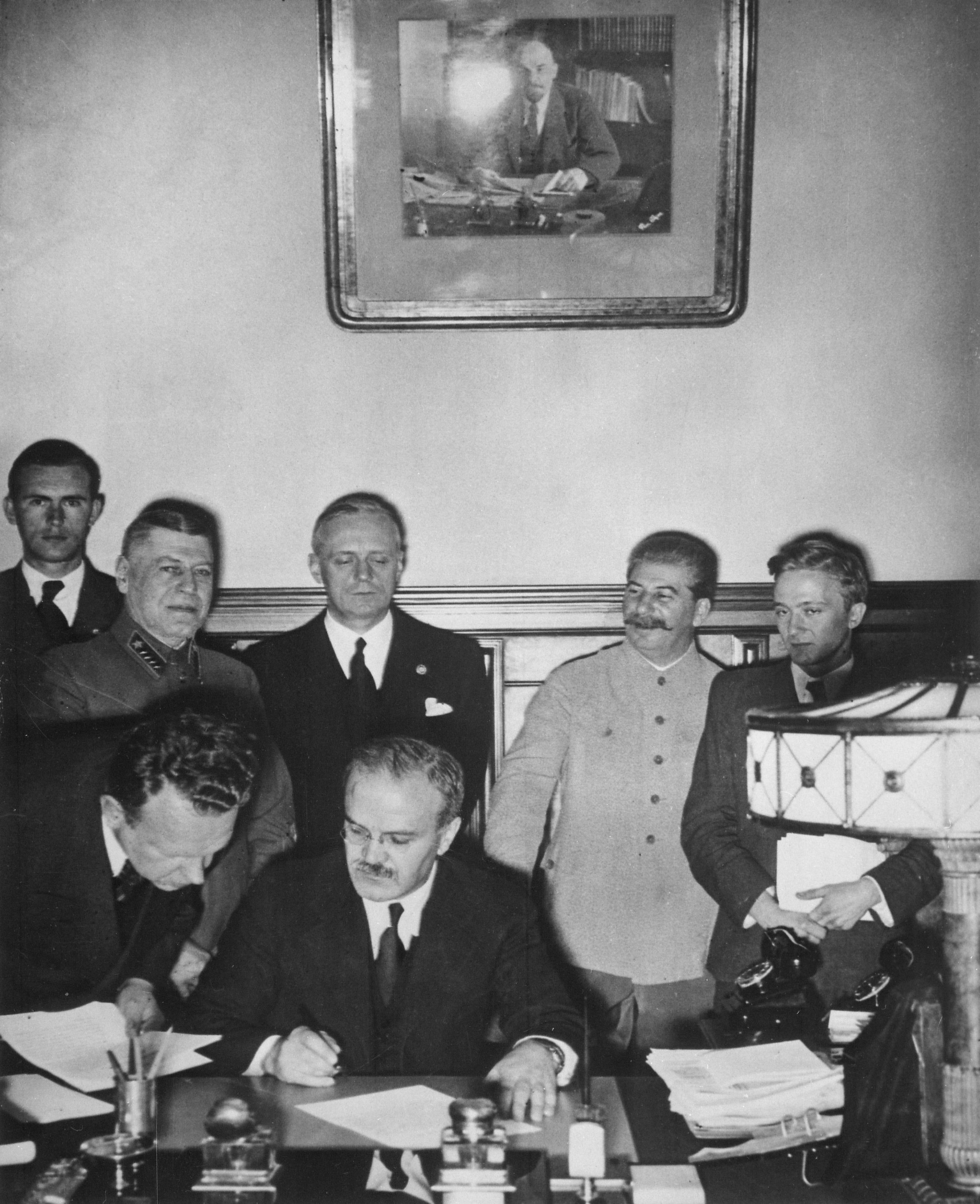
Soviet Foreign Minister Molotov signs the German-Soviet non-aggression pact; Joachim von Ribbentrop and Josef Stalin stand behind him, Moscow, 23 Augst 1939 (via Wikipedia, original German photo)

It's fair to say that the Soviet Union was viewed with a great deal of suspicion by much of the world very much since the October Revolution. The Communist system naturally had very negative implications for the ruling elites of the West; reports of atrocities going on in the USSR (as it turned out later, pretty well founded) naturally must have made people afraid of what Marxism- Leninism would mean if it were to become the governing ideology of their country. Many of the Fascist groups that took power in Central and Eastern Europe in the 1920s and 1930s played on the fear of this to get votes and retain power; it can be argued that Hitler would never have gotten anywhere near the Reichs Chancellery without the USSR.

Many, to their later shame, decided to try and deal with the "devil they knew" - even Churchill himself was keen to have good relations with Fascist Italy until the Abyssinian invasion of 1935-6, which showed the clear lack of power of the League of Nations. It seemed to be a decent alternative to the economic chaos of the Great Depression - despite the fact that Hitler's hatred of Jews was clear from the off.

If the West had made better relations with the USSR earlier, the entire war could have been prevented.

****
The Molotov-Ribbentrop Pact of 22 August 1939, in which Germany and the Soviet Union agreed not to attack each other (all while the former at least was secretly planning to do so anyway) is rightly considered a nasty, grubby deal that resulted in massive, unprecedented suffering for the peoples of Poland, Estonia, Latvia and Lithuania. As a historian, I do not seek to justify it - only to understand why the deal was made.

We know why Hitler did it - he wanted to be able to invade Poland without fear of Soviet intervention. The Soviet reason is a bit more complex.

There's a saying: "it's not paranoia if they're really out to get you". While Stalin was not the sanest man around, he had good reason to be paranoid - British forces had been involved in the Russian Civil War; there had been plots to oust him (dealt with by "Operation Trust", a Soviet intelligence operation that had basically created a fake plot so they could control any plotters) and Hitler's comments about Lebensraum were a clear statement that he was "out to get" the USSR.

It's also not like the Red Army was exactly in brilliant form - the Great Purges had crippled its command structure, with large numbers of senior officers ending up dead or in the gulags. The Red Army's embarrassing stalemate against Finland in the Winter War of 1940 only served to show up its failings quite clearly.

Moscow needed time to prepare (so for that matter, did Germany, as their weapons programmes were tied to a war in 1945, not 1939). Arguably that delay did the trick and may well have saved the USSR.

Yet, one can only feel that if Russia had come to the defence of Poland or at least threatened to do so, a lot of lives could have been saved. Mind you, it's very unlikely the Poles would have let Soviet forces in - they didn't when Hitler occupied Czechoslovakia in March 1939 and indeed took a part for themselves. Perhaps a threat to their own existence might have changed their minds... we'll never know.

Edit: The evidence regarding plans by the USSR for an attack on Germany is highly disputed. I have revised the paragraph appropriately.

Part Two

13 June 2011

The girl's going to be fine (Review: 'Doctor Who' 32.7, "A Good Man Goes To War")

I don't know what was the bigger surprise: the true identity of River Song or the fact that the next episode is called "Let's Kill Hitler".

****

This is a story that like the TARDIS is simultaneously big and small. When the Doctor takes out a Cyberfleet (full kudos for using the ships from "The Invasion") in the pre-title sequence, you know that you're in for a large story. However, this multi-location epic involves a number of very intimate scenes with Team TARDIS, particularly between Rory and Amy.

Let's start with the multi-locational aspect: the jumping about collecting people bit in the first act is rather reminiscent of "The Pandorica Opens" and works just as well. Mind you, when the Sontaran came up, I ended up thinking of a certain recurring character in the Gallifrey Base Screencaps thread... They're going to have some fun with that...

When we get to Demon's Run, things get even more interesting. There's a lot of "soldiers at work" dialogue that gives what might be one-note characters a lot more foundation and makes you feel sorry for them. Lorna Bucket reminds me of "Lynda-with-a-y" from way back in "Bad Wolf" and touches the audience in a similar manner.

I wasn't too keen on the portrayal of the Clerics. The Moff is an atheist, I'm a thin Anglican. We're not going to agree on much in the religion field, but I honestly felt some of the stuff was overdoing it a little and could have been reined in.

Matt Smith seemed slightly off at times, but made up for it in others. I think I find myself comparing him with Tennant more than I really should and I know the Doctor was supposed to be subdued then, but still... Great stuff from Arthur Darvill as usual and Karen Gillan was also pretty good. Alex Kingston, who doesn't appear all that much, was also wonderful.

The plot was excellent and it was good to see the Silurians again - they're one of the better 'new' creatures of the Moffat era. The dialogue was excellent as usual and I see that the Moff still is doing the gay jokes. Plus I found the idea of the Doctor speaking 'baby' great; there's strong evidence that all babies speak in the same language.

Then that ending: a lot of things make sense as a result, including River Song's name. We still haven't found out who [spoiler] the Doctor in "The Impossible Astronaut", but I guess we'll find out at some point. It's a great point to end for the mid-season break.

****

9/10. You've got to be something truly special to get a 10 and this wasn't quite it, for a few reasons. Still, one of the best episodes of the season so far.

Labour leadership suggestion for Labour MPs

If you think that Ed Miliband is a poor leader and needs to be replaced; openly challenge him to a leadership contest. If not, stop talking to journalists, because the only people you're helping are the Tories.

Closing the wormhole: The failure of 'Stargate Universe'

The last episode of Stargate: Universe is scheduled to air tonight on Sky 1. It's fair to say that it marks the end of any more Stargate on television for at least the next few years.

The show must be judged a failure and I'm going to give some reasons why I think it failed.

Lack of likeable characters

There was maybe one character in this show I truly cared for: Ginn. The rest of the characters, from Scott through to Colonel Young, were likeable at best. Dr. Rush was an arrogant man with a strong hint of selfishness; Colonel Young lacked authority and Chloe just served to get put in peril. Whenever a character from the original show appeared, they demonstrated just how superior they were - even Rodney "Go suck on a lemon" McKay.

A lot of the time I couldn't even remember the names of some of the minor cast; which clearly means they weren't that good.

Lack of good aliens

The original show had the Goa'uld, Atlantis the Ori. This show had blue fish-like creatures and an army of space drones; none of which had any decent individuals or even spoke English. The Lucian Alliance don't count.

A concept that was limited in scope

There was the ship; a bunch of planets without intelligent life and that was generally it. The team frequently had to use the communication stones to "go" to Earth, because there clearly wasn't enough to do on the ship plot-wise.

Inability to kill a good number of the cast

If you're going to do a dark science-fiction drama, you should at least kill a few people off permanently, not keep hitting the reset button. It would have been better dramatically if whats-her-name had died when the hydrodome vented last week.

Throwing in sex and violence

May well have turned some people away from the show. A lot of the time, sex scenes aren't really necessary.

Other realism issues

Just how many people went through the gate at Icarus and how did they manage to get that much supplies through before the whole planet went up?

All the characters wore the same clothes day in day out, but they never got worn out or needed to be patched.

TJ's hair. The ability of women not to have serious visible roots (as well as being able to have good make-up) after 9 months plus on a desert island etc. is a common problem in this type of work. Please, someone, fix it.

Final Thoughts

When watching a show turns into a chore, you know you have problems; I can't think of many episodes that I actually enjoyed.

I don't yet know the final outcome, but I guess we won't be getting the answer to where TJ got her peroxide from.

Quote of the day 2

From a Gallifrey Base discussion on Camelot:

xj900uk: Eva Green worked out that in order to properly converse with the Dark Forces in the forest at midnight, she first has to get her kit off.

DuncanRose: Now there's a chat up line worth trying .

11 June 2011

Thank you to Jams

I've been getting a record amount of traffic this week; much of from The Poor Mouth; thanks Jams for adding me to your blog list.

Mind you, I'm not entirely sure why I've got over 50 hits from your article on the Angela Merkel doll...

10 June 2011

It was acceptable in the 80s... (Review: 'The Bill' The Complete First Series)

(Yes, I know this was released in 2005...)

One of the most unwittingly prescient things that I've ever written was part of the TV Tropes entry on a British cop show called The Bill, where I stated that the show's long-term future had to be considered uncertain. This was in 2009; it ended within a year.

For those of you not familiar with the show (something rather hard to be if you were British); The Bill was a police procedural that ran from 1983 (in a pilot one-hour drama called "Woodentop", part of the Storyboard strand), to 2010, pretty much on a weekly or bi-weekly basis from 1987. Set in the fictional London area of Sun Hill, it focussed on the coppers of one relief at the local police station; very much one of the "cops and docs" type of shows, but (mostly) with less angst. The show got a bit silly c. 2005 under a certain Paul Marquess' tenure as Executive Producer and started to improve after his departure, but a controversial move to a 9pm timeslot and elimination of the classic "Overkill" theme music dropped ratings to the extent that ITV pulled the plug.

During its time, it was very much a household name and attracted a large number of well-known guest stars, including a number of famous actors at the beginning of their careers (including Sean Bean - who appears in this season and doesn't die horribly - and Keira Knightley). There's a joke that if three members of Equity meet in a pub, two of them will have appeared in The Bill... Even today, you can still run into actors who used to play starring roles on British TV and even in American shows.

Anyway, back to the beginning. I arrived in the show in late 2000 (the conclusion of the Don Beech arc); the first season is well before my time.

The four-disc DVD set does not come with any extras. It doesn't even have subtitles. What we get are the original masters complete with title cards and the scrolling thing in the top right that informs you when an ad break is approaching. No modern show would ship like this.

That complaint over, let's look at the episodes themselves. We get "Woodentop" and the eleven episodes of the 1984-5 first series. Each of these episodes is memorable and most of them are actually rather good. "A Friend in Need" provides an inventive, if very illegal, way to get a free lunch. "It's Not Such a Bad Job After All" is a story of the dangers of the big city. "Burning the Books" is an ultimately farcical story about the hunt for some porn.

The first thing that you notice from watching these episodes is that a long-standing "rule" of the show; that every scene must feature a copper and scenes of villains going "muh-ha-ha" (or the equivalent) among themselves should not occur, isn't around at this time. There are numerous scenes, particular in "Death of a Cracksman" where three crooks discuss how they're going to break into a safe they've stolen, where villains are the only characters in the scene. There's also areas where civilians are, say, finding a body, the common starting point for many a cop show.

You'll also find that the theme tune is different from the "classic" one; nearly entirely different. 

At times, this looks and sounds very 80s. On one estate we encounter kids who look like they've just escaped from a David Bowie video. There's an "Early Air Raid Warning" light in the Sun Hill front office. One particular villain is singing "Karma Chameleon" (an 80s song if there ever was one) just before he's arrested.

Which brings me onto policing methodology and general behaviour. In a police force on the cusp of PACE, you get characters behaving in manners that you wouldn't get away with today. PC Jim Carver clips a boy around the ear in the pilot and no further action is ultimately taken when his father says he would have done the same thing. DI Roy Galloway (of whom more later) actually uses borderline ethnic slurs on suspects and gets physical with others.. Another villain actively comes onto WPC (now there's a term that's long gone) June Ackland and actually puts his arm around her on more than one occasion. The local criminals are on fairly friendly terms with Galloway and officers in general; we also get a fair share of Cockney geezers in this. Also, there are no ethnic minority officers present at all.

In addition, CID and uniform do not get on well at all. Stand up shouting matches between Sergeant Bob Cryer and Galloway do occur.

Then, there's the results of life in an age before the Internet and mobile phones; which I only vaguely remember. Galloway has to leave a number he can be contacted at when he goes to lunch. DS Ted Roach and DC Mike Dashwood have to literally travel to a Benefits Office to find a suspect's last known address. Reports have to done on typewriter (there's only one computer in the whole nick). You'd love to visit, but you wouldn't want to live there.

Speaking of living in places; Sun Hill is located in the East End of London. For the early years of the show, filming was done in and around the Wapping area; which shows here (Whitechapel Market is recognisable in at least two scenes). It only later moved to the Merton area after the News International strike in 1985/6 (there were concerns the actors would be mistaken for real police officers).

The stories are strong, with good plots that generally justify the 50 minute running times that shows had back then. There are some great moments of humour: "The Sweet Smell of Failure" in particular as well as the ending of "Death of a Cracksman". Mind you, there are some dragging moments, particularly in "A Friend in Need".

OK, have I forgotten anything?

Yes, you have, sunshine! Me!

Ah, Mr Galloway, sorry - the characters. A number of long-term stalwarts appear for the first time here (Carver, Ackland, Cryer, PC Reg Hollis and also PC Tony Stamp as an extra), but some less remembered characters also turn up. Most notably, Sun Hill's first DI, Roy Galloway. He's played by Robert Pugh in the pilot, but John Salthouse took over the role for the series proper. Galloway puts the fiery in "fiery redhead". A man with a permanent short fuse (yes, sir, I know that you have some very annoying people to deal with), a brusque attitude and some marital problems clearly looming, he's certainly memorable in any scene he's in.

So summing, this is an excellent DVD providing a great look back at how the UK's highest episode count cop show began, although it arguably has very little rewatch value due to the lack of extras. Recommended for fans of a show that will be missed by many - but best to borrow or rent if you can't find it for less than £15.

8/10.

06 June 2011

Seriously, two is better than one (Review: 'Doctor Who' 32.6, "The Almost People")

This was a bit of a bloodbath. Only one character didn't actually die this week. Mind you, he's done his fair share this season...

"The Almost People", the second part of what we're going to have to call a three-parter now, involves two Doctors. As any long-term fan knows, the multi-Doctor stories are generally considered among the best in the show (with the exception of "The Two Doctors"...)

So having Matt Smith play against himself with the wonders of modern camera technology was a rather wonderful thing. The two played off each other brilliantly, with great dialogue and a rather wonderful twist that busted through Amy's prejudice. There were also good homages to the past and the first appearance of Tom Baker's voice in the new era.

Plot was well... a bit so-so. It involved a lot of machinery stuff, the acid (where is that coming from anyway - I know you don't get acid from the ground...). Some of the emotional stuff may have been a bit overdone in my opinion, but it wasn't too bad. Rory's sudden decision to lock up the Originals seemed a bit out of character to me.

We also got one of the old tropes of doubles; the "I'm not the evil twin! She is!" thing. I've seen variants on this going back to an episode of Are You Afraid of the Dark with Tia and Tamera Mowry way back in the mid-1990s and this was an interesting new one. Mind you, why would the Flesh dissolve like it? Surely, it behaves just like other matter.

Then we had the ending. Now, that's a game-changer. How long has Amy been, well, in that state? I suppose we'll find out.

****
Good episode with some great themes and a reasonable pace, boosted by a wonderful ending.

8/10.

67 Years since D-Day

It's 67 years to the day since the start of the liberation of Western Europe by the allies.

Joe Beard has written an excellent article on the events and their significance. (H/T Brant @ Grog News)

May those involved never be forgotten.

31 May 2011

Trust in the rust (Review: 'Clear Skies 3')

Sequelitis is a common problem in franchises; where gags and concepts that were good once aren't necessary good a second time. Or for that matter, a third. It's rare to find a sequel that's better than the first installment; The Empire Strikes Back springs into mind. Finding a threequel that exceeds the quality of the first two is like finding hens' teeth.

Ladies and gentleman, we have a toothy hen.

****

For those of you who haven't seen the first two Clear Skies animations, I would strongly recommend you watch them before you watch this. You can find all three here. You won't regret it.

The Clear Skies series is set in the universe of EVE Online, the space-based MMORPG developed in Iceland and with a larger player population than that country. Probably a stronger economy too. You don't need any familiarity with the game to enjoy this - although there are plenty of insider jokes for those players. There are some key changes from the game universe, most notably the lack of "clones".

Using EVE for external shots and the Source SDK (the modding kit of the engine used for Half-Life 2 - before you ask, Garry's Mod has never been used in this) for interior scenes, the series follows the crew of the Minamatar Tempest class battleship Clear Skies, as they travel through New Eden, trying to make ends meet and keep their ship together. This is not an easy task.

In this third instalment, the mysterious Mr Smith asks them to give back a piece of technology he gave them in the previous story. Things aren't what they seem, though.

****

Ian Chisholm, who plays captain John Rourke and generally heads up a high-quality team of voice actors and other crew, has spent close to five years of his life on the trilogy. Most machinima are basically music videos or comedy shorts. This is a full-cast, action-packed drama that runs to a total time of 73 minutes, 23 minutes longer than the second movie, I believe - this might even be some sort of record. It's also extremely funny, which I'll get to.

The plot is excellent, with believable characters, villains with convincing motives and great performances by all involved - nearly all amateurs (with the exception of Francis Capra, a professional American actor with a rather impressive listing of guest roles in US drama). There are some wonderfully moving scenes, including self-sacrifice (and the aversion thereof). The ending is lovely and wraps everything up in a great manner.

The dialogue is up to the superb standards of the series. CS has created a number of catchphrases among its fans ("HOW MUCH?", "top-wingy bit", "Get that interdictor!") and this will add some more. Wait until it's "Hot drop o'clock". The humour is better than many sitcoms and will remind you of Red Dwarf or Firefly in its style, as well as its quality.

The visuals of this have been spruced up considerably, with help from CCP, EVE's developers. Ian and his crew had access to a motion capture program that allows for a fist fight to occur at the climax, something not previously possible. The HD, 1080p graphics may make the download a whopping two gigs, but it's worth every bit. The excellent set design remains and we get some wonderful new sets, including a Caldari fighter hangar that gets only a few shots, but would be worthy of at least a short in its own right. There are plenty of sight gags - including the explosive charge labelled "Plan B". I may well have missed some.

Then there are the spaceship battles. CS2 featured an 80-ship four minute gate fight. This tops that in nearly every regard; with a chase through a station that owes some resemblance to the "Death Star Trench" scene, but only some.

The sound is crisp all round and the incidental music, which includes things from Coldplay to Mike Oldfield and EVE music fits perfectly. The choice of "Fix You" for one battle scene is arguably just as good, if not better, as the use of "Far Above The Clouds" for the gate fight in Clear Skies 2.

****
Ian Chisholm has stated he will not be making another movie - he wants his life back and I understand that. I'm sure that many fans would want to carry on this story, with his blessing of course.

There are some minor flaws that could make me lower this if it were a professional production. However, since this is an amateur production, I see no reason to. Achieving something of high professional standard when you're largely self-taught it is worthy of the highest praise.

Congratulations to all involved. Mr Chisholm, even if you don't make a fourth one, you've gained immortality in this business.

10/10. It's a true Titan of machinima.

30 May 2011

Clear Skies 3 is out!

I'm currently downloading it and so are a lot of other people.

Here's the main, now updated site.

EDIT: I have now downloaded, but I won't be watching this until Wednesday in all likeliness. Please don't post spoilers in the comments.

29 May 2011

Congratulations to Ian Chisholm

Sir, you've managed to crash eve-files.com as people try to get Clear Skies 3. Congratulations.

28 May 2011

Doctor Who review

I accidentally forgot to put a delay on the review - I have now removed the potentially spoilery review and reset it to appear at the appropriate time.

My apologies.

Blogger issue fixed

I can now approve comments etc. Woo hoo!

Clear Skies 3 should be out this weekend - expect a link and also a review...

27 May 2011

Problems with Blogger

I’m one of the people affected by the Blogger log-in issue, so I’m not really in a position to a) approve comments  or b) comment on other people’s blogs. I can still post by email and I certainly plan to post some stuff this week or next.


I will be delaying the posting of my review of “The Almost People” for a week; the Memorial Day weekend has forced the US showing of that episode back until the following Saturday.

23 May 2011

Clones are people too (Review, 'Doctor Who' 32.5, "The Rebel Flesh")

Doctor Who is arguably more of a fantasy show than a science-fiction one. However, this doesn't stop it from from having "sci-fi" episodes and this was one of them.

Exploring the themes of "surrogate bodies" and identity, "The Rebel Flesh" involves Team TARDIS arriving at a factory on 22nd century Earth just before it's hit by a solar tsunami (of which more later). The dangerous work is done through created bodies controlled by human operators known as "Gangers". When the tsunami hits, the gangers become living people of their own...

"The Rebel Flesh" is a rather different episode from the previous four of Season 31. Instead of being big and bombastic, it focusses on moral issues, like quite a few of the great stories over the years, such as "Doctor Who and The Silurians", "The Ambassadors of Death" and "Genesis of the Daleks".

On this form, I don't think the story is going to join the pantheon of true greats, but neither is it going to end up in the pit of shame like "Timelash" or "Warriors of the Deep".

Matthew Graham's done a good story here, making us think about our views of clones and AI duplicates, which we too often dismiss as cheap plot devices and don't really feel for as they're not "real". The Gangers feel very much real and should be considered as such. Matt Smith turns in a quiet, understated performance, not overdoing things - in fact he's a little too subtle at times. Everyone else, including Marshall Lancaster and Sarah Smith, do well and the pre-titles sequence is good in particular.

There are two flaws in the story. I've heard of solar flares, but I've never even heard of a solar tsunami. Without some decent explanation, it sounds stupidly unscientific (yes, I know this a show with a time travelling spaceship that's bigger on the inside) and a power failure, plus attendant earthquakes, could have been caused by, well, an earthquake...

Secondly, the pacing seems a bit slow for my liking. While Who doesn't have to always be a huge rush, this story seemed to be going for the pace of the classic era and it didn't always work.

I'll see how "The Almost People" goes, but so far this isn't brilliant, it's merely good.

7/10.

Press TV found by Ofcom to have breached fairness rules

Pages 30-40. You'll need to skip past the porn stuff.

Very interesting.

21 May 2011

New review up

Review of 'Castle' 3.11, "Nikki Heat".

For those if you wondering where the Spiral review is, I decided not to do it - I had left too late after first UK airing and so it was a bit irrelevant. From now on, I will only review stuff I have watched within 72 hours of first UK transmission unless I have good reason to do otherwise.

18 May 2011

The Silent Hunter: How people find me.

Jams has done an article on how people come to his site through search engines. (Mild language warning)

Figured I might as well do the same... Or similar. I can't find what he's actually used (I have a free account on StatCounter only), so I'll list some of the more interesting searches that people have arrived at my attempt at interesting commentary via:
  •  who are the super injunctions: There's a lot of ones like this. I wrote an article giving my thoughts on the subject on 23 April, but it certainly does not even attempt to speculate on the identities on those who have them.
  • Obama hostages for counter strike": OK...
  • "counter strike source" abbottabad map: This does exist, but I've never even discussed it.
  • "backfire raid". Glad to see people are interested in the Tu-22M "Backfire", my favourite military jet.
Also, looking at Blogger stats, my ten most popular posts all were posted in late July and early August last year, including my four-parter Farnborough report.

Doubt I'll ever be as popular as the superlative Jams O'Donnell, but it's nice to know people are at least glancing at my site.

Upfront Week

This week is Upfront Week, when the US TV networks announce their schedules for the upcoming TV season, thus revealing what pilots they've picked up and which of their running shows won't be returning.

It's been a fairly good one for me - only two shows on my watch list were cancelled - Lie to Me and Brothers & Sisters. While I enjoyed both, the former had started to drag a bit in its third season and while the latter was still good, I feel it jumped the shark with the car crash last season.

Xander Markham

I've added a new blog to my links and updates list.

Xander Markham  has just started out in the blogging business, but his television and video game oriented blog already has some excellent posts. Plus he likes Doctor Who, which is always a good thing.

16 May 2011

A joyous run through the darkness (review: 'Doctor Who' 32.4, "The Doctor's Wife)

So, bestselling fantasy author Neil Gaiman had a go at writing Doctor Who - and he did a very good job.

I'm not going to describe the plot - for a start,I couldn't explain it properly without spoilers and the Moff has expressed his unhappiness about spoilers. Secondly, no amount of description would do it just.

So, I'm going to resurrect something I used to when I was reviewing 24. I used to do "24 Points on 24". That's a bit long, so I'm going to do eleven points, one for each Doctor so far.
  1. The TARDIS travelling effects look much better than they've ever done before - of course, Doctor Who has had some ropey effects over the years.
  2. Matt Smith's Doctor, while very good here, tends to be at his best in Steven Moffat stories. Moffat of course created the character and so can channel him best - others do a rather hit-and-miss job. Gaiman's was a hit though.
  3. Speaking of chanelling, Idris did remind me a lot of Helena Bonham Carter in a lot of her roles (it's rare for Bonham Carter not to play crazy these days). Full credit to Suranne Jones for a great performance - she's left Corrie well and truly behind her now.
  4. Rory's is turning into this show's version of Daniel Jackson without the archaeological knowledge.
  5. Amy does not have a very nice episode - she even lets out a couple of screams. It says something about the state of the show now that it's no longer a huge issue that a companion screams. Of course, Rory does as well.
  6. That was Michael Sheen doing the voice? I thought it was Gabriel Woolf!
  7. Oh, lovely to see [spoiler] again - I hope to be able to see it in person at some point soon.
  8. We haven't had this many repeating corridors since "The Horns of Nimon".
  9. I'm happy with the outcome in connection with my RP.
  10. It's a good choice of title - that's all I'll say.
  11. Uncle and Aunt were creepy. In fact, much of this episode was.
Overall

A very good episode and one that's arguably a lot differently from regular Doctor Who. There were great performances all around and a very moving ending. By no means perfect (the pace was a little off in the middle and the Doctor was a little unconvincing at times), but a lovely first go and I'd be glad if Gaiman came on board for another story.

8/10.

15 May 2011

The relegation of West Ham United

Just like they did all season, West Ham threw away a two-goal lead to lose 3-2 to Wigan, becoming the first team to be relegated this season.

Avram Grant was sacked within an hour - I won't miss him.

The bubbles have burst big time this season - we're going to face major problems next year with our debt and all; there's certainly no guarantee of a fast return to top-flight action.

The players, with the exception of Scott Parker, should hang their heads in shame.

12 May 2011

The descent to Davy Jones' locker (Review, 'Doctor Who' 32.3, "The Curse of the Black Spot")

After last week's epic conclusion to the two-parter, we go for a what is a bit more of a romp, with the Timey Team on board a pirate ship dealing with a "siren" that is luring the crew away.

I'm not going to go into a description of the plot, which involves an alien spaceship, treasure and a famous pirate. I'll just go straight into the review.

The start is very promising, but then things go downhill rapidly. The pacing is off badly; this might have worked better as a two-parter. The dialogue starts to get a bit forced - this seems to be a pale imitation of Moffat's style and it shows. Then the bit at the end with Rory just walks slap bang into cliché. One note - if you're not breaking ribs, you're not doing it right.

Hugh Bonneville's Captain Avery is served badly by the script. Lily Cole doesn't even get an intelligible line and doesn't really add much to the story. Matt, Karen and Arthur all try their best with the material, but that's all they can do.

Nice try, but I'm going to have to give this a 5/10. The words "whole", "sum" and "parts", spring to mind.

Neil Gaiman's episode next week looks good. We'll see if my Doctor Who RP (The Triple First) ends up having its entire concept yanked out...

Taggart: One Mean Broadcaster

Taggart has been cancelled by ITV after 30 years.

This is a great shame: hopefully STV will find a way to keep this vehicle for Scottish talent going and hopefully we can still see it on TV south of the border.

Demjanjuk convicted of aiding 28,000 murders at Sobibor

In news that I am sure will please many, John Demjanjuk has been convicted in a German court.

Justice has at last caught up with this man.

Many others cheated earthly justice by dying first. They, though, will one day face the infinite justice of God.

Update: He has now been freed, reportedly pending an appeal.

11 May 2011

A year of the Coalition

Today marks the first anniversary of the creation of the Coalition and David Cameron becoming Prime Minister.

I wonder how many people are celebrating today. I won't be.

08 May 2011

Doctor Who reviews

For those of you looking for my reviews of the new season of Doctor Who, the first two are here and here.

Future reviews will be posted on both blogs, allowing about 48 hours after transmission.

VE Day - 66 Years On.

It's the 66th anniversary of the end of the Second World War in Europe today.

Over the last year, I've been reading through Winston Churchill's six-volume account of the war and am now on the final book, covering D-Day to the end of the war. In particular, he pays attention to the Italian campaign.

Italy was by no means the "soft underbelly" that people thought it might have been. It was a hard slog up the country - Germany wasn't reached from that direction until very near the end. Few major roads, narrow passes and at times very cold temperatures.

Today, I'm thinking about all those veterans of the Italian campaign and all the others. You truly were the greatest generation.

04 May 2011

I'm voting No tomorrow.

Tomorrow, we vote on whether to change the voting system for Westminster elections from First-Past-The-Post to the Alternative Vote system.

I will be voting No. I do not want a system that will make the Liberal Democrats, a party that I believe abandoned their principles for Cabinet seats, the deciding force in any future elections. I would only favour a more proportional system if there was a fourth major party (i.e. two party blocs) and even then that would not be AV, but rather AMS.

This is not to say that I welcome or agree with the tone of the NO campaign by any means. Their conduct has appalled me.

02 May 2011

The death of bin Laden

So, tonight there is one less mass murderer in the world. Osama bin Laden has been killed by US forces in Abbotabad, Pakistan, apparently being shot while taking a woman hostage.

If true, he died as he lived - a coward who had no qualms about innocents getting hurt. No 72 virgins for him, that's for sure.

While this is by no means the end of the fight against terrorism, I can imagine that many terrorists will not get a good night's sleep tonight.

28 April 2011

Screenshot: Charging in with dualies

cs_dracula: How not to do a map


Terrorists blasting away - yes, three hostages have already died in the crossfire.

I've just come off a game of Counter-Strike: Source on the UKCS server. The second map I played during my time on the server (great servers BTW, I would highly recommend them) was cs_dracula.

This was a hostage rescue mission in a Dracula-style castle with spiral staircases, long winding passages and portraits of famous horror characters.

However, there are two problems with the map. One, the lack of a map in the whatever the map screen thing is called, isn't too bad.

The second though is huge. The hostages are located in a room with only one large entrance and a long staircase on one side. It's a terrorist camper's dream.

Seriously, that map needs a redesign, because even I know that violates a key rule of multi-player map design.

25 April 2011

Pirates of the Burning Sea downtime

The online MMORPG I play, Pirates of the Burning Sea, has just had 14 hours of downtime after a patch uncovered further issues the tech team needed to fix.

I'm curious to know why they didn't keep the website up and whose idea it was to patch on a holiday weekend.

It's a good thing that I'm not paying any monthly subscription for this. Please don't do this again.

Edit: This isn't to say that the game isn't good - it's just that stuff like this really annoys me because I want to play it.

23 April 2011

Super-injunctions and "privacy law"

The tabloid newspapers in the UK have made a lot of comment in the last week on judicial decisions to grant super-injunctions on the alleged infidelities of certain high-profile figures.

They're arguing that these judges are acting against freedom of speech, but I'm not entirely sure that there isn't some ulterior motive; selling newspapers.

Freedom of speech to me is about freedom of opinion and the right to express that opinion, also the right to expose governmental corruption and ensure that the public can make an informed decision at election time. I'm not entirely sure that the creators of the European Court of Human Rights, or for that matter, the US Constitution, were exactly envisaging their rights being used to spread salacious gossip and muck-raking.

I'd like to run a hypothetical past you:

Caitlin is an attractive newsreader for a major television channel. She is married to Bob and they have two primary-school age children.

Caitlin had a brief affair with struggling model Andrew, for reasons we won't go into here. Eventually, Caitlin couldn't live with herself and confessed everything to Bob. Bob has forgiven her and the two are trying to rebuild their marriage.

Now Andrew is trying to sell his story to a newspaper.

Now, here's some questions: is it really fair to expose Caitlin, Bob, their two children and all their friends and families to massive media intrusion, as well as the lurid details of Andrew and Caitlin's affair? Whose interest does it serve?

Also, while celebrities voluntary expose themselves to the media eye, but are they not entitled to a private life as well?

Please leave your thoughts below.

21 April 2011

Review of 'Doctor Who: The Movie' and other plans

I've done a review of the Doctor Who TV movie over at my other blog.

Future reviews will either go here or there - probably there. My plans include a review of all 7 episodes of the first half of the upcoming season of Doctor Who, the Castle episode "Nikki Heat" when that airs and a grand review of Spiral season three, which will probably be entitled "Madame Shouty".

I also will be voting NO in the AV referendum on 5 May.

19 April 2011

Elisabeth Sladen 1948 - 2011

I've just heard the news of the death of Elisabeth Sladen, best known for her role as Sarah Jane Smith in Doctor Who.

She will be deeply missed by millions of fans.

Rest In Peace.

18 April 2011

Holy Week 2011

It's Holy Week this week. Last Easter I posted seven posts on the subject of Jesus' last week before his death. To avoid repeating myself, I'll link them here. Please take a look at them, hopefully you'll learn something.

Part One
Part Two
Part Three
Part Four
Part Five
Part Six
Part Seven

14 April 2011

Foreign-born workers

David Cameron, in what looks to me to be an attempt to divert attention from the lack of support for NHS reforms, is today making a speech about immigration.

One common statistic is that 75% of jobs created in the last ten years have gone to foreign-born workers. Of course, the term "foreign-born" is one that could be highly misleading.

Let me give some examples where this could get ridiculous from here and abroad:
  • Sir Trevor McDonald, the famed newsreader, was born in Trinidad. Does that count as being foreign-born? Trinidad & Tobago is now an independent state, but it was part of the British Empire in 1939.
    • One could equally apply this query to most of the members of the "Windrush Generation".
  • Amanda Tapping, the Canadian actor best known for her role as Samantha Carter in Stargate SG-1, was actually born in Rochford, Essex, moving to Canada at the age of 3. She could count as a foreign-born worker.
  • Genndy Tartakovsky, creator of Dexter's Laboratory, was born in the Soviet Union, going to the USA at the age of 7. He counts as foreign-born despite the fact he would likely remember very little of his time in the USSR.
Here's a suggestion to some of my fellow left-wingers. Next time someone complains about immigration, ask them if they watch/watched Hustle, NCIS, Waking The Dead or House...

Update:

There's a great article from the Office of National Statistics on this. I would particularly advise people to look at Tables 7 and 8.

12 April 2011

50 Years of Human Spaceflight

50 years ago today, Yuri Gagarin, a Soviet test pilot, was launched into space in Vostok 1. After orbiting the Earth more or less once, he ejected from his capsule after a safe re-entry, landed in a field. He then had to ask a startled farmer and his daughter to find him a telephone. Some more information about the flight can be found here.

Gagarin's first journey, which was very much a venture into the unknown for a human being, is a source of great inspiration for many. About 530 people have followed in his footsteps, 12 of them to the surface of the Moon.

I'm unhappy that we're now taking somewhat of a step back with the retirement of the Space Shuttle and I hope we'll have new reusable spacecraft soon.

It's a shame that Gagarin is not here for this anniversary. Rest in Peace.

01 April 2011

April Fool's Day

I see the papers are doing their usual round of April Fool's Day jokes... including The Guardian doing a "live feed" on the upcoming Royal Wedding.

Personally, one of my favourites was Planet Half-Life's 1999 "announcement" of Half-Life 2...

31 March 2011

One crew, one ship, one more time...

Clear Skies III trailer (76.9 MB)

Seriously, it looks awesome.

One Dane and her jumpers (Review: 'The Killing')

It all began with Kenneth Branagh. More specifically, his role as Kurt Wallander in the BBC1 adaptations of the Henning Mankell novels. Without those I wouldn't have heard about the far superior Swedish-language TV series starring Krister Henriksson and the rather good Rolf Lassgård films. These led me on to The Killing.

Forbrydelsen (literally translated as "The Crime", but sold to English-language markets as "The Killing") is a 20-part Danish-language television series produced by DR. A second season has already aired in Denmark, with a third in production. Oh, yes, there's also a US remake due to start airing on AMC tomorrow, IIRC.

Before I go into the plot, let me say that it is certainly worth 20 hours of your time and 20 hours worth of reading subtitles if you don't speak Danish. It is the best foreign-language detective drama I have ever seen - and among the best detective dramas I have seen, full stop.

The main character is Detective Chief Inspector Sarah Lund. Lund (played wonderfully by Sofie Gråbøl) is a determined female cop who focusses on the job at the expense of her personal relationships. She also often wears a traditional Faroese sweater - at least three of them (one ends up slashed by a knife and another ends up in police evidence). She's on her last day working as a detective in Copenhagen before she moves to Sweden with her boyfriend and her son.

Then a 19-year-old girl, by the name of Nanna Birk Larsen goes missing. The missing persons inquiry soon turns into a murder investigation when her body is found in a submerged car. You just know that Sarah Lund isn't going to Sweden.

The following 19 episodes involve twists, turns, lots and lots of red herrings, plus warehouses. Plenty of warehouses. Over a third of the Danish population tuned in to find out who did it.

By the way, each episode covers a single day in the investigation of Nanna's murder.

The story doesn't just focus on the criminal investigation - oh, no. In a similar manner to one of my favourite shows, 24, there are two other plots running through the show that interlink and feed off each other.

The first involves the bereaved family of Nanna, including her parents Treis and Pernille. I admit I actually managed to confuse the latter with DCI Lund on a number of occasions while watching this - they look similar. It's a deeply moving look at what happens to the families left behind after a murder like this - something that doesn't usually happen in these sorts of works.

The second involves Troels Hartmann, a candidate to become Lord Mayor of Copenhagen in upcoming elections against the rather slimy incumbent Poul Bremer. The political ducking and diving is good, although arguably a little overdone.

It's a slow-paced work; Nordic works tend to be. This doesn't stop there from being some very tense scenes and the rather shocking demise of a key character near the end.

The solution, which I won't spoil, wasn't fully explained and the denouement did seem a bit rushed. There's a strong sense at the end that justice has not fully been done. Personally, I'm not too bothered by that - such, alas is life.

A truly excellent work and one that I would highly recommend.

5/5. I look forward to the next season.

26 March 2011

March for the Alternative

The TUC are organising a large march in London today against Government spending cuts. The Government says that those against the cuts need to have an alternative.

Here's some of my alternative, then:
  • Aim to eliminate the bulk of the deficit by 2020, not 2015.
  • Halve the speed of the cuts.
  • Cut salaries of top executives - no public sector worker should earn more than the Prime Minister
  • Require universities to make similar cuts on top-level pay before they are allowed to charge £9,000 a year
  • Focus on getting people into work in the private sector, so they can fuel growth
  • A Robin Hood tax.
  • Ensure that funding to local councils is based on local needs (e.g. free school meal requirements). It is unjust that Witney should have a far smaller cut than Lewisham.

18 March 2011

Review: 'Doctor Who Comic Relief Special "Space/Time"'

Got to say I really enjoyed this sketch. It was very funny, with great one-liners for everyone and a wonderfully timey-wimey plot. Only slight weakness was an overuse of innuendo, but it wasn't a massive problem.

Great work, Steven Moffat.

4/5.

Elsewhere in the Middle East

There have been further clashes between protesters and the government in Syria and Yemen, with deadly force being used against peaceful protesters in the latter.

My message to those regimes: Shame on you.

Libyan 'ceasefire'

Either Gaddafi has seen the possibility of Typhoons destroying his air bases and blinked, or he's just trying to buy time.

I personally think it's the latter.

17 March 2011

UN Resolution #1973

The United Nations Security Council has authorised a no-fly zone in Libya.

Let's hope this is a short war.

Libya: Hopefully this will be enough.

The United States has finally come around to supporting a No Fly Zone over Libya and in fact now wants to go further, with a no-drive-zone. Gaddafi is using his artillery and tanks far more than his (rather antiquated) air force, so this would help the rebels quite a bit more than an NFZ.

I think that an NFZ (at least) is necessary to protect the people of Libya from a massacre. If Gaddafi attacks Benghazi, possibly next week, thousands of people are going to die in the attack and in the reprisals afterwards. Gaddafi has publicly executed people in the past and would likely do so again.

There are concerns about us being sucked into a war in Libya; however, we are being asked by the rebels to help. If we allow Gaddafi to win, we will not only have failed as an international community, we will have to deal with another rogue state; because there is no way "normal" relations with Libya can now be restored. Libya could well restart its WMD and long-range missile programs. I don't want that.

I don't like the idea of entering this war, but it is the lesser of two evils.

15 March 2011

Japan tsunami

Watching news footage of the events in Japan since Tuesday, the sheer magnitude of events there horrifies me. This has caused disruption to the lives of millions and my thoughts and prayers are with all those affected.

Hopefully the reactor problems can be minimised.

06 March 2011

The Libyan Civil War

Libya is in what is now arguably a state of a civil war and there have been calls for intervention in the form of a no-fly-zone.

If it is necessary to protect the people of Libya, I would support this. However, I hope it doesn't come to that and Gaddafi falls quickly.

03 March 2011

Leaving eRepublik

I have left eRepublik. Basically the admins made a bunch of controversial changes and then banned those who protested.

I don't have time for that, so I'm leaving.

28 February 2011

The Video Game War: A look back at the 1991 Gulf War

Today marks the 20th anniversary of the end of the 1991 Gulf War; the cease-fire coming into effect on this day. Rather than a full history (which would be predictable), I'm going to post a few thoughts on the war, how it was fought and the impact of it.

So here are some of my thoughts with the advantage of 20 years of hindsight and the disadvantage of not being old enough to remember the war at the time:
  1. Saddam made a massive gamble in the invasion of Kuwait that might well have worked had he tried it pre-glasnost. Had the Soviet Union, the main armer of Saddam Hussein's Iraq, vetoed a UN resolution or made clear it was prepared to come on Saddam's side in some form, then it is unlikely that Desert Storm would ever have been mounted as it was.
  2. Saddam Hussein could not have been allowed to control Kuwait's oil and threaten Saudi Arabia as well. That is a strong argument in itself. In addition, military invasion is no longer a justifiable way to resolve border disputes - it hasn't been since 1939.
  3. Some of Kuwait's PR moves to gain support for a risky UN-led operation could be argued to be a case of the end justifying the means. We'll never know if the US would have gone in without them.
  4. Desert Storm in itself was made possible by the clear technological superiority that the Coalition possessed. There is no way that Schwarzkopf's pincer movement could have been made without GPS and no way that Iraq's powerful air defence could have been handled without the F-117A.
  5. Taking out said Iraqi air defence on night one must be considered one of the best air strike operations in the 20th century.
  6. The "Scud" attacks may have helped Iraq by diverting resources onto a fruitless hunt from the TELs, but that is all.
  7. The primary duty of a commander is the protection of his own force; this may mean he has to use controversial methods to protect it. However, if there is a better way to do that does not have political ramifications, it should be taken. It's a case-by-case thing.
  8. The attack on the retreating convoys on the Basra road was militarily justifiable, but politically a mistake. Perception is important in any war.
  9. Controlling the media is a common part of modern war. The US lost in Vietnam due to free-roaming media. The Coalition would have a lot more difficulty with Twitter et. al today.
  10. We should have provided broader support to the 1991 Shia uprising; it could have prevented a lot of problems later.
  11. Saddam's armed forces were never the same after 1991; he never even got near the capability he had then.
  12. Things could have turned out very differently for the Coalition. Their rapid success may have coloured views on military action too much for the next decade and a bit.
  13. The 1991 Gulf War was arguably the last clear-cut "just war", although I am sure some would disagree with that.
Your thoughts?

22 February 2011

Change of plans

Some RL stuff and ongoing events that will probably warrant more coverage means that I'm trimming my planned series on the 20th anniversary of Operation Desert Storm to a single post around 28 February.

21 February 2011

Libya

From the fragmentary reports we've been getting, there is now open revolt against Colonel Gaddafi in the east of Libya.

I hope these are the last days of a vile leader who has supported many terrorist groups over the years.

18 February 2011

RTE: The Frontline Leader's Debate

This is quite possibly the first post I've written here about politics in the Republic of Ireland. My label system must be a Unionist, it kept correcting the Ireland label to "Northern Ireland" (or shouldn't that have been "Ulster").

Being a bit of an elections fan (I can still remember the moment I realised Bush had won the 2004 US election based on the Latino vote in the exit polls), I saw that BBC Parliament was showing Monday's Irish election debate yesterday and decided to record it.

I don't know a tremendous amount about Irish politics, but I've picked up bits here and there. I can't honestly remember the precise difference between Fianna Fail and Fine Gael, but there is one.

Ireland uses the Single Transferable Vote system for elections to the Dáil Éireann, the lower house of their bicameral legislature. This resulted in five parties being present at the debate rather than the three that turned up in the UK ones.

This debate was under the aegis of The Frontline, a weekly politics programme on Ireland's main public broadcaster, Raidió Teilifís Éireann (RTE). There was another debate yesterday, conducted in Gaelic on TG4 with only three paries, which appears to have got rave reviews. Enda Kenny, the Fine Gael leader, did not turn up to the TV3 debate, also in English (intended to be three-way) due to scheduling problems.

Let's get back to the RTE debate. The debate was basically "an audience member asks a question", then the five leaders had a discussion around it and kept interrupting each other. Pat Kenny was the host and frankly didn't do a brilliant job; he really should have reined the people in.

Our nearest neighbours, Ireland is both very similar and very different to our one. They've got a deficit problem and worries about healthcare. However, Ireland's a republic that emerged via a bloody war of independence and a civil war. It is a user of the euro and has a tiny military. There is also the massive issue of the recent IMF/EU bailout...

The most interesting issue that where we have concerns with people coming in; the Irish (who have a literally massive diaspora) have concerns about people leaving.

So without further ado, I shall give my impressions of the five leaders (from left to right on the screen):

John Gormley (Green)

The Greens were part of the government until recently before pulling out. Gormley demonstrates the very large difference between Green parties that are (or have been) in government and those are not. He was quiet, subdued and not exactly advocating a massive change to the economy. Otherwise, he was unimpressive.

Eamon Gilmore (Labour)

Based on the current polls, Labour are likely to be the junior partners in the new government with Fine Gael. Gilmore was a very muscular, thumping socialist of the old school; calling for a renegotiation of the bailout and wanting to put lots of money into creating jobs. Good, particularly for a guy who has become much more left-wing economically recently, but not brilliant.

Enda Kenny (Fine Gael)

The likely next Taoiseach (that's Prime Minister), Kenny is the leader of the Christian Democratic party Fine Gael ("Tribe of the Irish"). Kenny was strong and assured, advocating a private sector-led recovery (I hope that works - it's not here at the moment) and probably the best person there.

Micheal Martin (Fianna Fáil)

It's pronounced "me-haw", not "my-kal" (Irish names are different like that). As the successor to Brian Cowen as leader of the conservative Fianna Fáil (usually rendered in English "Soldiers of Destiny"), the outgoing PM, Martin is on a hiding to nothing. He wasn't very good at this. He's a bit like Gordon Brown in that regard.

Gerry Adams (Sinn Fein)

Ah, Gerry Adams... I'm familiar with him already through his involvement in NI. Leader of a very socialist party most well known for wanting a unified Ireland, Adams started off convincing then just went bizarre. Wanting to tell the IMF where to get off and getting accused by everyone of his sums not adding up, Adams managed to invoke the Irish Proclamation of Independence in a discussion on healthcare and also the "patriot dead" (those were died in the independence struggle). This might sound a little better in Ireland (the original IRA were socialists), but it sounded odd to me.

No-one wants to form a coalition with this guy and I'm not surprised.

Summary

Not a perfect debate, but a very interesting illumination into a land so similar and yet so different to ours.

I plan to watch the results if I can.

17 February 2011

Product placement 2

A follow-up to this.

Just re-watched the James Bond film The Living Daylights (still great) and have observed that you're going to need the product warning before all of them...

Mr. Bond is a living Brioni-clad Walther P99-carrying Aston Martin-driving advertisement...

(This post does not contain paid for advertising).

16 February 2011

14 February 2011

Product placement warning

BBC News article.

This is a bit silly in my honest opinion. Perhaps Ofcom are hoping to discourage it by making people do this.

I have seen some awful product placement in US shows; the other week on CSI: NY was essentially an i-Pad advert disguised as a whodunnit...

13 February 2011

There's probably a good football metaphor here (Review: 'Hustle' 7.5)

Hustle is now coming to the end of its seventh season and I wouldn't be surprised if the show goes on past ten. It may not be a show with massive amounts of depth, but at the end of the day it's highly entertaining and that does the job for most people.

After Ash Morgan, one of the five-person team of loveable con artists, has his favourite football team go into administration, he's not happy about it and wants to go after the corrupt agent responsible. He makes a passionate speech about the state of the beautiful game, which you could quite happily use in many a serious drama with only slight changes, then reminds the team that they could get a lot of money. The latter convinces them.

The target is Don Coleman, played by David Harewood, previously best known to me for Robin Hood. Like all the marks in this show, Harewood brings the ham and brings it well. He's a thoroughly slimy piece of work, without any redeeming features, but that's par for the course.

The con is reasonably standard but good nonetheless; the group decide to pass off Sean Kennedy as an elite Canadian football player - despite the fact he can't actually play (I won't reveal how they get around that). That's the convincer. Then they try to sell Coleman a US football club and then do some switcheroo that persuades Don to give the gang a lot of money.

There's a rather large snag involving a head injury here that is a refreshing little change to the show; the team's setback here isn't faked as part of the plot and it's only Coleman's sheer hubris that actually makes the con work.

All in all, it's a very enjoyable episode. It does drag somewhat, especially around the 20-minute mark, but there's some brilliant little gags and even Eddie the barman, who sometimes feels like an unnecessary source of comic relief, is actually rather funny for a change. Now, guys, pay your tab!

Emma, the sole female in the group, doesn't get a lot to do this week. Possibly for the best; she's the weakest character in the gang.

I've wondered recently who pulls the better cons; this crew or the Leverage team. Based on this, I'd have to say that the jury is still very much out.

4/5.

11 February 2011

Exit Mubarak

After the disappointment of last night, I wasn't expecting this.

While there are understandably concerns about the future, this is a great day for the people of Egypt.

10 February 2011

Votes for prisoners

BBC News story.

I completely oppose the idea of giving any prisoners the vote. If you are sent to prison, you should not be able to vote to get out.

I'm not entirely sure that this vote is a good idea though; it could have serious repercussions for the devolved body elections - and the AV referendum.


I don't like the idea of this, but if it was a choice between prisoners voting and pulling out of the European Convention of Human Rights altogether, I'd have to go for the former.

03 February 2011

Trapped in Terra

http://www.trappedinterra.com/

(Contains strong language)

I've found this via a guy advertising it at RPG site Myth-Weavers. It's worth checking it; it's hilarious and very well-written. I'm looking forward to the next episode.

02 February 2011

Phoenix Roleplaying

Just to remind everyone that I have another blog.

Please check it out and Phoenix; you may well like it.

Lark Rise: 'tis a silly place. (Review: 'Lark Rise to Candleford', Episode 4.4)

One of the UK's main things it manufactures these days is costume dramas. The BBC have become world-renowned for them and ITV frequently produces some of high worth, most recently Downton Abbey, it's biggest hit that's not involved Simon Cowell for a while.

A few days ago, the BBC announced it would stop making its Sunday night costume drama Lark Rise to Candleford, arguing that they wanted to take it out on a high. If this is a high, I'd hate to see what a low looks like.
****
For those of you not familiar with the show, it is a loose adaptation of Flora Thompson's autobiographical novels about her childhood in 19th century Oxfordshire. It follows Laura - see what they did there? - a young woman, who moves from the sleepy village of Lark Rise to work at the Post Office in Candleford in the 1890s (it's 1897 now).

Each episode, some outside visitor or technical development threatens to disrupt the good orderly nature of life, there are a few arguments and eventually the situation is sorted out with everyone learning a valuable lesson about tolerance/patience/humility/whatever.

This episode is a case in point. The fair comes to town. Farmhand Alfie becomes champion at something called shin-kicking; Laura becomes Queen of the Fair for being the prettiest woman there (OK...) and Queenie Turrell, one of the local senior citizens, wins a pig.

What follows involves the postman taking slight at Laura's boyfriend saying his wife isn't that attractive, Alfie's nice but a bit stupid girlfriend Minnie the maid realising he cheated (his foot went over some line and he didn't say anything) and Queenie's husband Twister selling the pig for 8 shillings which he promptly spends on drink. However, all of these issues are cleared up by the end and everyone is friends again.

By the way, the pig ends up being dinner; there was no discussion on vegetarianism.
****
The BBC have a problem in not having ad breaks as their hour-long shows actually have about 56 minutes of content as opposed to c.42 for a commercial network. Quantity does not equal quality and it sometimes shows. Doctor Who is only 45 minutes and works exceptionally well as a result.

Here though a lot of that is here, there's other problems. It's just got silly. People constantly get the wrong end of the stick and don't find out until it's almost too late; the characters are predictable and the plots even more so. They've apparently stopped using the books and the show has done a Fonz. Yep, it's jumped the shark.

[Happy Days  fans will of course point out said show actually lasted seven years after that moment. Expressions don't need to be accurate, just funny]

Yes, this is supposed to be escapism, but it's just boring and that's the cardinal sin for any show.

It's not without its good parts; there were some genuinely funny moments, I liked the ending and the costuming continues to be brilliant. Even the moral stuff is good. However, these don't outweigh the silly parts.

I'm glad this is going; perhaps we'll get something better.
****
3/5. Because I'm feeling generous.

01 February 2011

Never let the facts get in the way of a good story...

I've just finished watching Elizabeth: The Golden Age. In it, Walter Raleigh is discovered to have secretly married one of the Queen's maids after getting her pregnant and is arrested for it.

While that did actually did happen; it didn't happen in 1588, but rather 1592. After the Spanish Armada...

31 January 2011

Egypt

I didn't really pay attention to events into Tunisia until Ben Ali headed for the exit.

I'm paying much more attention to Egypt.

Mubarak may well be hanging on at the moment and while it seems the army aren't putting down the protests, they aren't actively supporting them either. I don't think even they agree on the right course of action.

I think the best solution might well be for Mubarak to step down, hand over power to the new Vice-President, then hold elections in a few months like Tunisia. In the meantime, the "state of emergency" (it's 30 years old; long emergency) must end and freedom of expression allowed.

I doubt any new Egyptian government will be as friendly to the USA and Israel as the old one; especially as the USA has not only been not actively supporting the protests but also supplied the equipment the authorities have been using, including the fighter jets. The support for Mubarak may well come back to haunt the USA.

****
Comparisons to 1989 have already failed for one reason; deadly violence. In all bar one case (Romania) no-one died in the revolutions there, although a rumour that someone had was sufficient to bring down the Communists in Czechoslovakia.

History repeats, but it never repeats exactly. I don't know if the fall of Mubarak would cause a chain reaction elsewhere; I suspect a couple of states would be easily able to contain any demonstrations.

****
I hope that the people of the great and ancient nation of Egypt can have a peaceful and democratic future.

30 January 2011

Games won and lost

I see Andy Murray lost in straight sets in the final of the Australian Open. Is this guy ever going to win a Grand Slam.

In other news, Armchair General has just concluded "Operation Narwhal", a simulation of a Sealion-style attack on the UK in 1940, using the TOAW III system. The forum is here; you can easily find the relevant threads.

The outcome stacked somewhat with the historical analyses of the likely result; the Germans lost. However, due to focussing the Luftwaffe on the Royal Navy, they held the supply lines open for 45 days.

27 January 2011

Holocaust Memorial Day

I recently watched a series on UKTV History called Nazi Collaborators, which as the name describes was about those who helped the Nazis rule much of Europe and carry out the "Final Solution".

Some of these were people just trying to preserve their own people as best they could; if saying no cost you your life, you might well have to say yes. Others though were out-and-out evil people trying to gain personal power, like the Arjas Kommando in Lithuania. Many of these will burn in hell for their actions.

The details of The Holocaust are staggering. I had a look at the transcripts of the Nuremberg War Crimes Tribunal the other day; where graphic descriptions of the brutality carried out by the Nazis are present. It was also pointed out that much of the evidence used to convict the senior Nazis of crimes against humanity was of their own making; including the film footage we often see. People who film their "comrades" committing mass murder - words honestly fail. One Nazi even managed to work out an "efficient" way of mass burial to make the job easier. The whole thing was done on an industrial scale and with industrial methods.

I'm not even going to attempt to rationalise the collective mania that gripped Germany in the 1930s and 1940s. You just can't.

****
At the end of the day, we are all human beings. Sadly many people still forget that.
****
You can light a virtual candle here.

24 January 2011

Clear Skies 3 Teaser Trailer


The third instalment of quite possibly the best machinanima... in the world.

21 January 2011

The art of politics is... timing

So Andy Coulson has resigned in what is quite possibly the worst timed resignation I've seen for a while.

The media are not stupid; they can spot someone burying bad news and this looks like it. Why place the media focus back onto you and the Tories when Blair would have been the focus overwise?

This is an own goal and a half.

20 January 2011

Two years of Obama

Two years ago, I wrote this.

It was rather prescient in many ways, particularly the bit about conservatism. Obama's two years in office so far have been mixed at best. There's been the healthcare reforms, New START (stupid name for a treaty, IMO) and the repeal of DADT. However, there's been a distinct lack of progress in Afghanistan, unemployment remains high and much legislation had to be watered down.

It's not surprising that Obama suffered the biggest loss in mid-term elections since before the war. He needs to improve and seems to be doing so after the "shellacking" (as he termed it).

At the moment, I'm predicting Obama gets re-elected, but not in a landslide. There doesn't seem to be a stellar GOP candidate out there. I doubt Palin will get anywhere near the nomination.

Of course, I may be wrong.