Showing posts with label North Africa. Show all posts

29 November 2012

The Desert War: Conclusion

I could cover the last two years of the war and what happened to the key commanders - especially Rommel. However, I'm sure that you can find that information easily, so I'll finish up with some brief thoughts on the campaign itself and what we can learn from it.

Was it worth it?

The Allies did not win the war through the defeat of the Afrika Korps - they won it through the ground of invasion of Germany from two directions and via a highly bloody (on both sides) strategic bombing campaign.

Losing this campaign though would have been catastrophic - Middle Eastern oil supplies would have been in great danger and the loss of Egypt might have forced Churchill from office in favour of someone who would make a peace deal... that would have let mainland Europe to either the Nazis or more likely Stalin.

It can be argued that diverting forces to North Africa when they could have been used preparing for an earlier Second Front in Europe was a waste of resources and holding the line might have been enough...

I disagree. The Allies needed a clear strategic victory in 1942 at a point when they were facing defeat nearly everywhere. Forcing the Germans out of North Africa and liberating a number of future African countries did just that.

The Italy campaign on the other hand...

What can we learn from this campaign?

  1. It's not what you have, it's what you do with it - Rommel was an extremely capable general. Most Wehrmacht commanders would not have lasted as long as he did and if Rommel had not gone out of the equation permanently in 1944, the concept of him leading the Battle of the Bulge is a terrifying prospect. 
  2. The capacity of so-called military experts to be completely inept is massive.
  3. Logistics are vital in any war, especially when there is not a ready-made source of water and food nearby.
  4. Sometimes 'the sideshow' can be vital to the main event.
  5. Our veterans have had to fight in unpleasant conditions in wars that seem to have little to do with their home country... but they are usually of importance to the wider world and ultimately us. For this they should receive our gratitude.
Thank you for reading. I hope that you have found this interesting.

24 November 2012

The Desert War: 1943 - Patton finishes the job


As 1943 began, the Germans were beginning a full scale strategic retreat that would only end with the fall of Berlin. However, they were going to make sure that the Allies paid for every mile they took.

In the west of North Africa, an offensive into Tunisia had bogged down under a German counter-attack. To prevent another one, Rommel now ordered a counter-offensive in the west.

When looking at the closing stages of this campaign, it is important to remember the vast differences in experience levels of the two sides. The German forces had been at this particular conflict for about two years - the American troops had no experience of desert warfare at all and had only come into the war in December 1941. What experience they had in a modern environment was against the Japanese - half a world away and in very different terrain. The senior commanders of the US Army had seen action before... but that had been in 1918 during the relatively brief involvement of the United States on the Western Front. The US Army had been allowed to deteriorate considerably in the 20 years of peace, mostly due to lack of money from Congress.

Thus it was entirely logical to go for the much weaker forces.

Faïd Pass and Sidi Bouzid

On 30 January, German forces under the command of Hans-Jürgen von Arnim launched an attack at the Faïd Pass, occupied by French forces. The local commander called the Americans of General Lloyd Fredendall's II Corps for assistance, but they were too slow to react to a swift German attack.

SW of this pass was Sidi Bouzid, a major communications and supply hub of the US II Corps. It's at this point that one should make that Fredendall really didn't know what he was doing. Prone to informality and using his own slang, he created confusion in a situation where clarity was essential. He did not visit the front line, overruled local commanders and ignored advice about mutual support.

As he did here - the American defences were spread on two hills wide apart. They were not in a position to help each other. On 14 February, 140 tanks from two Panzer Divisions attacked through the pass under cover of a sand storm, most of the American vehicles had been destroyed or driven west. A US counter-attack the following day suffered heavy casualties under air and tank attack, its gains were only temporary as the US forces were forced to the Kasserine Pass west of Sbeitla.

Kasserine Pass

Rommel now proposed a strike into French Algeria to further undermine the US forces before the British could arrive from Libya, aiming for Tébessa, a major supply dump. Berlin approved this, but changed the single strike into two separate ones. Rommel was unhappy, but he continued with the assault anyway. There had been no large scale contact between US and German forces, but he was confident that he could defeat the Americans.

21st Panzer went against Sbiba Pass; totally inadequate American forces collapsed within minutes. Rommel himself led the forces heading for the Kasserine Pass. The Americans fell back en masse, allowing equipment to be captured - the sheer success then slowed the Germans down as they had to detach troops to mop up the pockets of resistance.

On 22 February, with Rommel's objective clear, British forces replaced the Americans in the line and the Afrika Cops now faced much stronger resistance. Behind their lines, the Allies put together a large artillery force and then used it to launch a pre-emptive artillery attack on the German positions, destroying many tanks.

Rommel was now facing the British coming in from Libya, so he ordered a retreat that was sped up by a massive USAAF airstrike. On the 25th, Kasserine Pass was recaptured, but at a heavy price - 10,000 Allied casualties for only 2,000 Axis ones.

Patton and El Guettar

While the situation was now stabilised, the series of defeats eliminated any remaining confidence in Fredendall. Eisenhower relieved him of command with the recommendation he be assigned to a training unit - he would spend the rest of the war in the United States.

His replacement was George S. Patton, one of history's great generals and one of the Second World War's bigger egos. An Olympic pentathlete (he came 5th in the first event in 1912 and would have been in the 1916 games had they not been cancelled) and an expert swordsman in particular, he launched the first US armored vehicle raid in the Mexican Expedition of 1916-17. When the US went to France in 1918, he was assigned to the Tank Corps, where he was wounded and decorated.

After that war, he moved back to horse cavalry as the US forces were shrunk in size, but returned to armour just before the US entered this war. He entered North Africa commanding the landings in Morocco.

Patton believed in strict discipline and being seen at the front - he was also more than a bit of a bigot (of course, this was still a segregated Army and a largely segregated country).

With his arrival as commander, the Allied forces began to prepare for another offensive against the Axis forces in Tunisia. This was launched on 17 March, with US forces reaching El Guettar. The Italian forces retreated and fortfied the surrounding hills, as well as blocking the nearby pass. The Germans then launched a counter-attack on 23 March - they had initial success, but then got stuck in a minefield, which allowed the US to destroy 30 of their tanks and force a withdrawal.

The Americans began to push back, but on reaching Hill 369, the battle turned into a stalemate. The hill was captured after four days of fighting, but the Germans had arrived and things weren't getting easier.

Then the British arrived from the east, linking with the American forces. By this point, a badly ill Rommel had left the theatre to recover, handing over to von Arnim - he would not return.

Endgame

What the Axis forces really needed now was an evacuation - Hitler refused to do so; continuing to supply the forces there by air. The Americans were now in a position to interfere with this supply run and appointed James Doolittle (of the Doolittle Raid) to run Operation Flax. Starting on 5 April, US and later British fighters attacked the aerial convoys, inflicting heavy losses on the German aircraft, especially their transports. Göring, faced with these losses, eventually terminated all flights into Tunisia, evacuating nearly all the local Luftwaffe presence by early May.

On 22 April, the final Allied offensive, Operation Vulcan, was launched. Stiff German resistance resulted in heavy casualties, but the Allies too the positions one by one, overwhelming the enemy or making them run out of supplies. On 6 May, Tunis and Bizerte were taken.

A week later, the remaining Axis forces in Tunisia, now in a tiny coastal pocket, surrendered - 240,000 prisoners were taken, meaning the British now had more German prisoners in their country than British prisoners in Germany for the first time since the war began.

The Mediterranean route was now clear. The job was done.

14 November 2012

The Desert War: 1942 - Montgomery turns the Hinge

Tanks waiting to advance at El Alamein

As 1942 began, it marked the end of a year where key events had dramatically altered the war. Both the USSR and the USA had been attacked by the Axis, becoming full members of the Grand Alliance (as Churchill termed it). Things had not been going that well for the former and were a disaster for the latter.

The USSR wished for a Second Front in Europe to relieve some pressure from their forces, who were  taking the brunt of the Axis firepower and would continue to do so. A significant portion of American public opinion favoured concentrating on the Pacific (who had actually attacked them) and those who favoured some involvement in Europe believed that the best use of American forces would be the invasion of France - feeling that the shortest route between two points was a straight line.

While the shortest route did ultimately prove to be a straight line (it took nine months from Normandy to the Rhine, as opposed to the over two years from Sicily to Austria), a land based invasion of France in 1942 was a complete non-starter; Dieppe was bad enough and a failure on that scale would have probably cost Churchill his job.

He was going to have enough political problems as it was.

The end of Crusader and Rommel's counterattack

Bardia fell on 2 January and the Allies continued to advance, reaching El Agheila. However, Rommel's supply lines were shortening and those of Auchinleck were getting longer. Thus Rommel was able to replenish his forces.

On 21 January, Rommel launched a surprise counter-attack. Meant initially to be a reconnaissance in force, lighter resistance than expected led this to turn into a full offensive and by early February 8th Army found itself back at the Gazala Line, where it had been in December.

At this point, both sides stopped and dug in.

Gazala and the fall of Tobruk

The British established a series of forts on a 50 mile line running south from Gazala to the old Turkish fortress of Bir Hakeim, believing that anything south of that was impenetrable by the Germans. Yep, it's one of those classic blunders. They also received new M3 Lee tanks and changed their air strategy from air superiority to combat support.

Rommel was also building up his supplies and had the advantage of shorter lines - the Mediterranean was still a risky proposition for Allied shipping (who were also dealing with the siege of Malta) and so those supplies tended to come the long way round.

On 26 May, after his 'good source' revealed the British were preparing a counter-offensive Rommel's forces launched an attack at the centre of the Gazala Line - aiming for Tobruk. It was a feint and the British fell for it. After the sun set, the tanks went south and round the line to the south, taking the British completely by surprise. Bir Hakeim was encircled, the start of a siege that would last until 11 June, when the remaining unwounded Free French troops managed to get out, having run out of ammunition.

The Allies launched two big counter-attacks and both ultimately failed.

With Bir Hakeim in his grasp, Rommel's forces raced forward, the British abandoning Gazala and having to leave a new line before they could settle in. Tobruk was now open.

Despite Churchill's desire to defend Tobruk to the end, Auchinleck was not of the same opinion. It's important to remember that there was no effective real-time communication between Egypt and London. Any messages would have to be sent over the radio in code - this took time to cipher and decipher. The local commanders had to have considerable freedom of action as a result.

(The Axis forces in Europe had the advantage of telephone links that Bletchley Park could not tap)

Tobruk was surrounded on 17 June and the final assault against the South Africa, British and Indian forces there began on the 20th with a heavy bombardment. The tanks raced through to the port facilities, capturing them by day's end. A breakout failed and the following day, 35,000 Allied soldiers surrendered.

Churchill, in Washington for a summit with FDR, is reported to have turned white when he heard the news. The American President's response was to send 300 vitally needed Sherman tanks to the British in Egypt. The British PM then went home and faced down a censure motion in the Commons (sitting in Westminster Hall as the Commons Chamber was destroyed in the last big raid of the Blitz - fortunately it was empty at the time).

For Rommel's part, he was promoted to Field Marshal.

First El Alamein

The British began to realise information was leaking - a German radio play in which an American attaché was depicted sending information to Washington may well have finally tipped them off. On 29 June, Fellers was reassigned out of Egypt. This did not close the leak immediately, but it was starting to help.

On 30 June 1942, German tanks reached a small railway halt in the middle of nowhere that would soon enter the history books. Auchinleck had declared that a line going through the town of El Alamein and ending with the effectively impassable Qabala Depression (as any forces would have head deep into the Sahara to go round it) would be the final defensive point - they had to hold here or Egypt was in grave danger of being lost.

In Cairo, panic was beginning to set in - documents were burned at the Embassy and the ex-pat community began to leave. Hitler and Mussolini relished the possibility of a huge victory - they were not going to get one.

Rommel decided not to give his forces a rest and pushed on, encountering heavy resistance. Both sides ground up against each other, with many casualties as the British held firm, while Allied forces launching attacks frequently got separated from their armour support, got lost or ended up in minefields.

On 10 July, an assault at Tel el Aisa resulted in the overrunning of 621st Signal Battalion's positions. This unit had been assisting Rommel by listening in on British communications, the British demonstrating a major failure of radio discipline. Rommel was now cut off from his information source.

After an offensive called Operation Manhood broke down and was cancelled on 31 July, things ended in a stalemate. Rommel, blaming his losses on a lack of supplies, poor Italian equipment and command (but not the soldiers) would go no further east.

The Allies took about 13,250 casualties (killed, wounded and missing) - the Axis around 17,000.

Enter Monty

Winston Churchill was not happy with merely holding the line, especially while possessing a bigger force. He took a very noisy, risky and uncomfortable flight to Cairo along with the Chief of the Imperial General Staff, Alan Brooke. While there, he fired Auchinleck from his post, the General ending up in command of the Indian Army.

To replace Auchinleck, a Lieutenant General named William "Strafer" Gott, who had commanded the Desert Rats was appointed to take over 8th Army. As he was flying back to Cairo, however, his transport plane was jumped by German fighters and took enough damage to make it crash - yet the 109s came back for another pass as it was going down. This highly unusual move (it's a waste of ammo to shoot up an aircraft that you've already effectively destroyed) has been taken by many, including the pilot of the transport - who survived the war - that the Germans knew he was on there

Brooke had not wanted Gott in charge, preferring a general with no experience of the desert called Bernard Montgomery. "Monty", a Western Front veteran who had survived a bullet wound that looked so bad that a grave was dug for him. He won the Distinguished Service Order as a subaltern (it usually goes to those above Lieutenant Colonel), which is usually given for acts of gallantry that just miss out on the Victoria Cross.

He was not really someone who played well with others - he lived a spartan life, opened a brothel for his troops to the disquiet of his fellow commanders and later expressed public support for apartheid. His ego was rather large. From a biography I read of him, he comes across (although I am no mental health expert) as borderline Asperger's. He had a fierce rivalry with the equally abrasive George Patton and would later come close to insubordination with Eisenhower.

At any rate, he proved to be a highly dynamic officer who made a strong effort to visit his men, acquiring a distinctive black tanker's beret on one of these visits. He ordered there would be no further retreat.

On 30 August, Rommel launched another offensive. However, with the advantage of ULTRA decrypts, the British knew it was coming and used their aircraft to harass the enemy supply lines, destroying 400 trucks. Short of fuel, the Desert Fox decided to withdraw on 2 September.

Montgomery launched a counter-offensive, but after suffering heavy casualties, a general known for his caution called it off. He would get a lot of criticism for this - as it allowed the Germans to escape to fight another day, but he felt his relatively inexperienced forces weren't ready for it.

Second El Alamein

Churchill, after refusing point blank to countenance any cross-channel invasion in 1943, got the agreement of the Americans to an amphibious landing in the Vichy French territory of North Africa. He wanted, for political reasons, a big victory before this landing happened.

Thus, on 23 October 1942, with the extra tanks and equipment promised by Roosevelt, Operation Lightfoot was launched at 2140 local time. The plan was to penetrate the German minefield near El Alamein (which was 5 miles thick) in the space of a single night, while launching a series of feint attacks. It would be a tall order even today - so it's no surprise that it didn't work like that.

Monty had the advantage of German command problems. Ill-health affected a lot of the forces in the desert - dysentery, malaria etc. Rommel was in Germany recuperating from stomach problems and had to rush back to take command. The local commander died of a heart attack, but his deputy took command in the meantime.

The fighting was heavy, but the British had the advantage of numbers as well as the fact the Germans believed they were fighting on a broad front. Rommel's tanks were running out of fuel, his units were being decimated and he was now seeking to withdraw. Hitler, not a man known for his military competence, was having none of it.

Monty's first offensive broke down, but he changed his dispositions and launched another, codenamed Supercharge. Rommel withdrew some of his forces, while his rear guard continued to fight hard.

On 4 November, the Desert Fox ignored Hitler and ordered a general withdrawal. By Armistice Day, the remaining Axis forces were either out of Egypt, dead or captured.

Montgomery's forces advanced more slowly than the retreating Germans - another example of caution that he has been criticised for, although in his defence he had supply problems. Thus, when he liberated Tobruk on 13 November, the enemy escaped again.

Rommel pulled his forces back to El Agheila, then by year's end to Buerat, well west of Sirte. He was going to be going a lot further back, for the Americans had arrived.

Torch and Tunisia 

On 8 November, the American forces landed in Morocco and Algeria. Onky resistance by Vichy French land and air forces was expected, although the reaction of the Navy (who had been attacked by British forces in 1940 seeking to eliminate their capital ships) was less predictable.

The previous day, an attempted coup by a local French officer who had switched sides led to local defences being bolstered, but resistance only lasted four days. The Americans cut a deal with Vichy French Admiral François Darlan that he would be given control (and allowed to maintain a Vichy-style regime) if he switched sides. This infuriated a lot of the Free French - Darlan was shot dead on Christmas Eve, but the tactic worked and eventually the local government got rid of its Vichy leadership, coming under the control of de Gaulle.

Also furious was Berlin and Rome, who launched an occupation of the main part of Vichy France, undertaken with minimal resistance - although in their last act, the French fleet at Toulon was effectively destroyed when the locals scuttled 77 ships.

With the Americans in his rear, it was one more reason for Rommel to pull back.

Churchill was ecstatic at these victories - he ordered that the church bells of Britain, silent since 1940, ring out in celebration. With the Soviet victory at Stalingrad, it was clear that this was (to quote Churchill's Mansion House address that year) "the end of the beginning".

Rommel was now in full retreat, but he wasn't done yet.

06 November 2012

The Desert War: 1941 - Enter the Desert Fox

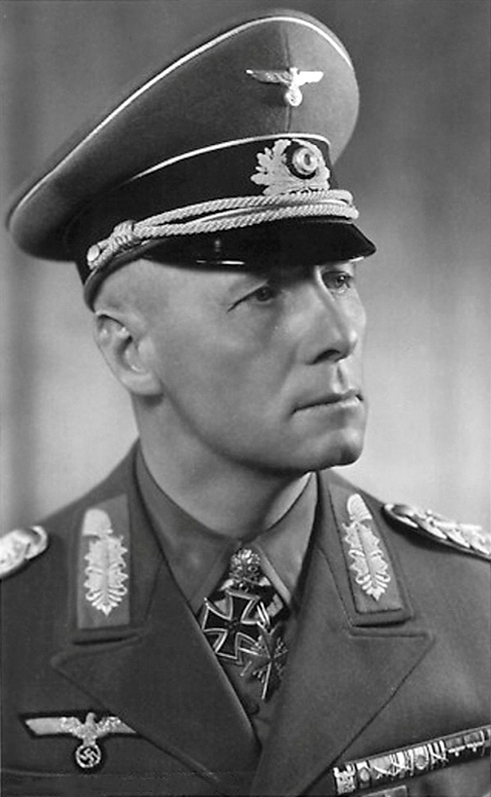
Erwin Rommel


Introduction, Part One

Winston Churchill publicly praised only two German officers during the war. One of these was Günther Prien, who on 14 October 1939 managed to get a U-boat into Scapa Flow, sink the battleship Royal Oak at anchor and get out again before the British realised what was going on. Then First Lord of the Admiralty, Churchill conceded that one was "a remarkable exploit of professional skill and daring".

The other was Erwin Rommel, who he described in the following terms:

We have a very daring and skillful opponent against us, and, may I say across the havoc of war, a great general

Rommel (1891-1944) had served with distinction in the First World War, being wounded three times and receiving two gallantry decorations. After that war, he stayed in the smaller Reichswehr, becoming an instructor - throughout this time, he was highly respected by his men and other officers, demonstrating courage and strong leadership. He also published books on military manoeuvres.

He got close to Hitler and achieved the rank of General in 1939. Asking for a field command, he got 7th Panzer Division, the only commander who had not been involved directly in the Polish invasion.

In France, his forces raced ahead of the others, being the first to reach the English Channel near Dieppe and also taking places like Cherbourg. He also made enemies among his fellow officers, particularly when he commandeered their equipment for his own advances.

With things going wrong in North Africa, Hitler tapped him to lead the Afrika Korps.

The end of Compass

In North Africa, the British raced on, heading for the Italian-controlled port of Bardia in Libya. The local forces were ordered to fight to the last man and denied air support. While the British under-estimated Italian forces by about half, the town was still taken in two days, with the bulk of the Italians surrendering - 36,000 defenders ended up as POWs and the British captured a great deal of materiel, along with a pumping station - vital for fresh water.

The main forces involved were the new Australian division and their involvement earned them fame overseas, including among the neutrals.

The Italian rout continued - Tobruk was bagged in three days, Derna in one. The Tenth Army fled west and were intercepted by the British forces. After attempts at a breakout failed, the remaining forces (except for 32,000 who escaped) surrendered on 9 February.

In just ten weeks, the British had advanced 800 kilometres, reaching El Agheila and taking the important city of Benghazi. 130,000 prisoners were taken, including no less than 22 generals. 400 tanks and 1,290 artillery pieces were also captured. The Tenth Army had basically ceased to exist as a fighting force.

At this point, the German invasion of Greece led to Commonwealth forces being diverted to try and stop that (they didn't), so the offensive stopped there.

Operation Sonnenblume and Rommel's arrival

At this point, Rommel arrived in theatre, with the Germans sending a small, but potent force to Libya. While this being built up, Rommel initially built up his defences and engaged in deception measures (including building fake tanks) to make the Allies think he had more forces than he really had. They bought the ruse.

Tobruk 1

On 24 March 1941, Rommel launched his offensive, taking back El Agheila and taking the British completely by surprise. He swept along towards Tobruk, capturing the towns along the way, although the supply dump at Msus proved useless to him as the British sabotaged the fuel stored there. Bardia was recaptured in the process.

Rommel had initially considered launching a flank attack around Tobruk before a direct assault to cut off the city, but deemed the defences there weak enough to justify going straight in from the west.

On 10 April, General Heinrich von Prittwitz und Gaffron launched the assault - and got killed in the process as the 25,000 Allied forces stood firm. It was time for Plan B - or rather Plan A, with Rommel surrounding the city from its land approaches.

He then launched attack after attack, but the strong Allied defences repulsed them all - until on 10 May Rommel was order to besiege the city instead of attack it directly.

This he did, but it wasn't really a siege, as Tobruk was still open to the sea, Allied convoys were able to bring in fresh supplies and rotate forces there, as well as providing occasional fire support. The 'siege' went on.

Operation Battleaxe

In June, the British launched another offensive, which failed after only three days. Rommel had access to signals intelligence that a British attack was likely - he was able to make good preparations for this. In addition, he had some better equipment, such as the 88mm flak gun, which proved just as good at dealing with tanks as it did with planes, while his Panzer IVs out-ranged the British tanks, being able to take out their artillery.

Rommel would send in his tanks then retreat, luring the British into a trap where the 88s could destroy them. The Germans lost 50 tanks (and were able to repair 38 of those) to the Allies' 91, with the British also taking higher manpower losses as well.

Churchill considered firing Wavell at this point, but decided against it. He instead swapped his job with that of Claude Auchinleck.

"Good Source"

In the autumn, the Axis powers separately cracked the US diplomatic code - allowing them to read the messages of the neutral (but leaning to the Allies) country. In particular, this allowed them to read the reports of one Frank Fellers, the American military attaché in Cairo. He talked with the British, visited the battlefronts - and discussed pretty much everything in his dispatches. The dispatches that the Germans could now read.

Rommel called his "good source" and while not able to use it that much in 1941, he made a great use of it in 1942.

Operation Crusader 

As the year came near its end and the summer ended, the British were able to launch another attack with two whole corps. The offensive was launched on 18 November, with bad weather hitting both sides - the British lost air support, but the Germans lost aerial reconnaissance.

The attacks on both sides were brutal, with heavy losses. Rommel launched a number of counter-attacks, but ultimately his forces were cleared from the border area (pulling back to a line called the 'Gazala Line') and Tobruk was relieved. The Germans got the worst of and this was a clear Allied victory - the success continuing as 1942 began.

It wouldn't last and soon Suez would be under threat. However, events half a world a way were going to save the British and mark the 'end of the beginning'.