Showing posts with label The Second World War. Show all posts

29 November 2012

The Desert War: Conclusion

I could cover the last two years of the war and what happened to the key commanders - especially Rommel. However, I'm sure that you can find that information easily, so I'll finish up with some brief thoughts on the campaign itself and what we can learn from it.

Was it worth it?

The Allies did not win the war through the defeat of the Afrika Korps - they won it through the ground of invasion of Germany from two directions and via a highly bloody (on both sides) strategic bombing campaign.

Losing this campaign though would have been catastrophic - Middle Eastern oil supplies would have been in great danger and the loss of Egypt might have forced Churchill from office in favour of someone who would make a peace deal... that would have let mainland Europe to either the Nazis or more likely Stalin.

It can be argued that diverting forces to North Africa when they could have been used preparing for an earlier Second Front in Europe was a waste of resources and holding the line might have been enough...

I disagree. The Allies needed a clear strategic victory in 1942 at a point when they were facing defeat nearly everywhere. Forcing the Germans out of North Africa and liberating a number of future African countries did just that.

The Italy campaign on the other hand...

What can we learn from this campaign?

  1. It's not what you have, it's what you do with it - Rommel was an extremely capable general. Most Wehrmacht commanders would not have lasted as long as he did and if Rommel had not gone out of the equation permanently in 1944, the concept of him leading the Battle of the Bulge is a terrifying prospect. 
  2. The capacity of so-called military experts to be completely inept is massive.
  3. Logistics are vital in any war, especially when there is not a ready-made source of water and food nearby.
  4. Sometimes 'the sideshow' can be vital to the main event.
  5. Our veterans have had to fight in unpleasant conditions in wars that seem to have little to do with their home country... but they are usually of importance to the wider world and ultimately us. For this they should receive our gratitude.
Thank you for reading. I hope that you have found this interesting.

24 November 2012

The Desert War: 1943 - Patton finishes the job


As 1943 began, the Germans were beginning a full scale strategic retreat that would only end with the fall of Berlin. However, they were going to make sure that the Allies paid for every mile they took.

In the west of North Africa, an offensive into Tunisia had bogged down under a German counter-attack. To prevent another one, Rommel now ordered a counter-offensive in the west.

When looking at the closing stages of this campaign, it is important to remember the vast differences in experience levels of the two sides. The German forces had been at this particular conflict for about two years - the American troops had no experience of desert warfare at all and had only come into the war in December 1941. What experience they had in a modern environment was against the Japanese - half a world away and in very different terrain. The senior commanders of the US Army had seen action before... but that had been in 1918 during the relatively brief involvement of the United States on the Western Front. The US Army had been allowed to deteriorate considerably in the 20 years of peace, mostly due to lack of money from Congress.

Thus it was entirely logical to go for the much weaker forces.

Faïd Pass and Sidi Bouzid

On 30 January, German forces under the command of Hans-Jürgen von Arnim launched an attack at the Faïd Pass, occupied by French forces. The local commander called the Americans of General Lloyd Fredendall's II Corps for assistance, but they were too slow to react to a swift German attack.

SW of this pass was Sidi Bouzid, a major communications and supply hub of the US II Corps. It's at this point that one should make that Fredendall really didn't know what he was doing. Prone to informality and using his own slang, he created confusion in a situation where clarity was essential. He did not visit the front line, overruled local commanders and ignored advice about mutual support.

As he did here - the American defences were spread on two hills wide apart. They were not in a position to help each other. On 14 February, 140 tanks from two Panzer Divisions attacked through the pass under cover of a sand storm, most of the American vehicles had been destroyed or driven west. A US counter-attack the following day suffered heavy casualties under air and tank attack, its gains were only temporary as the US forces were forced to the Kasserine Pass west of Sbeitla.

Kasserine Pass

Rommel now proposed a strike into French Algeria to further undermine the US forces before the British could arrive from Libya, aiming for Tébessa, a major supply dump. Berlin approved this, but changed the single strike into two separate ones. Rommel was unhappy, but he continued with the assault anyway. There had been no large scale contact between US and German forces, but he was confident that he could defeat the Americans.

21st Panzer went against Sbiba Pass; totally inadequate American forces collapsed within minutes. Rommel himself led the forces heading for the Kasserine Pass. The Americans fell back en masse, allowing equipment to be captured - the sheer success then slowed the Germans down as they had to detach troops to mop up the pockets of resistance.

On 22 February, with Rommel's objective clear, British forces replaced the Americans in the line and the Afrika Cops now faced much stronger resistance. Behind their lines, the Allies put together a large artillery force and then used it to launch a pre-emptive artillery attack on the German positions, destroying many tanks.

Rommel was now facing the British coming in from Libya, so he ordered a retreat that was sped up by a massive USAAF airstrike. On the 25th, Kasserine Pass was recaptured, but at a heavy price - 10,000 Allied casualties for only 2,000 Axis ones.

Patton and El Guettar

While the situation was now stabilised, the series of defeats eliminated any remaining confidence in Fredendall. Eisenhower relieved him of command with the recommendation he be assigned to a training unit - he would spend the rest of the war in the United States.

His replacement was George S. Patton, one of history's great generals and one of the Second World War's bigger egos. An Olympic pentathlete (he came 5th in the first event in 1912 and would have been in the 1916 games had they not been cancelled) and an expert swordsman in particular, he launched the first US armored vehicle raid in the Mexican Expedition of 1916-17. When the US went to France in 1918, he was assigned to the Tank Corps, where he was wounded and decorated.

After that war, he moved back to horse cavalry as the US forces were shrunk in size, but returned to armour just before the US entered this war. He entered North Africa commanding the landings in Morocco.

Patton believed in strict discipline and being seen at the front - he was also more than a bit of a bigot (of course, this was still a segregated Army and a largely segregated country).

With his arrival as commander, the Allied forces began to prepare for another offensive against the Axis forces in Tunisia. This was launched on 17 March, with US forces reaching El Guettar. The Italian forces retreated and fortfied the surrounding hills, as well as blocking the nearby pass. The Germans then launched a counter-attack on 23 March - they had initial success, but then got stuck in a minefield, which allowed the US to destroy 30 of their tanks and force a withdrawal.

The Americans began to push back, but on reaching Hill 369, the battle turned into a stalemate. The hill was captured after four days of fighting, but the Germans had arrived and things weren't getting easier.

Then the British arrived from the east, linking with the American forces. By this point, a badly ill Rommel had left the theatre to recover, handing over to von Arnim - he would not return.

Endgame

What the Axis forces really needed now was an evacuation - Hitler refused to do so; continuing to supply the forces there by air. The Americans were now in a position to interfere with this supply run and appointed James Doolittle (of the Doolittle Raid) to run Operation Flax. Starting on 5 April, US and later British fighters attacked the aerial convoys, inflicting heavy losses on the German aircraft, especially their transports. Göring, faced with these losses, eventually terminated all flights into Tunisia, evacuating nearly all the local Luftwaffe presence by early May.

On 22 April, the final Allied offensive, Operation Vulcan, was launched. Stiff German resistance resulted in heavy casualties, but the Allies too the positions one by one, overwhelming the enemy or making them run out of supplies. On 6 May, Tunis and Bizerte were taken.

A week later, the remaining Axis forces in Tunisia, now in a tiny coastal pocket, surrendered - 240,000 prisoners were taken, meaning the British now had more German prisoners in their country than British prisoners in Germany for the first time since the war began.

The Mediterranean route was now clear. The job was done.

14 November 2012

The Desert War: 1942 - Montgomery turns the Hinge

Tanks waiting to advance at El Alamein

As 1942 began, it marked the end of a year where key events had dramatically altered the war. Both the USSR and the USA had been attacked by the Axis, becoming full members of the Grand Alliance (as Churchill termed it). Things had not been going that well for the former and were a disaster for the latter.

The USSR wished for a Second Front in Europe to relieve some pressure from their forces, who were  taking the brunt of the Axis firepower and would continue to do so. A significant portion of American public opinion favoured concentrating on the Pacific (who had actually attacked them) and those who favoured some involvement in Europe believed that the best use of American forces would be the invasion of France - feeling that the shortest route between two points was a straight line.

While the shortest route did ultimately prove to be a straight line (it took nine months from Normandy to the Rhine, as opposed to the over two years from Sicily to Austria), a land based invasion of France in 1942 was a complete non-starter; Dieppe was bad enough and a failure on that scale would have probably cost Churchill his job.

He was going to have enough political problems as it was.

The end of Crusader and Rommel's counterattack

Bardia fell on 2 January and the Allies continued to advance, reaching El Agheila. However, Rommel's supply lines were shortening and those of Auchinleck were getting longer. Thus Rommel was able to replenish his forces.

On 21 January, Rommel launched a surprise counter-attack. Meant initially to be a reconnaissance in force, lighter resistance than expected led this to turn into a full offensive and by early February 8th Army found itself back at the Gazala Line, where it had been in December.

At this point, both sides stopped and dug in.

Gazala and the fall of Tobruk

The British established a series of forts on a 50 mile line running south from Gazala to the old Turkish fortress of Bir Hakeim, believing that anything south of that was impenetrable by the Germans. Yep, it's one of those classic blunders. They also received new M3 Lee tanks and changed their air strategy from air superiority to combat support.

Rommel was also building up his supplies and had the advantage of shorter lines - the Mediterranean was still a risky proposition for Allied shipping (who were also dealing with the siege of Malta) and so those supplies tended to come the long way round.

On 26 May, after his 'good source' revealed the British were preparing a counter-offensive Rommel's forces launched an attack at the centre of the Gazala Line - aiming for Tobruk. It was a feint and the British fell for it. After the sun set, the tanks went south and round the line to the south, taking the British completely by surprise. Bir Hakeim was encircled, the start of a siege that would last until 11 June, when the remaining unwounded Free French troops managed to get out, having run out of ammunition.

The Allies launched two big counter-attacks and both ultimately failed.

With Bir Hakeim in his grasp, Rommel's forces raced forward, the British abandoning Gazala and having to leave a new line before they could settle in. Tobruk was now open.

Despite Churchill's desire to defend Tobruk to the end, Auchinleck was not of the same opinion. It's important to remember that there was no effective real-time communication between Egypt and London. Any messages would have to be sent over the radio in code - this took time to cipher and decipher. The local commanders had to have considerable freedom of action as a result.

(The Axis forces in Europe had the advantage of telephone links that Bletchley Park could not tap)

Tobruk was surrounded on 17 June and the final assault against the South Africa, British and Indian forces there began on the 20th with a heavy bombardment. The tanks raced through to the port facilities, capturing them by day's end. A breakout failed and the following day, 35,000 Allied soldiers surrendered.

Churchill, in Washington for a summit with FDR, is reported to have turned white when he heard the news. The American President's response was to send 300 vitally needed Sherman tanks to the British in Egypt. The British PM then went home and faced down a censure motion in the Commons (sitting in Westminster Hall as the Commons Chamber was destroyed in the last big raid of the Blitz - fortunately it was empty at the time).

For Rommel's part, he was promoted to Field Marshal.

First El Alamein

The British began to realise information was leaking - a German radio play in which an American attaché was depicted sending information to Washington may well have finally tipped them off. On 29 June, Fellers was reassigned out of Egypt. This did not close the leak immediately, but it was starting to help.

On 30 June 1942, German tanks reached a small railway halt in the middle of nowhere that would soon enter the history books. Auchinleck had declared that a line going through the town of El Alamein and ending with the effectively impassable Qabala Depression (as any forces would have head deep into the Sahara to go round it) would be the final defensive point - they had to hold here or Egypt was in grave danger of being lost.

In Cairo, panic was beginning to set in - documents were burned at the Embassy and the ex-pat community began to leave. Hitler and Mussolini relished the possibility of a huge victory - they were not going to get one.

Rommel decided not to give his forces a rest and pushed on, encountering heavy resistance. Both sides ground up against each other, with many casualties as the British held firm, while Allied forces launching attacks frequently got separated from their armour support, got lost or ended up in minefields.

On 10 July, an assault at Tel el Aisa resulted in the overrunning of 621st Signal Battalion's positions. This unit had been assisting Rommel by listening in on British communications, the British demonstrating a major failure of radio discipline. Rommel was now cut off from his information source.

After an offensive called Operation Manhood broke down and was cancelled on 31 July, things ended in a stalemate. Rommel, blaming his losses on a lack of supplies, poor Italian equipment and command (but not the soldiers) would go no further east.

The Allies took about 13,250 casualties (killed, wounded and missing) - the Axis around 17,000.

Enter Monty

Winston Churchill was not happy with merely holding the line, especially while possessing a bigger force. He took a very noisy, risky and uncomfortable flight to Cairo along with the Chief of the Imperial General Staff, Alan Brooke. While there, he fired Auchinleck from his post, the General ending up in command of the Indian Army.

To replace Auchinleck, a Lieutenant General named William "Strafer" Gott, who had commanded the Desert Rats was appointed to take over 8th Army. As he was flying back to Cairo, however, his transport plane was jumped by German fighters and took enough damage to make it crash - yet the 109s came back for another pass as it was going down. This highly unusual move (it's a waste of ammo to shoot up an aircraft that you've already effectively destroyed) has been taken by many, including the pilot of the transport - who survived the war - that the Germans knew he was on there

Brooke had not wanted Gott in charge, preferring a general with no experience of the desert called Bernard Montgomery. "Monty", a Western Front veteran who had survived a bullet wound that looked so bad that a grave was dug for him. He won the Distinguished Service Order as a subaltern (it usually goes to those above Lieutenant Colonel), which is usually given for acts of gallantry that just miss out on the Victoria Cross.

He was not really someone who played well with others - he lived a spartan life, opened a brothel for his troops to the disquiet of his fellow commanders and later expressed public support for apartheid. His ego was rather large. From a biography I read of him, he comes across (although I am no mental health expert) as borderline Asperger's. He had a fierce rivalry with the equally abrasive George Patton and would later come close to insubordination with Eisenhower.

At any rate, he proved to be a highly dynamic officer who made a strong effort to visit his men, acquiring a distinctive black tanker's beret on one of these visits. He ordered there would be no further retreat.

On 30 August, Rommel launched another offensive. However, with the advantage of ULTRA decrypts, the British knew it was coming and used their aircraft to harass the enemy supply lines, destroying 400 trucks. Short of fuel, the Desert Fox decided to withdraw on 2 September.

Montgomery launched a counter-offensive, but after suffering heavy casualties, a general known for his caution called it off. He would get a lot of criticism for this - as it allowed the Germans to escape to fight another day, but he felt his relatively inexperienced forces weren't ready for it.

Second El Alamein

Churchill, after refusing point blank to countenance any cross-channel invasion in 1943, got the agreement of the Americans to an amphibious landing in the Vichy French territory of North Africa. He wanted, for political reasons, a big victory before this landing happened.

Thus, on 23 October 1942, with the extra tanks and equipment promised by Roosevelt, Operation Lightfoot was launched at 2140 local time. The plan was to penetrate the German minefield near El Alamein (which was 5 miles thick) in the space of a single night, while launching a series of feint attacks. It would be a tall order even today - so it's no surprise that it didn't work like that.

Monty had the advantage of German command problems. Ill-health affected a lot of the forces in the desert - dysentery, malaria etc. Rommel was in Germany recuperating from stomach problems and had to rush back to take command. The local commander died of a heart attack, but his deputy took command in the meantime.

The fighting was heavy, but the British had the advantage of numbers as well as the fact the Germans believed they were fighting on a broad front. Rommel's tanks were running out of fuel, his units were being decimated and he was now seeking to withdraw. Hitler, not a man known for his military competence, was having none of it.

Monty's first offensive broke down, but he changed his dispositions and launched another, codenamed Supercharge. Rommel withdrew some of his forces, while his rear guard continued to fight hard.

On 4 November, the Desert Fox ignored Hitler and ordered a general withdrawal. By Armistice Day, the remaining Axis forces were either out of Egypt, dead or captured.

Montgomery's forces advanced more slowly than the retreating Germans - another example of caution that he has been criticised for, although in his defence he had supply problems. Thus, when he liberated Tobruk on 13 November, the enemy escaped again.

Rommel pulled his forces back to El Agheila, then by year's end to Buerat, well west of Sirte. He was going to be going a lot further back, for the Americans had arrived.

Torch and Tunisia 

On 8 November, the American forces landed in Morocco and Algeria. Onky resistance by Vichy French land and air forces was expected, although the reaction of the Navy (who had been attacked by British forces in 1940 seeking to eliminate their capital ships) was less predictable.

The previous day, an attempted coup by a local French officer who had switched sides led to local defences being bolstered, but resistance only lasted four days. The Americans cut a deal with Vichy French Admiral François Darlan that he would be given control (and allowed to maintain a Vichy-style regime) if he switched sides. This infuriated a lot of the Free French - Darlan was shot dead on Christmas Eve, but the tactic worked and eventually the local government got rid of its Vichy leadership, coming under the control of de Gaulle.

Also furious was Berlin and Rome, who launched an occupation of the main part of Vichy France, undertaken with minimal resistance - although in their last act, the French fleet at Toulon was effectively destroyed when the locals scuttled 77 ships.

With the Americans in his rear, it was one more reason for Rommel to pull back.

Churchill was ecstatic at these victories - he ordered that the church bells of Britain, silent since 1940, ring out in celebration. With the Soviet victory at Stalingrad, it was clear that this was (to quote Churchill's Mansion House address that year) "the end of the beginning".

Rommel was now in full retreat, but he wasn't done yet.

06 November 2012

The Desert War: 1941 - Enter the Desert Fox

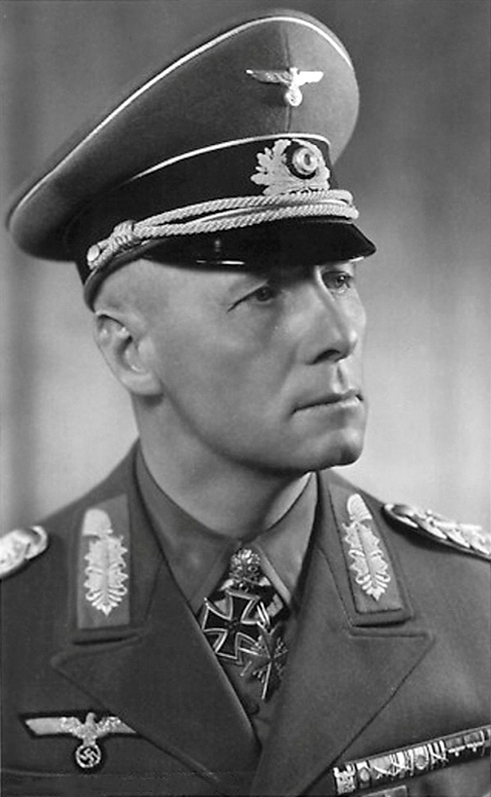
Erwin Rommel


Introduction, Part One

Winston Churchill publicly praised only two German officers during the war. One of these was Günther Prien, who on 14 October 1939 managed to get a U-boat into Scapa Flow, sink the battleship Royal Oak at anchor and get out again before the British realised what was going on. Then First Lord of the Admiralty, Churchill conceded that one was "a remarkable exploit of professional skill and daring".

The other was Erwin Rommel, who he described in the following terms:

We have a very daring and skillful opponent against us, and, may I say across the havoc of war, a great general

Rommel (1891-1944) had served with distinction in the First World War, being wounded three times and receiving two gallantry decorations. After that war, he stayed in the smaller Reichswehr, becoming an instructor - throughout this time, he was highly respected by his men and other officers, demonstrating courage and strong leadership. He also published books on military manoeuvres.

He got close to Hitler and achieved the rank of General in 1939. Asking for a field command, he got 7th Panzer Division, the only commander who had not been involved directly in the Polish invasion.

In France, his forces raced ahead of the others, being the first to reach the English Channel near Dieppe and also taking places like Cherbourg. He also made enemies among his fellow officers, particularly when he commandeered their equipment for his own advances.

With things going wrong in North Africa, Hitler tapped him to lead the Afrika Korps.

The end of Compass

In North Africa, the British raced on, heading for the Italian-controlled port of Bardia in Libya. The local forces were ordered to fight to the last man and denied air support. While the British under-estimated Italian forces by about half, the town was still taken in two days, with the bulk of the Italians surrendering - 36,000 defenders ended up as POWs and the British captured a great deal of materiel, along with a pumping station - vital for fresh water.

The main forces involved were the new Australian division and their involvement earned them fame overseas, including among the neutrals.

The Italian rout continued - Tobruk was bagged in three days, Derna in one. The Tenth Army fled west and were intercepted by the British forces. After attempts at a breakout failed, the remaining forces (except for 32,000 who escaped) surrendered on 9 February.

In just ten weeks, the British had advanced 800 kilometres, reaching El Agheila and taking the important city of Benghazi. 130,000 prisoners were taken, including no less than 22 generals. 400 tanks and 1,290 artillery pieces were also captured. The Tenth Army had basically ceased to exist as a fighting force.

At this point, the German invasion of Greece led to Commonwealth forces being diverted to try and stop that (they didn't), so the offensive stopped there.

Operation Sonnenblume and Rommel's arrival

At this point, Rommel arrived in theatre, with the Germans sending a small, but potent force to Libya. While this being built up, Rommel initially built up his defences and engaged in deception measures (including building fake tanks) to make the Allies think he had more forces than he really had. They bought the ruse.

Tobruk 1

On 24 March 1941, Rommel launched his offensive, taking back El Agheila and taking the British completely by surprise. He swept along towards Tobruk, capturing the towns along the way, although the supply dump at Msus proved useless to him as the British sabotaged the fuel stored there. Bardia was recaptured in the process.

Rommel had initially considered launching a flank attack around Tobruk before a direct assault to cut off the city, but deemed the defences there weak enough to justify going straight in from the west.

On 10 April, General Heinrich von Prittwitz und Gaffron launched the assault - and got killed in the process as the 25,000 Allied forces stood firm. It was time for Plan B - or rather Plan A, with Rommel surrounding the city from its land approaches.

He then launched attack after attack, but the strong Allied defences repulsed them all - until on 10 May Rommel was order to besiege the city instead of attack it directly.

This he did, but it wasn't really a siege, as Tobruk was still open to the sea, Allied convoys were able to bring in fresh supplies and rotate forces there, as well as providing occasional fire support. The 'siege' went on.

Operation Battleaxe

In June, the British launched another offensive, which failed after only three days. Rommel had access to signals intelligence that a British attack was likely - he was able to make good preparations for this. In addition, he had some better equipment, such as the 88mm flak gun, which proved just as good at dealing with tanks as it did with planes, while his Panzer IVs out-ranged the British tanks, being able to take out their artillery.

Rommel would send in his tanks then retreat, luring the British into a trap where the 88s could destroy them. The Germans lost 50 tanks (and were able to repair 38 of those) to the Allies' 91, with the British also taking higher manpower losses as well.

Churchill considered firing Wavell at this point, but decided against it. He instead swapped his job with that of Claude Auchinleck.

"Good Source"

In the autumn, the Axis powers separately cracked the US diplomatic code - allowing them to read the messages of the neutral (but leaning to the Allies) country. In particular, this allowed them to read the reports of one Frank Fellers, the American military attaché in Cairo. He talked with the British, visited the battlefronts - and discussed pretty much everything in his dispatches. The dispatches that the Germans could now read.

Rommel called his "good source" and while not able to use it that much in 1941, he made a great use of it in 1942.

Operation Crusader 

As the year came near its end and the summer ended, the British were able to launch another attack with two whole corps. The offensive was launched on 18 November, with bad weather hitting both sides - the British lost air support, but the Germans lost aerial reconnaissance.

The attacks on both sides were brutal, with heavy losses. Rommel launched a number of counter-attacks, but ultimately his forces were cleared from the border area (pulling back to a line called the 'Gazala Line') and Tobruk was relieved. The Germans got the worst of and this was a clear Allied victory - the success continuing as 1942 began.

It wouldn't last and soon Suez would be under threat. However, events half a world a way were going to save the British and mark the 'end of the beginning'.

20 January 2012

After Pearl Harbor Part Six - The Second Battle: Midway

The Japanese aircraft carrier Hiryu maneuvers to avoid bombs dropped by USAAF Boeing B-17E Flying Fortress bombers
Part One

The Battle of Midway from 4 June to 7 June 1942 is arguably the most important naval battle in the Pacific War. With one fell swoop from the forces of two US carriers, Japan lost three of its aircraft carriers - a fourth would follow later. The United States only lost one. Japan's naval supremacy in the Pacific entered a downward path that they would never recover from.

As the story of Midway is well known, I'm going to take a different tack on this post. I'm going to discuss carrier operations c. 1942 with some of my computer game experiences helping in the analysis of this. I find that war games can be very educational in this regard.

Pre-launch

I don't imagine the air conditioning on US Navy warships was all that good back in 1942. I guess key components could be kept cool, but for many you're basically in a large metal can that has the sun shining on it the whole time. In the Pacific in mid-summer it wouldn't be pleasant.

It'd also be cramped. Sailors have long faced a lack of privacy and a tiny living area - sometimes having to "hot-bunk", which I really wouldn't want to do.

Take off

Launching from an aircraft carrier wouldn't be all that hard. Just push the throttle forward to maximum power and use the wind speed generated by a combination of the carrier's own engines and the prevailing wind to get airborne. Of course, if your engine didn't work properly, you could drop into the sea, facing the chance of either being run over by your own carrier or drowning trapped in your aircraft.

I've never had any particular problems with carrier take-off in the Battlefield games at all (it's a bit harder in Il-2) - in fact it's easy in all walks of life to "take off". The question is staying airborne and landing safely.

Transit and return from target

The ocean is a big place and finding a small ship is not easy, especially when you don't have radar. Even then, you might misidentify your target in some form.

In addition, a spotter plane that found an aircraft carrier would need to call the report in. You couldn't do it like today with an encrypted satellite phone and your own voice. I may be wrong, but for distance transmissions you were having to rely on Morse - which takes time to send. It was not unheard of for a spotting aircraft to be destroyed before it get a contact report off.

Navigation was a lot harder back then as well. You were basically relying on a compass, a stopwatch and sometimes the stars - no real landmarks at sea. A small error could quickly mount up and result in you missing your target by miles. Or even worse, failing to find your carrier before you ran out of fuel. This can be demonstrated in particular by the early performance of Bomber Command over Germany where the vast majority of bombs didn't even get within five miles of their target. That's a big miss.

Attacking the target

No fancy stand-off weaponry back then. There were two basic ways to attack a carrier - dive-bombing or torpedoing.

Dive-bombing basically involves swooping down on the carrier and releasing your bombs so that they hit the deck. This is harder than it sounds. I've had enough problems in Battlefield trying to get bombs to drop accurately onto target - I usually just do lay-down and hope, with little success so far.

You've got to come in at a steep angle against a moving ship that is shooting at you. With a lot of guns - US carriers had a large number of AAA guns on board up until the missile age. One hit in the right place and you're either going to explode or not be able to pull out of the dive.

Torpedo attacks involved coming in straight and low, so the torpedo (which ran straight) would not go straight down when it hit the water. Again, you've got flak coming at you from the ship, with some small arms fire for added "effect". A hit here and you have little room for manoeuvre before plunging into the sea.

Landing

"Trapping" on a carrier is regarded as one of the most scary things to do in aviation, especially at night. You have to find the carrier in the first place and then come in at the right angle and approach to catch one of the four arrestor wires on a deck moving in three dimensions, which will bring you to a screeching halt. There were none of the optical landing systems back then - they would be invented after the war. You were reliant on eyesight and the landing officers waving you in. Come in too low and a "ramp strike" was a distinct possibility or having your landing gear collapse on you.

If you miss the wires today, you just slam the engines on afterburner and go around - as the landing area is at an angle to the rest of the ship to prevent a "bolter" from hitting aircraft parked forward and allowing for a safe fly-off. Back during the war, you'd either hit the aircraft, hit a safety net and have your aircraft badly damaged, or go off the side.

I've never made an arrested carrier landing in any game, so I can't comment on this.

Leaving your aircraft

Ditching from an aircraft over the sea is not something that any pilot would ever want to do. If you landed close to an enemy carrier, you were going to end up a POW or dead - considering the Japanese, some might have preferred the latter. If you landed in the open ocean and managed to avoid drowning by being pulled under by your own chute if you failed to release it on landing (a distinct possibility if you were injured), you had to hope someone found you...

Conclusion

It's a simple one really - it takes skill and bravery to be a carrier aviator. I don't think I could do it.

08 January 2012

After Pearl Harbor Part 5: The First Battle - Coral Sea

Lexington explodes
The series starts here.

[Change of plan - I'm doing Coral Sea and Midway as separate posts and doing a final concluding post]

One of my favourite war novels is called The Sixth Battle by Barrett Tillman. Published in 1993, it revolves around a war in Southern Africa and features a supercarrier battle between US and Russian Eurasian forces. Early in the book, some of the characters are discussing how many battles between carrier groups there have been. Using the definition of a mutual exchange of air strikes, they come up with five, the first two being Coral Sea and Midway.

These two battles would prove pivotal in the war in the Pacific, as well as a much smaller, but no less audacious operation.

The Doolittle Raid

The Americans badly needed a morale boost and they got it on 18 April 1942 via the Doolittle Raid, where 16 B-25 bombers launched off the deck of USS Hornet and bombed Tokyo - a city that the Japanese had previously thought untouchable. It didn't do a lot of damage, but the psychological impact of the raid was immense - on both sides. All of the aircraft were lost - 15 crash-landed in China or ditched in the sea and the other one landed in the Soviet Union (which would remain neutral vis-a-vis Japan until August 1945), where it and its crew were interned. Three aircrew died during the raid, while eight of the others were captured - three being executed and one later dying of disease. Everybody else eventually made it back into operational service - James Doolittle, commanding the raid, ended up getting promoted two ranks to Brigadier General (he would eventually end up a full General) and getting the Medal of Honor.

The raid forced Japan to recall a raiding force from the Indian Ocean and delayed the launch of a new carrier that could have played a role in later events.

Target New Guinea

The Japanese were planning three major operations - against the Aleutian Islands, Midway and Port Moresby, New Guinea (now capital of Papua New Guinea).

The reason for Port Moresby (the offensive was codenamed Operation Mo) was simple - firstly it would provide a base for land-based aircraft to support any invasion of Australia and secondly, it would allow access to phosphate for Japanese agriculture. With the bulk of the carrier forces tasked for the other two, only modest forces were allocated for this particular operation. The invasion force sailed on 1 May, with two fleet carriers (Zuikaku and Shokaku) and an light carrier (Shoho) providing the key part of the strike force, escorting 11 transports that would make the main invasion.

The Americans knew that an attack was coming - they were reading the Japanese naval ciphers and so began to position their forces to counter the attack, two carrier task forces centered around Lexington (TF11) and Yorktown (TF17). They were still taken somewhat by surprise - as they were refuelling on 3 May, the Japanese started to land on Tulagi in the Solomon Islands, which was undefended as the local forces had been evacuated. TF17 heard the news and rapidly turned for Guadalcanal, where it would launch an air strike the following day against the landing force.

42 aircraft struck at the Tulagi landing force, sinking four vessels. It didn't stop the invasion (Japan would hold Tulagi until August)

The IJN promptly sent their two fleet carriers  south and recce planes into the area where they thought that the carriers were, failing to find anything. Each side spent the next three days looking for each other, mostly without success - American B-17s found Shoho but failed to hit it. Japan bombed Port Moresby in readiness for the invasion.

Day One - 7 May 1942

Early in the morning, Japanese patrol planes found something.

Misidentification of enemy vessels is something war games don't simulate enough. This is not just getting the ship name or class - this is completely misidentifying the type of vessel or its side. Easy to do in the dark or at a distance in a time with limited availability of radar (limited to large ships) where most scouts relied on Mark One Eyeball aided by binoculars. In addition, both fleets were 30 miles from each other and neither knew it.

So the Japanese scouts called in a light carrier and so the two fleet carriers launched against it... only it turned out to be a tanker and a destroyer. They disabled the former and sunk the latter, then, after dark started to come into land on what they thought was one of their carriers - only to discover they were trying to land on Yorktown. The Americans didn't realise the situation themselves until the aircraft were on their final approach.

That same day, American planes from TF17 found what they thought were Japanese carriers - but were in fact merchant ships. The Americans launched a strike at it and ran into the Shoho group, sinking the light carrier after a long dogfight, although most of that carrier's aircraft were able to recover to the other two carriers or dry land.

Both sides then held off for further attacks for the rest of the night.


Day Two - 8 May 1942

The second day of the battle began with both sides launching roughly 120 aircraft a piece. The Americans found Shokaku and damaged it at the cost of 43 aircraft. While they didn't sink the carrier, the damage caused made both fleet carriers turn back and resulted in neither being available for Midway.

The Japanese attack was more successful - their strike damaged Yorktown (although that damage was quickly fixed on return to Pearl Harbor) and wrecked Lexington's fuel lines. A chain of secondary explosions led to a conflagration and the second carrier was scuttled.

Both sides broke off at this point - the Japanese no longer had air cover for their invasion fleet and recalled it, while Yorktown made for Pearl.

The Japanese could at least claim a tactical victory here - but it was a pyrrhic one as they would never get near Port Moresby again.

They certainly could not call the next one a victory.

31 December 2011

After Pearl Harbor: Part 4 - The Worst Defeat - Singapore

Lt. Gen. Percival leading the surrender party at Singapore

Part One Part Two Part Three


The British, it is often said, maintain a stiff upper lip in even the worse circumstances. These gentlemen certainly look like they're doing so.

That must have been utterly hard considering what had just happened - and what would happen.
****
One of the best ways to understand why British Empire had all these outposts in far-flung obscure places is to plot some of them on a map. Gibraltar, Malta, Cyprus, Suez, Aden, Diego Garcia, Singapore, Hong Kong. As you can see, they all provide coverage of key trade routes to China and India.

Singapore, today a very prosperous limited democracy, covers a key route between the Indian Ocean to the west and the South China Sea to the east. It's one of the world's busiest ports and its strategic value from a purely geographical point is obvious. Therefore, the British invested large amounts in its naval defences, believing that it would be impenetrable from a seaborne invasion. Nobody, from the lowest ranking officer up to Churchill himself (who said in The Second World War that someone, himself included, should have seen it coming), thought that the Japanese would attack from the north, as surely the Malayan jungle was impenetrable.

Of course it wasn't.

****
On 1 February 1942, the Japanese reached the shore opposite Singapore after riding their bicycles through the Malayan jungle. The British were again woefully unprepared - they hadn't even implemented rationing - but still had superior numbers.

The first Japanese move was a feint attack by Yamashita's badly depleted forces (he was, in fact, outnumbered three to one) on 5 February against the island of Pulau Ubin to the north-east of Singapore island - a move that led Percival to move his key ammunition stores to the east. The Japanese then attacked from the northwest on 8 February. Australian forces from the 22nd Brigade fought off the initial landing attempts, but eventually succumbed to Japan's superior artillery and air support - the limited Allied fighter force did not last long against greater Imperial Japanese numbers. Percival believed that further landings would came from the north-east and so did not reinforce them - the Brigade were routed on 10 February.

Percival (told by Churchill to fight to the end) also started destroying docks and fuel dumps - while this stopped the Japanese from getting them, the effect on morale was highly negative, but worse was to come. A million people, mostly civilians crowded into the increasingly small area that the Allies controlled and food and water began to run out. Boats trying to leave were strafed by Japanese fighters, who now dominated the sky.

Percival was urged to surrender by his senior officers on the 13th but decided to fight on while he still had water, although he did ask for authority to surrender from London - which he eventually got.

14 February would see the Japanese commit another bloody massacre, killing 321 people in the Alexandra Barracks Hospital, usually by bayoneting them. Only five people were known to have survived. When Yamashita had about this, he had the soldiers responsible executed. This was just one of the atrocities committed.

The following day, Percival's forces were running out of ammunition and only had enough for two more days of fighting - although he didn't know the Japanese weren't much better on this front. At 1400 local time, deciding not to risk any further civilian casualties, he surrendered his forces unconditionally to Yamashita. 80,000 Allied soldiers became POWs, where most would spend four years in horrific conditions - many would never return. Thousands of Indian soldiers would switch sides and fight alongside the Japanese - but most of that army stayed loyal.

It was the biggest capitulation in British history. Part by bluff, part by superior fire power, Singapore had been taken by a numerically smaller force. The Australians were now worried about their own territory and rightly so - the Japanese seemed unstoppable.

****
But they weren't. As we shall see in the next post, Japan was to suffer two massive reverses in the following months.

27 December 2011

After Pearl Harbor, Part Three: The Bicycle Campaign - Malaya

Japanese troops advance through Kuala Lumpur
Part One Part Two

Part of the Japanese work in South-East Asia had already been done for them - the fall of France allowed for them to use the colonial territories of Vichy France as a staging area i.e. French Indochina (Vietnam, Cambodia and Laos). From there, it was a short sail across of the Gulf of Thailand to the British colonial possession of Malaya.

Malaya was an area rich in natural resources that the Japanese Empire needed - rubber and tin, as well as serving to put Borneo, Java and Sumatra, with plenty of oil within their reach. Hit by embargoes from the US, the UK and the Netherlands (the latter controlling Indonesia) for their earlier actions in China, the behemoth needed all of this just to sustain its economy. Add to that further "strength-in-depth" against air attack and the attraction was obvious

Just after midnight on 8 December 1941 (in fact seventy minutes before the Pearl Harbor attack commenced), the Japanese invasion force, hidden by bad weather and in one case shooting a Catalina that had spotted them before it could report their position, landed in Thailand and Malaya. British aircraft tried their best to stop them, but to no avail, although the Japanese did take heavy casualties at Kota Bharu.

The words "to no avail" crop up a lot in this narrative. Again, the British were woefully under prepared for jungle warfare - in fact many thought the Malayan jungle an impenetrable barrier. The Japanese weren't much better, but at least they had a good idea. Bicycles. They could carry far more than a regular foot soldier could and so the Imperial forces "requestioned" them from the local civilians and retailers. As for the British - their troops were undertrained, their aircraft e.g. Brewster Buffaloes were obsolescent and some units lacked proper communications.

Not only that, some of the responses were poor. Singapore was hit by an air raid on 8 December and a blackout still wasn't ordered. Facilities were not properly destroyed when abandoned - the British failed to destroy the radio facility on Penang when they evacuated it on the 13th, so the Japanese got it intact four days later and used it to taunt the Singaporeans, asking "How do you like our bombing?". The troops then looted Penang and massacred the ethnically Chinese residents - a move that went too far even for the Japanese, who eventually executed three soldiers over it. General Wavell, in charge of the local area for the British, kept overruling tactical commander Lt. Gen Percival, but never removed him - a half-measure that just wrecked morale.

On 11 January 1942, the Japanese took Kuala Lumpur with limited difficulty and headed down the island towards Singapore despite the British blowing bridges as they went - that great British fortress was in sight. The British had suffered two divisions worth of casualties - the Japanese only five thousand men. The local civilians of course had it far worse - the precise numbers killed during the invasion and subsequent occupation is unknown due to the destruction of records, but was likely between twenty and fifty thousand.

Malaya was one massive defeat for the British - but worse was to follow.

19 December 2011

After Pearl Harbor, Part Two: The Philippines

US and Filipino troops surrendering at Bataan
Part One

Barely ten hours after the strike at Pearl Harbor, Japanese forces attacked the Philippines. While the defeat of American and Filipino forces, so far away from reinforcement and home in the former case, was inevitable, it certainly wasn't easy for the Japanese.

For the Allied POWs afterwards, it was horrific.

****

The Philippines consists of 7,107 islands in the Western Pacific, forming the eastern edge of the South China Sea and a valuable springboard for any force going from China to Indonesia and Malaysia. When I think of the islands and their people (who are currently dealing with a horrific typhoon), I think of the large number of merchant mariners that hail from the country and also of au pairs - the Philippines is a country that a lot of people leave to get work and then send money back to. I also think of Imelda Marcos and her shoes.

Of course, much of this was in the future. When war broke out, the Philippine Islands, as they were then, were an American-ruled autonomous territory, having been gained from Spain in 1898 in a war perhaps best remembered for William Randolph Hearst's sensationalising and "yellow journalism". A Commonwealth at this point, the islands were heading for independence, which was going to get rather delayed.

****
Certainly there had been an idea that an attack on the islands was possible in the light of US sanctions on Japan. Certainly far more possible than an attack on the United States proper at Oahu. Douglas MacArthur was called out of retirement, given $10m and 100 B-17s, then got told to prepare for an attack. He parked his bombers on the northern part of the islands, where US politicians believed they would deter Japanese aggression and allow an attack on Tokyo if required, recovering to Soviet airbases around Vladivostok.

Not a smart move, that one. Even less smart was the delay in moving the B-17s out of Japanese attack range so the bomber pilots could have a party. As they were recovering, the Japanese attack arrived and took out half of MacArthur's air force on the ground. Bad hangover doesn't quite cut it.

On the same day, the Japanese landed at three sites (Lingayen, Lamon Bay and Mindanao), taking airbases to support their drive south. The American response, which should have been a delaying action and arguably guerilla warfare, basically started off by putting inexperienced Filipino troops on the beaches against combat-hardened (in China) Japanese. Naturally, they got routed.

The advance was quick. On Boxing Day, the capital Manila was declared an open city, not that it stopped Japanese bombing and the city fell on 2 January 1942.

The Americans and Filipinos eventually retreated down the Bataan peninsula on Luzon to Corregidor, fighting delaying actions along the way including the last cavalry charge in US history. They tried to hold out for a relief force which would not show up. They certainly fought valiantly, but to no avail. 9 April 1942 would see the largest surrender of US forces in history and another month of bloody fighting saw the rest of the islands taken.


****
For the Americans and Filipinos that surrendered, it was the start of hell on earth. 76,000 POWs were forced to march 60 miles in what became known as the Bataan Death March. Travelling in high humidity, with little food or water, those who collapsed were often killed by bayonets, shot or even driven over. Thousands died, viewed by the Japanese as not human just because they had surrendered. It was rightly judged a war crime.

Just one of many that Imperial Japan would commit in South-East Asia, as we shall see.

08 December 2011

After Pearl Harbor, Part One - 7/8 December 1941

Yesterday marked the 70th anniversary of the surprise Japanese attack on Pearl Harbor. It also marked the 70th anniversary of the beginning of the Japanese invasions of Thailand, Malaya, Hong Kong, the Philippines, Guam and Wake Island.

When the Japanese launched that six-carrier strike on Oahu, it was only the first attack of a major offensive of the size and scope that even Hitler never tried to pull off.

Three days after the attack, the only two remaining Allied capital ships in the Western Pacific, the British battleship Prince of Wales and battle cruiser Repulse were sunk by a Japanese air strike. The still operational capital ships in the entirety of the Pacific were the survivors of the Pearl Harbor attack, heading back for California. Winston Churchill himself described it as the biggest shock he had in the entire war.

The Japanese aim was to create a "Greater East Asia Co-Prosperity Sphere" basically a massive empire with rich resources and plenty of small islands they could use as airbases. Those islands, places like Peleliu, Iwo Jima and Saipan would become household names, small rocks in the ocean that were worth little apart from their location.

In the six months that followed, Japan almost achieved its goal - it got to within bombing range of Northern Australia, was banging on the door of British-controlled India and even took some of the Aleutian Islands, the chain of islands running west from Alaska. Only one event really stopped them - the Battle of Midway.

The next four parts of this will explore the early defeats of the Allies - Philippines, Malaya and Burma, as well as rightly one of the most renowned carrier battles in history. It will also look at the crimes committed by Japan - for Pearl Harbor was but one day of infamy among almost a decade.

Part Two

13 November 2011

In the defence of freedom

Today is Remembrance Sunday, where we remember those who died in the service of our country.

Many might feel that our involvement in many recent conflicts has not been in the defence of Britain at all; instead getting involved in other people's wars for material gain.

Yet, when you look back at our martial history, there have been surprisingly few conflicts that we've actually entered because we've been directly attacked. We declared war in the two World Wars in defence of Belgium and Poland respectively, certainly not being successful in the latter case as Poland spent almost fifty years under foreign control. In fact, we could have stayed out of both conflicts and remained independent.

What kind of nation would we be though if we did that? Certainly not as respected as we are. In fact, not entering the Second World War would mean that Hitler could have dominated Europe and be in a greater position to attack us.

I think Rudyard Kipling summed it up perfectly in his poem Dane-Geld:  


It is always a temptation to an armed and agile nation
  To call upon a neighbour and to say: --
"We invaded you last night--we are quite prepared to fight,
  Unless you pay us cash to go away."

And that is called asking for Dane-geld,
  And the people who ask it explain
That you've only to pay 'em the Dane-geld
  And then  you'll get rid of the Dane!

It is always a temptation for a rich and lazy nation,
  To puff and look important and to say: --
"Though we know we should defeat you, we have not the time to meet you.
  We will therefore pay you cash to go away."

And that is called paying the Dane-geld;
  But we've  proved it again and  again,
That if once you have paid him the Dane-geld
  You never get rid of the Dane.

It is wrong to put temptation in the path of any nation,
  For fear they should succumb and go astray;
So when you are requested to pay up or be molested,
  You will find it better policy to say: --

"We never pay any-one Dane-geld,
  No matter how trifling the cost;
For the end of that game is oppression and shame,
  And the nation that pays it is lost!"

Our servicemen and women have not put their lives on the line for their country - they have put their lives on the line for something greater; the principle that people should be free to determine their own destinies, rather than dictated by strongmen. For that, I thank them.

30 June 2011

The Biggest War in History, Part Eight: The past as present

The Soviet War Memorial in Treptower Park, Berlin, Germany (from Wikipedia, taken by "Victorgrigas")
Part Seven
Aftermath and Legacy

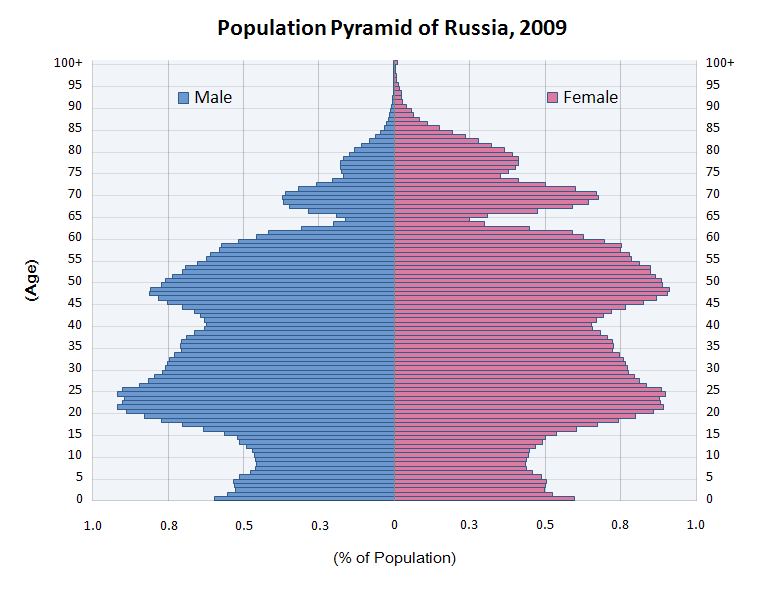
The population pyramid says it all. Even today, the Great Patriotic War continues to have a demographic effect on Russia and the other 14 nations that comprise the former Soviet Union. The male/female balance in the USSR tilted decisively in favour of women as a result of the huge numbers of men killed in the war - even today, there is still a noticeable imbalance between men and women, worsened by lower male life expectancy due to widespread alcohol abuse.

Everyone in the country was touched by the war in some way even if they survived; particularly those who liberated the death camps. The biggest and bloodiest war in history had devastated large parts of the country. If the Second World War still resonates even among young children in the UK today, then the effect must be just as large in Russia and the other republics.

A large number of war films and TV series were produced (and are still produced) by Soviet/Russian companies; most of these are not particularly well-known in the West. I've only heard of a few (Seventeen Moments of Spring, for example) and seen none of them - my Russian is only basic at best and I'd need subtitles to watch them.

Stalin's victory in the war led him to a wave of popularity that lasted until the Secret Speech in 1956 - he still remains pretty popular in Russia today, much to the puzzlement of Western commentators, including myself. His well-known paranoia remained and only his death in March 1953 prevented another major purge.

The USSR gained a considerable amount of territory from the war - including parts of Germany, Poland, Romania and Finland, as well as ending the independence of the three Baltic republics that had gained their freedom in 1918. It also retained a fear of attack from the West - with Germany now replaced by NATO, led by the United States. The retention of very large military forces, as well as the large-scale naval build up under Gorshkov, all stemmed from a desire to defend the Motherland, rather than wanting to take over the world (not that spreading communism wasn't part of Soviet foreign policy).

Of course, the large Soviet military meant that the West, fearing an attack itself, spent considerable amounts of money on weaponry itself.

It can only be said that if Hitler had never come to power, the world would be a much better place.

Reflections

The sheer scale of the Great Patriotic War boggles the mind. I visited Auschwitz a few years ago and saw one of the rooms they had where the pile of shoes that had been found when the camp was liberated. That's the moment that the sheer scale of The Holocaust hit me fully. Ten million was only really just a number until then. 26.6 million (and those were just the people in the USSR) is now a far realer number.

There was a casual indifference to human life on both sides during this conflict. I've yet to mention the Soviet tactics of NKVD commissars shooting retreating forces and the use of penal units to clear minefields by running across them. The latter sounds more like something someone would do in a computer game. Of course, the Germans were far worse - Hitler's lack of grip on military realities doomed millions.

I think the memories of this war, combined with the threat of nuclear destruction, has helped us ensure broad levels of peace in Europe for over 60 years. Hopefully, the memories will not die with the veterans.

I will close with one simple word in Russian to those who helped bring down the most evil man in history:

Spasiba.

29 June 2011

The Biggest War in History, Part Seven: Reaping the Whirlwind

Soviet soldiers hosting the Soviet flag on the balcony of Hotel Adlon in Berlin after the Battle of Berlin.(Bundesarchiv, Bild 183-R77767 / CC-BY-SA), via Wikipedia
Part Six

As 1945 began, any sensible military commentator on either side (if there had been any publicly writing on the German side) could see that the Thousand Year Reich was not going to survive the year, especially as it was outnumbered six to two million on the Eastern Front, while running out of fuel and ammunition.

Many of the German High Command knew that and that the best thing to do was make peace, although the chances of a negotiated peace treaty had now gone out of the proverbial window, especially after the liberation of Auschwitz on 27 January 1945. In fact, some of them had tried to remove the biggest obstacle to peace, namely Hitler himself, the previous July in the failed Valkyrie plot.

Adolf Hitler had lost it by this point. He still believed that he could win the war with the new wonder weapons he was bringing into service. Some of these weapons, such as the Me-262 jet fighter, would have been good had there been sufficient numbers of them. Others, like the V-2 short-range-ballistic missile, were just sucking up increasingly diminishing resources as the strategic bombing efforts of the Allies took their toll of German manufacturing - and civilian lives.

Now hiding out in a bunker under the Reichs Chancellery (one that wasn't really up to a command and control job due to lack of communication equipment), Hitler tried to give orders to units that when they still existed could not hope to fulfil them.

Until Hitler was eliminated, by one means or another, a good number of Germans were going to fight on. For others, there was another reason - it was a matter of defending their own country. In the east, it seemed for many to be a choice between Red or dead.

As the Soviet forces advanced, they began to loot, rape and murder on a massive scale, taking their revenge for what the Germans had done to them. Of course, most of them didn't and historian David Jones suggests that only 10-15% got up to this sort of thing. My response to that is: 10-15% is very high by any normal standards. A massive flight of refugees ensued as Germans fled west to try and escape the Soviets - 425,000 refugees were evacuated by sea, the biggest such evacuation in history.

In one case, a cruise liner packed with refugees, M.S. Wilhelm Gustlof, was misidentified as a troop ship by a Soviet submarine and sunk. It is estimated that 9,400 people drowned - making this the worst maritime disaster of all time. It's also one of the least remembered.

Lead up to Berlin

The Soviets launched another massive offensive on 17 January 1945 from bridgeheads on the Vistula river in Poland. The forces soon entered pre-war German territory and by 31 January, they were less than 40 miles from Berlin on the Oder river; soon to form part of the post-war border of East Germany. The fortress cities were generally surrounded by Soviet forces. Some of these cities would end up with different names after the war, such as Danzig (Gdansk) and Breslau (Wroclaw).

By April, Vienna and Budapest were under Soviet control; the final target, Berlin was now in sight.

The Final Battle - Berlin

The reasons for the Western Allies not getting to Berlin first are both clear and unclear. Certainly, there had been a hard slog through the Ruhr area - indeed, all the way from Normandy. There was still a lot of "mopping up" to do and concerns about a "National Redoubt" forming in the Bavaria area, where the die-hards would make their final stands. However, in an environment where it was increasingly clear that the USSR was not playing ball with regards to freedom post-war, Eisenhower's declaration of Berlin as a secondary target when he tended to link military action to political objectives is strange. Churchill disagreed, but the US stuck to their guns.

Stalin wanted the glory as well. He told the Western Allies that the offensive on Berlin would be in the second half of May and would only involve secondary forces; as the Allies cleared the Rhine and the Weser, he moved up the attack into late April. The stuff about "secondary forces" was a lie, because the forces who would attack were led by Marshals Zhukov and Koniev, two of his two commanders.

The 1st Belorussian (Zhukov) and 1st Ukrainian Fronts were basically allowed by Stalin to race for the city; whoever got to Lübben on the Spree river would have first crack at the city. It was clear from the force dispositions that the former would have the easier job.

Berlin's defence fell to Generalleutnant Helmuth Reymann; the eventual "plan" involved three defensive rings and various obstacle areas. It was a good plan - it just completely lacked the materiel and the men to put it into effect, even when the elderly Volksturm and juvenile Hitler Youth brigades were thrown in.

As mentioned, Zhukov had the easier job of the two relevant Soviet commanders - he almost managed to mess it up.

On 16 April, a massive artillery barrage kicked off Zhukov's part of Operation Berlin around the Seelow Heights, the last major defence line before reaching Berlin itself; 10,000 guns fired for 20 minutes, before 143 searchlights turned on to help the attacking Soviet troops, with the artillery moving its aim forward to the German positions.

Unfortunately for Zhukov, confusion ensued as marshy terrain caused coordination to break down and a massive traffic jam ensued as bridging units were moved up. Zhukov threw in his tank armies and just made things worse. The German defences eventually cracked - but it took four days and a lot of casualties.

On 18/19 April, the final RAF raid on Berlin took place. On 20 April, bombing of the city by Soviet artillery began, while elements of the German 9th Army launched desperate counter-attacks at Frankfurt-an-Oder. The German leader celebrated his 56th birthday and was seen for the last time in public.

Two days later, the Red Army was in the suburbs of Berlin. At this point after discovering a counter-offensive he'd ordered of the SS units Army Detachment Steiner (basically a big corps in reality) had never been launched and his worst enemies were in the capital, Hitler decided to stay in Berlin until the end; the concept of Hitler fleeing abroad has been explored in some works of fiction, but he'd just be too recognisable (maybe).

Berlin's taking was a much faster, but ultimately more successful version of Stalingrad. The fighting took on a house-to-house, room-to-room nature, particularly in the final assault on the Reichstag. It could take hours just to cross a street.

On 23 April, Hermann Goering, at Berchtesgaden, told Hitler that if he hadn't heard from him by 11.00pm that night, he was going to take over as he assumed that the Fuhrer was not free to act. Hitler was enraged and promptly sacked the overweight Luftwaffe head from all his positions.

25 April was marked by three developments of note, the linking up of US and Soviet forces at Torgau, the encirclement of Berlin entirely.

Over the next seven days, facing intense resistance but still with overwhelming numbers, the Soviet forces pushed their way through Berlin. The narrow streets were dangerous for tanks - there could be a Panzerfaust-carrying German in any window - and just as unpleasant for the infantry. Civilians just had to survive as best as they could.

An attempt to relieve the city by the Germans was launched on 26 April and completely failed; large elements of the 9th Army were surrounded the same day near Halbe. 9th Army, desperate to surrender to the Western Allies instead of the Soviets launched a desperate breakout west that actually succeeded and got them to 12th Army's lines on 1 May.

On the night of 28/29 April, the Soviets had reached Anhalt station, a major rail terminus in central Berlin (it no longer exists - it was closed in 1952 and knocked down in 1960, although an S-Bahn station of that name remains present). This was half a mile from Hitler's bunker, where he would marry his mistress Eva Braun that morning and write his will.

On that same day, Hitler heard the news of Mussolini's death at the hands of Italian partisans and was informed of just how bad the situation now was. With the Red Army beginning to attack the centre of the city, the man who had once ruled an empire running from Brest to the outskirts of Moscow decided that he would take the easy way out. The next day, Adolf Hitler, quite possibly the most evil man in history, shot himself, his wife taking poison. The SS did a botched job on cremating his body - it would take the Soviets to finish the job properly. In 1970, they dumped his ashes in the Elbe river.

The Red Army launched a massive assault on the Reichstag that afternoon - a decision to go into a pretty worthless building (as it was largely damaged due to the 1933 fire), albeit one that was heavily defended, was largely for propaganda reasons - a false report of the Soviet flag being raised there had led to large numbers of war correspondents turning up and the local commander did not want to disappoint them. With the clock running down to May Day, it was a race to get a flag onto the roof, but it was duly done so with 70 minutes to go. Then promptly taken down again by the Germans again. It would take a further two days to fully clear the building.

[The famous Reichstag flag-raising photo is actually a re-enactment with the flag in a different position and taken during the day as it was too dark at the time for a decent photograph.]

On 3pm on 2 May, General Weidling surrendered the remaining forces in Berlin, although resistance continued for a few hours afterwards.

The Soviet and Polish forces took over 300,000 casualties in the assault (based on the usual 1 in 4 deaths as was common at the time, we're looking at nearly 100,000 dead); the German and civilian figures are estimated at approximately 22,000 dead each. In addition, a million Berliners were now homeless.

The Final Days

The Germans essentially completely collapsed after this point as forces began to surrender en masse. In the West, British Field Marshal Montgomery launched an attack into Denmark to liberate that country before the Red Army could get there and got the surrender of forces facing him at Luneberg Heath on 4 May, promptly nicking the original of the surrender document for his own collection.

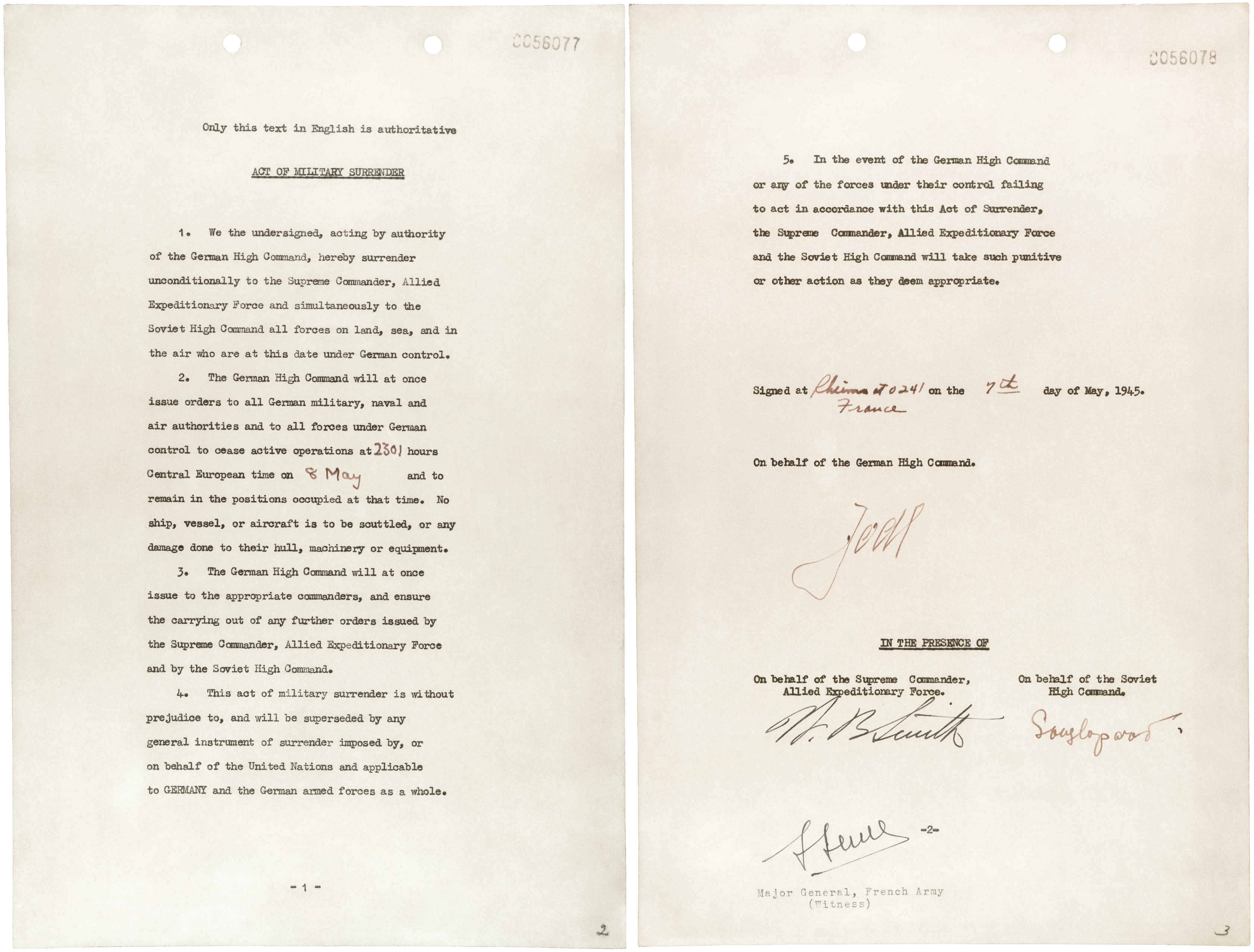
On 7 May, General Jodl went to Rheims offered to surrender all forces facing the Western Allies to Eisenhower. Ike told him that he would only accept the surrender of all German forces and negotiations would be broken off otherwise. The Germans had no choice to accept and it was agreed that the war would end at 2301 Central European Time on 8 May. This would be 0101 Moscow time, which is why they mark the end of the war on 9 May instead.

Some fighting would continue in the east until 13 May as the last elements of German resistance were suppressed - on a Dutch island called Texel, Georgian soldiers in a German unit revolted and a battle between them and the Germans with Dutch help on the former side continued until 20 May.

For most citizens of the Soviet Union, on 9 May 1945, the bloodiest war in history that had killed 26.6 million of their fellow countrymen and women, leaving every family with at least one family member dead, the war was over.

The impact, though, had only just begun.

Part Eight 

27 June 2011

The Biggest War in History, Part Six: Forgotten progress

Soviet troops in Lvov, Ukraine, 1944 (via Wikipedia)
Part Five

When one thinks of the year 1944, one automatically thinks of Operation Overlord and the liberation of France, along with the debacle that was Market Garden. Western popular opinion doesn't really remember the considerable advances against heavy opposition that the Red Army and its allies would make during this year. Perhaps it's the lack of a big, memorable "spectacular", like the huge amphibious landing that was D-Day or the street fighting of Berlin.

Despite making a lot of headway in the post-Kursk attacks, the front line in the Eastern Front, an assignment increasingly dreaded by German troops, remained entirely within the USSR as of the beginning of 1944. By the end of it, Soviet forces had ejected the Germans from the USSR entirely, had gained control of Romania and Bulgaria, was half-way into Yugoslavia and was at the gates of pre-Hitler Germany.

In the process, one would argue for the worse, the USSR had established the conditions for its post-war domination of Central and Eastern Europe.

The year opened with two big offensives in Ukraine and the Crimea, designed to clear the Soviet breadbasket of enemy forces. These areas were also important to Hitler; with the Crimea in Soviet hands, the VVS (Soviet Air Force) would be in bombing range of the Romanian oil refineries - refineries that Germany had to control if it was to keep its vehicles moving.

The Korsun Pocket

The Red Army forced its way across the Dnepr river in many places due to sheer weight of numbers, but a salient of German forces still existed between Kanev and Cherkassy, with two whole Corps of 8th Army in the area. There was an airfield at Korsun in said salient, so any forces that got cut off could be resupplied by air (a risky proposition though considering increasing Soviet air superiority), but von Manstein was sufficiently concerned about encirclement to ask to be allowed to withdraw. You can guess Hitler's answer.

Stavka spotted the situation and on 24 January, the 1st and 2nd Ukrainian Fronts attacked from opposite ends. After four days, the "Korsun Pocket" closed, with 57,000 Germans trapped inside, now under command of General Wilhelm Stemmerman. While the Korsun airfield was initially used to supply the forces in there, that was eventually abandoned due to increasing pressure. An attempt to relieve the German forces and encircle the encircling forces (another one of of Hitler's daft ideas, as most of the forces needed were under half strength) fell foul of an early spring thaw.

Stemmerman was eventually allowed to launch a breakout attempt on 16 February, having to abandon nearly of his heavy equipment (due to lack of fuel and horses. People often forget the large role played by our hooved friends on all sides in the war), but erroneously believed that a key hill (Hill 239) was in German hands. With the radios destroyed, he couldn't be informed otherwise. The initial thrust of the breakout forces ran into the enemy and the situation promptly turned into a full-scale rout, as panicked German soldiers in same cases ended up swimming across a freezing river to escape.

Eventually 35,000 men escaped, but with most of their weaponry lost, six German divisions had been effectively neutralised.

By June, US bombers and fighters could conduct "shuttle" missions, flying from the UK to attack German targets, landing in the USSR to refuel and rearm, attack targets in Romania and then return via Italy to the UK. Known as Operation Frantic, it had mixed success - the original targets had been captured by the autumn, operations were suspended for the winter and it was no longer needed by spring 1945.

Operation Bagration

The advances in the south and north now left a 250-mile bulge occupied by Army Group Centre between the Pripyat marshes and the Dvina river. As their summer offensive, the Soviets decided to eliminate this rather large bulge.

Hitler, anticipating an attack in the south, had taken most of AGC's tanks to reinforce there. He had also implemented a policy of fortified areas around key communication centres, while completely ignoring some useful natural barriers. The "fester platz" as these cities became known was another of Hitler's dumber ideas - the Soviets just bypassed them, deciding to deal with them later at will.

After a massive pre-attack bout of partisan activity, similar to that which would proceed Overlord in the same month, the first phase of the attack began on 19 June 1944.

To cut a long story short, Bagration was a massive success. With the Luftwaffe forces having been withdrawn to deal, as best they could, with the Allied landings in Normandy, the Soviet Union enjoyed clear superiority in pretty much every area, including strategic surprise. The weakened German defences were smashed and retreating forces were either cut off or continually harassed. Minsk was liberated on 3 July and by the end of the month, the Germans were completely out of the USSR. Various forces were cut off and eliminated - 28 divisions would end up either destroyed or ineffective; the Germans losing almost 300,000 men, either dead or captured. A massive hole was now open in the German front; the Soviets would go through it all the way to Berlin.

The Warsaw Uprising

By 31 July, Soviet forces were approaching Warsaw. Radio Moscow called on the people to rise up against the Nazis and the Polish Home Army promptly did just that the next day, expecting Soviet help to arrive in just a few days.

It wouldn't come. Stalin halted the Red Army short of Warsaw and prohibited the Western allies from using Soviet airfields to supply the resistance, limiting what they could do in terms of air drops because of the distances involved. It is no surprise that after two months of fighting intense German attacks, the survivors had to surrender. 100,000 - 200,000 civilians died in the fighting, which was then followed by the Germans starting to level the city, completing 70% of the job.

The failure of the Warsaw Uprising must be deemed the most cynically disgusting act of the war by Stalin; by allowing the Home Army, linked to the pre-war exiled government (now in London) to fail and lose much of its leadership, the way was set for a pro-Soviet government to take over after the war, with the Soviets claiming they had "liberated" Warsaw when they finally arrived in January 1945.

The rest of the year

The Soviet forces continued advancing, entering Romania in August and Bulgaria in September. Both pro-Axis governments were overthrown by internal forces and both countries promptly changed sides to supporting the Allies. Both would ultimately become communist. Finland also concluded a peace treaty in this year.

As 1944 came to an end, it was clear that the war was going to end in Europe during the next year. But it was still not over.

Part Seven 

25 June 2011

The Biggest War in History, Part Five: The crumbling of the Citadel


"To the West!" -  Soviet propaganda poster (via Wikipedia)

Part Four

As today is Armed Forces Day in the United Kingdom, it seems appropriate to start this entry with a discussion of the small, but significant British role in the Great Patriotic War - namely the Arctic Convoys.

Between 1941 and 1945, British merchant ships carried thousands of tons of supplies from the UK to northern Russia. This was one of the riskiest assignments of the war and a number of convoys were cancelled because of the losses. Most of the route was inside the range of German shore-based aircraft, even skirting around occupied Norway. Many of the convoys were carried out in the depths of the Arctic winter, where equipment froze up and sometimes even men. If you ended up in the sea, chances are you were going to die from hypothermia in fairly short order. However, supplies did manage to get through - helping the people of the USSR continue to fight against the Germans.

100 ships were sunk and almost 3,000 British sailors died - most of whom have no grave but the sea. May they never be forgotten.

****
Following the German defeat at Stalingrad, the Soviets started to fight their way back towards Germany; a dangerous gap for the Germans now opening up in their lines. The Red Army took Kharkov, but following the confusion that ensued after that, the Germans, thanks to a German general (von Manstein) getting his way for once, managed to take the city back in a successful counter-attack in February 1943, which broadly stabilised the situation.

Then the spring thaw turned the roads into slush and mud, bringing things to a bit of a halt, allowing both sides to take stock and try and gain the initiative. The Soviet lines now had a salient (a bulge in their lines) around Kursk, with several Armies in it. The Germans spotted an opportunity. Using 9th Army from the north and 4th Panzer from the South, both aiming for Kursk, they would cut the troops off in a pincer attack and hopefully eliminate a large amount of the Red Army.

However, Stavka (the Soviet High Command, sometimes incorrectly capitalised) were not idiots by any stretch of the imagination and they realised Kursk was the likely German target. Marshal Zhukov (the only man to have gained 4 Hero of the Soviet Union awards legitimately) persuaded Stalin and Stavka that this would need to be dealt with first rather than resuming the offensive, putting together a large reserve to deal with this.

Both sides used the spring to prepare; the Germans transferring a huge amount of their armour to the area (roughly 70%, including some of their newest tanks like the Panther) and the Soviets setting up an elaborate deception plan, while building up vastly improved defences.

On 4 July 1943, Operation Citadel, as the Germans called it, began with the usual air and artillery bombardment, something which didn't exactly take the USSR by surprise as they had good intelligence on German intentions (including ULTRA decrypts of Enigma and Lorenz signals traffic). As to be expected, both advances soon ran into heavy resistance and both would end up in failure, as the Soviets threw their reserves.

In the north, the Germans got about 10 miles before the grinding to a halt. By 10 July, they couldn't advance any further, having worn themselves out on the Soviet defences and with a vulnerable left flank.

In the south, the Germans were more successful but still had problems getting through the Soviet lines. In the end, neither offensive would even get a third of the way through the Soviet defences.

On 12 July, the key engagement of the battle took place. 2nd Panzer Corps met 5th Guards Tank Army in the biggest tank battle of all time - Prokhorovka. After initial bombardments, the battle turned into a full-blown tank-on-tank melee that air support couldn't get involved with for fear of blue-on-blue, to use the current parlance. What precisely happened isn't entirely clear, particularly in terms of numbers, but the battle must be considered a draw - neither side succeeded and suffered heavy losses. The battle was, however, a massive propaganda victory for the USSR - they had stopped the cream of German army in its tracks.

On the same day, the Red Army launched a counter-offensive to the north of the salient (Operation Kutuzov), but in the end, other events would also intervene. On 10 July, having successfully hoodwinked Germany into believing that Crete would be the target via Operation Mincemeat (the one involving a dead tramp), the US and UK invaded Sicily. With the need to divert forces there, Hitler cancelled the Citadel operation on 17 July.

Thanks to the superior numbers, tactics and planning of their opponent, the last major German offensive on the Eastern front had failed. Many of their tanks were destroyed and they'd lost a lot of men. So had the Red Army, but they could recover.

The Germans fell back over the rest of the year and by the start of 1944, the Soviet forces were back into Ukraine.

Part Six

22 June 2011

The Biggest War in History, Part Four: The beginning of the end

Soviet forces storm a factory in Stalingrad

Part Three

I have decided to move Kursk until tomorrow, to avoid an overly long post.

After the British victory at El Alamein ended Rommel's dreams of conquering Egypt and started a long retreat that would end up with the complete destruction of Axis forces in North Africa, Winston Churchill, always a man with a great turn of phrase, said this:

"This is not the end. It is not even the beginning of the end. But it is, perhaps, the end of the beginning".
If El Alamein was the end of the beginning, Stalingrad has a strong case that it was the beginning of the end of the Second World War. After this, the Germans never gained another strategic victory (Operation Market Garden, for all the attention focussed on the failures at Arnhem, cannot be called one, as the Allies had still made a considerable advance).

It's been said before, but it's best to say it again: Hitler was a useless military commander. His military experience was spent entirely as a messenger; he never commanded a platoon, let alone an army. His micro-management proclivities cost the Wehrmacht dear, much like his (very brief in time) successor Karl Doenitz did with the Kriegsmarine's U-Boat forces, which suffered the highest casualty rate of any arm in any side in the entire war. Churchill, who had some more command experience and had previous naval leadership knowledge as First Sea Lord during the First World War, generally left his generals to get on with the job. Also, Hitler generally refused to countenance any form of withdrawal to more defensible lines and sacked a number of commanders for doing so without authorisation.

All of this resulted in the decision to draw up and then launch Case Blue; an attack by Army Group South, now split into Army Groups A and B, on Stalingrad and the Caucasus oil fields, as well as cutting the Volga river. This (so Hitler hoped) force the Soviet Union to sue for peace. The offensive was launched, over some pretty strong objections from Wehrmacht officers (including Fedor von Bock, who was dismissed for objecting to the splitting of Army Group South)  who knew what they were doing a bit more than Hitler, on 28 June 1942.

The Germans ran into resistance at Voronezh, but the Red Army forces there eventually withdrew - and this is the important bit - in good order. While a "tactical withdrawal" is sometimes mocked by wargamers as "running away", it has a significant difference from a disorderly rout (like the Old Guard at Waterloo) as it still leaves your forces in a relatively good condition.

With Voronezh captured, the Germans were feeling confident of victory. At this point Hitler made a fatal mistake. He diverted 4th Panzer Army from Stalingrad and retasked it with attacking the oil fields. In the process, it crossed the line of march of the 6th Army - and caused a massive traffic jam. One must remember that most of the roads of Europe at this time were single-lane paved highways at best and muddy tracks at worst. If a tank breaks down, or runs out of petrol; it's going to take a while to get it out of the way. Speaking of petrol, an army marches on it as much as food today. In the process of this giant jam, 4th Panzer Army had taken most of 6th Army's fuel... The whole mess delayed the Germans by two weeks - giving the Soviet Southern Front time to withdraw in good order to Stalingrad.

The Germans were advancing towards the Volga and meeting little resistance. At Army Group B, they were realising, to use the old cliché, that things were quiet... too quiet. You know what generally happens after that.

The Main Battle

German forces arrived in the Stalingrad area in late August, starting off with heavy bombing raids. Civilians started to flee across the Volga - with the ferries being used to bring reinforcements in, so naturally said ferries became targets. However, the ferries kept running.

By 1 September, things were becoming rather reminiscent of a game of Warhammer 40,000 (the Imperial Guard in said game bear strong resemblances to the Red Army, right down to the Commissars who shoot 'deserters'). Fighting ended up literally room-to-room in some cases. The rubble from shelling created more hiding places for the defenders.

The battle dragged on and on, turning into a bloody game of attrition. Individual acts of heroism stand out here - most notably Sgt Yakov Pavlov, whose platoon defended a key strong-point for 59 days. Famous snipers like Vasily Zaitsev and Tanya Chernova wreaked havoc (although there is very little evidence for the story depicted in Enemy at the Gates). T-34s went straight from the Krasny Oktyabr (that's Red October for non-Russian speakers) factory into battle. We haven't even mentioned the female fighter pilots.

The Soviet forces were having supply problems - they needed to hold out long enough for the Volga to freeze over completely and the Germans now controlled 90% of the city. When ice floes started to form, rendering the river temporarily unusable, supplies were air dropped, but most ended up in German hands.

The Germans having rather exposed flanks as a result of their advance (the Soviets had moved away and so they weren't too worried about them initially), guarded by weaker forces from other Axis powers like Romania, who weren't too keen to die in someone else's war of expansion. On 19 November, they launched a counter-attack (Operation Uranus) and a day later, a second one from the south (Operation Saturn). The attack routed the Romanians and rapidly cut off 6th Army's supply lines.

General von Paulus, commander of 6th Army, knew he was in trouble. He asked for permission to withdraw twice and was refused. Eventually 6th Army was surrounded - their horror was only just beginning.

Ill-advised attempts to re-supply by air and a failed attempt to relieve 6th Army just cost the Germans a lot of men and equipment. 6th Army was trapped in a Russian winter, starving to death. Ammo and medical supplies were running out.

As disaster loomed, Hitler evacuated everybody else from the Caucusus region. von Paulus asked for permission to surrender and was instead promoted to Field Marshal (so if he died, Hitler could use the fact that no German Field Marshal had ever been taken alive as propaganda). Eventually, he decided to surrender anyway on 31 January 1943. 90,000 Germans were captured - only 5,000 would return to Germany, some spending twelve years as POWs. von Paulus remained as a "guest" of the East Germans until his death in 1957.

The battle of Stalingrad was over.

After an ill-advised attack that claimed well over a million lives on both sides and devastated a city, Germany's martial reputation was gone. The Soviet army was now starting its long journey to Berlin.

Part Five