Showing posts with label Railways. Show all posts

27 September 2025

200 years of the railway

Today marks 200 years since the opening of the Stockton & Darlington Railway, the first modern railway. The impact of that line was truly world-changing for good - and also ill. It made global commerce truly possible - and also imperialism. It also allowed people greater mobility and sped up communication, making political organisation far easier.

Appropriately enough, I am writing this on a train, travelling on Brunel's Great Western Railway from Paddington to Reading.

While standing in the vestibule. With the catering not open because the train is full. A 5-car IET is no replacement for a HST in terms of capacity. 

Great British Railways is heading down the tracks; Greater Anglia transfers over on 12 October.

Whether that will actually improve services remains to be seen. One problem with public railways is that they tend to be rather dependent on the whim of government and its political interest.

This is not a full defence of privatisation; the British franchise version was far too fragmented. At least it gave variety in terms of paint jobs. Or rather vinyls.

Anyway, here's to another 200 years. Perhaps I will live to see railways on Mars. Dust on the line anyone?

11 August 2025

The Greatest Gathering - or that's a lot of trains

As you may already know, 2025 marks the 200th anniversary of the opening of the Stockton and Darlington Railway, the first public railway that used steam engines. As a result, a large number of events are taking place around the country to mark what is called "Railway 200".

One of the highlights of this anniversary year, clearly marked as such from when it was first advertised, was The Greatest Gathering, taking place at the Alstom train works in Derby from 1 to 3 August.

The coat of arms of the city of Derby

It most definitely lived up to the name, with the number of items of rolling stock going into three figures. I was there from around 11.30am to just before closing time and I still didn't get to see anything.

Many others will have covered this in their own articles, so I will just show some of my pictures with some of my own comments.


There was a heritage bus service running to the station with vintage vehicles from around the country, but I didn't get this.

These two were from The Cab Yard, a museum under development near Swansea. The 442 cab in the left is a cab simulator, but this required booking and was full up for the day.

Locomotive present ranged from 1825's Locomotion No.1 to...


The brand new Class 93 from Stadler, a tri-mode locomotive (25kV overhead, diesel engine, battery)
Making its "debut" here - the Watercress Line's recently acquired Class 150, in a Regional Railways vinyl livery. This is the first of the "Sprinter" family to enter preservation and probably not the last.

HST power cars were rather prevalent - the yard near Derby station also had a bunch of them.

There's a lot more that I could share. It was definitely a highly memorable day and a testament to the skill of everyone involved that it came off.

04 October 2023

HS2

Sadly, unless we can bring costs under control, cancelling HS2's Northern leg is the best option.

But the money must now be used on genuine improvements elsewhere. I doubt that the Tories will deliver that... for one thing, they might not be in power much longer.

30 May 2022

Elizabeth Line Central Core visit

Took a ride on this today, getting off at most of the stations and having a look around. It's a great line and will be an even better one once fully connected up; fast trains, great information displays and huge platforms.

I also had some other good fortune as an enthusiast today:
  • witnessing a "scrap move" of two of Southern's withdrawn Class 455s
  • seeing a Class 59 and a 2EPB on my journey out to Hayes & Harlington
  • Arriving at Romford in time to see two of the older Class 315s arriving. Video to go on YouTube.
Some of my photos are below.


14 May 2022

Southern Class 455 Farewell

Went to Victoria this evening to see the farewell tour coming in. I wasn't quite expecting that many enthusiasts. I wasn't expecting that many young and loud enthusiasts. I wonder what the security guys were thinking!

I can't begrudge them enjoying it though - it's nice to know that the hobby has motivated newcomers.

So, that's the end of the 455/8s on Southern. We've got the SWR ones still left going for a few months and I may try to do their farewell tour.


06 March 2022

Blue Train to Munich - Nightjet and the capital of Bavaria

At the beginning of 2020, I arranged a trip to Bavaria planning to visit Munich and attend the Oberammergau Passion Play. Then Covid happened; the play was put back to 2022 and while Munich looked a possibility for September 2020, increasing travel restrictions made my plans increasingly hard and I eventually shelved the whole thing.

Fortunately, the international travel situation has improved to the point that a fully vaccinated traveller can go to much of the planet with some extra bureaucracy and costs, most notably around testing. Remember when we were told not to stick things up our noses? I know all this stuff is necessary, but I don't think many of us enjoy it.

With some changes to my original plan, I decided to go on the second of my long-distance international train journeys.

First, some context.


Nightjet and all that jazz[1]

Nightjet is the brand name for the overnight trains operated by ÖBB, the state operator of Austria. The operation was created in 2016 when Germany's Deutsche Bahn decided to stop running its sleeper trains and ÖBB took over those services, combining them with its existing EuroNight operations in a name designed to go with their Railjet express services.

They successfully arrested a decline in European sleeper trains and have indeed expanded their services to other countries including the Netherlands earlier this year after a Covid delay.

The Nightjet service consists of three types of carriages:

  • Seated carriages. These contain six-seat compartments for the really budget conscious and not recommended by seasoned travellers. Compartment coaches are something non-existent outside heritage lines in Great Britain, although the proposed Grand Union open access service on the West Coast Main Line is looking to bring some back. 
  • Couchettes. Consisting of two or three padded bunks on each side of the compartment, this is the middle-level option. Mixed-sex, although some ladies-only ones are available, and you don't fully undress in there. The bunks can be folded away to convert the carriages to 'day mode' akin to the seated carriages. There is a toilet and washroom at each end of the carriage.
  • Sleepers. Up to three-fold-down beds with a washbasin in a cupboard; there are also some deluxe compartments with en-suite toilet and shower. The latter had sold out by the time I made my booking, so I needed to use the toilet/shower at the end of the corridor.
Most of the Nightjet sleeper fleet consists of carriages built in the 2000s; while they have charging plugs for mobile phones or laptops, they do not have Wi-Fi, which can be a bit of an issue when you're out in the countryside. Make sure you download anything you want to watch.

Unlike the Caledonian Sleeper (which I went on in 2016, although they now have new carriages) or Night Riviera services in the UK, the compartments can be converted between day mode and night mode with the beds lowered down and put back when you want them. This is something that the attendant does for you and shouldn't be done yourself.

Safety isn't an issue if you take the normal precautions; you can bolt the door to your compartment from the inside and are provided with a keycard for when you pop down to the restroom or shower.

Nightjet also provide a car-sleeper service where you can transport your car on a double-deck wagon on some routes, although not all year round. This is something that could do with reintroduction in the UK; it would help reduce CO2 emissions. 


Outward journey

I purchased a Global Interrail Pass for this trip - worth the money as the high-speed train journeys are expensive otherwise.

I left my home at the civilised hour of 08:05 on Wednesday 6 October, making my way to St Pancras via the London Underground. Once I got there, I made my way to the Collinson Group Covid testing centre on the top floor - the Dutch required a negative lateral flow test for entry. You need to pre-book and even then, there's a bit of a queue, but they do the swabbing for you.

I then checked in; I had to do this manually with my pass, but there were no problems there. I got my negative result while standing in the passport queue for entering France.

Speaking of passports, due to Brexit, British travellers are now required to obtain stamps in their passport when entering or leaving the Schengen border-free zone; not having one can lead to problems. Once ETIAS, the EU's electronic registration system for visa-free entry, becomes a thing, these will no longer be done.


Then it was a case of waiting in the lounge below the platforms until the boarding call.

The Eurostar services to Amsterdam are operated by 320km/h capable electric multiple units built by Siemens. I have been on these before and found them comfortable trains with smart interiors. You don't really notice the speed either unless you're looking out of the window, although walking down the aisle can be a challenge; the handholds should be used.

I had a light lunch on the train during the just over four-hour journey to Amsterdam. The most interesting section of the route is the Brussels to Antwerp part, which runs along a non-high-speed line, allowing you to see regular Belgian rolling stock, which is sometimes covered in graffiti. The Channel Tunnel itself is just a long tunnel and you don't even lose mobile reception in it.

I had three hours to spend in Amsterdam before my sleeper train, so I went for a walk through the city. I avoided the red-light district, which is not my cup of tea at all. I did see a cannabis shop though.

Once I had done my walk, I returned to Amsterdam Centraal and had dinner at the Grand Cafe 1e Klas on Platform 2. A pricey affair - I chose not to pay for dessert - but excellent food and ambience; you can see the activity on the platforms from your seat.

Once I had finished, I collected my suitcase and made my way to Platform 7 where the Nightjet service was due to arrive.
 

Nightjet 421, at the time of my journey, was split into two sections when it departs from Amsterdam, with the third section from Brussels joining it at Troisdorf instead of Cologne West due to engineering works affecting the latter and forcing a diversion away from Cologne's elegant central station. As you can see, there are typically only one or two sleepers for a given route. More is non-economical.

I was in coach 282, third from the back and it was just a case of waiting for the train to pull in. I didn't get a particularly good shot of the Siemens Vectron locomotive in NS yellow-and-blue as it pulled the ten-carriage formation in from the sidings; there also wasn't really time for me to walk down to take a photograph as I was focussed on getting on board.

I showed my ticket to the attendant - in the old days he'd have taken my passport for dealing with frontier checks - and made my way down the corridor to find my compartment.

In this case, it was a 125mph cupboard - the Comfortline carriages are cleared for 200 km/h, although don't get anywhere near it on this journey.


An array of photographs of the interior can be found here; they're better than my shots. While bigger than the Caledonian Sleeper compartments, it is still possible for you to do yourself a mischief if you're used to bigger rooms.

Departure was on time and with no other dessert options available - something I should checked beforehand - I had a large chocolate bar. I also drank the complimentary Prosecco, figuring that it might help me sleep,

There wasn't a huge amount to see - the sun had already set by the time I'd boarded this train, so it was a case of watching something on my tablet - I forget what it was.

The power charger in my room was proving to be temperamental. In fact, the whole room power turned out to be unreliable with the loss of most of the lights, the water (which needs a pump) and the air conditioning. This was one of the most modern locomotives in Europe and it wasn't working properly! Eventually, the train was brought to a stop. By the classic method of turning it off and turning it on again, the power problems were fixed.

We eventually reached Troisdorf and were running behind schedule at this point. With my compartment facing a solid wall and no way I was going to be able to watch any shunting operations on the other side, I decided to turn in at that point.

My sleep wasn't that great. The swaying of the carriage i.e. it was tilting a bit and the narrow bed are not things that I am exactly used to. Coupled with the uncertainty about my location and the fact we were running late, I barely got beyond Rapid Eye Movement. 

We got to Nuremberg around two hours late and I did get around two hours sleep after that before the attendant, having adjusted for our late running, woke me up. Once I was dressed, he converted the compartment back to day mode and then brought me my breakfast.

It was a particularly good breakfast and the Bavarian forest scenery was truly excellent as we approached Munich. The final approach to the Bavarian capital is past an extensive number of sidings and depots, where sights included some Class 218 diesel hydraulic locomotives from the 1960s and two HST power cars now owned by RailAdventure that were parked up at Munich Central.

In the end, we arrived at Munich 75 minutes behind schedule - long enough for me to be entitled to a 25% refund, which I eventually got a few weeks later. I took some photographs of the Taurus locomotive that was going to haul the train, now with car transports added from Hamburg while at Nuremberg, in the opposite direction for the rest of its journey to Innsbruck.

After a few photos, I then dropped my suitcase at my hotel - it was still not even 9am local time, so I then decided to explore the city.

I have to say that I enjoyed the Nightjet journey and would take a sleeper train in future with them. Hopefully, the power won't go out next time.

The whole journey took around 24 hours, although about a sixth of that was waiting at stations or walking in Amsterdam. Not a massive acceleration on how things would have been 50 years ago, where I would have had multiple overnight options from different ports, with the Orient Express from Paris a realistic option.

Time in Munich and elsewhere

Munich itself is a very charming city; with a lot of nice architecture in the city centre around Marienplatz. That location was where I converted my NHS Covid Pass into an EU one for the cost of €6 at the pharmacy there. Bear that in mind for 2022 if you're visiting.

I visited several the sites in this area, including the Residenz, the old Bavarian royal palace that is now a museum. Much of the place was severely damaged in the Second World War[2] and several rooms are incomplete as a result, something that the audio guide frequently points out. It is a big place; you'll need a couple of hours to do it and you may be a bit sick of rococo by the time you're done.


The city also has an extensive public transport system, with a U-Bahn (metro) dating from the 1970s, trams and buses. The suburban railway network is also particularly good and if you're a rail enthusiast, a journey along the line from Pasing to Central provides a smorgasbord (or whatever the German equivalent is) of railway vehicles to see.

I couldn't pass up the opportunity to munch on some sausages in a beer hall, although I didn't drink any beer. The Hofbräuhaus is a genuinely lovely place to visit, although best not to mention the fact it was used for Nazi Party meetings. The hall where the putsch attempt started was demolished in the 1970s, BTW.

Nuremberg & DB Museum

Nuremberg, where Germany's railways began, is easily accessible by train from Munich and you don't have to pay the expensive ICE fare with an Interrail Pass. The modern InterCity Express high-speed services that criss-cross Germany are some of the best trains in Europe, full stop.

Nuremberg itself was where the Nazi regime very much started and ended, with the annual rallies during the 1930s and the war crime trials after the war was done.

I was unable to get close to the reviewing stand where Hitler did his speeches as there was a motor racing event going on - the road in front of it forms part of a street circuit and has done since the American occupation.

However, I was able to visit the Nuremberg Trials Memorial. The former courtroom used for the trials was converted back to a German one after they were done and carried on being used for criminal cases until 2019, when it became part of the museum. The main part of the exhibition is upstairs and while the displays are in German, an audio guide in English is provided. Sitting inside the courtroom itself is a sobering experience even if the Tribunal features are mostly gone. I realised that where I'd been sitting was within literal spitting distance of Hermann Göring's seat during the Major War Criminals Trial. As Hitler's de facto deputy for nearly all the war, he would be the most senior Nazi to face earthly justice, although he would take a cyanide pill just before his scheduled execution.

But the museum does not shy away from the fact that many Nazis got away with their actions. The start of the Cold War meant that many people lost interest in the crimes of that regime and the Western Allies increasingly let the West Germans run the show. Many got away with minor sentences or never faced the courts; no top-level director of Deutsche Reichsbahn for example was ever charged over transporting people by rail in inhuman conditions to the camps.

The role of the German railways in supporting the Nazi regime is something not ignored in the place I visited in the afternoon. Going back to the days of the Bavarian state railway, the DB Museum in Nuremberg is one of three such ones in Germany, with the other two sites in Halle and Koblenz.

The ground floor covers the history of German railways from the start up until 1945, with several historical vehicles on display, including state coaches of Otto von Bismarck and Ludwig II of Bavaria, the one who built the extravagant castles. This includes displays on the World Wars, including the Holocaust.

The first floor takes the story up from 1945, covering the parallel development of Deutsche Bundesbahn and Deutsche Reichsbahn i.e. the operators from West and East Germany. This was by far the most interesting bit of the museum, with an array of exhibits ranging from early railway computer systems to examples of some of the dodgier advertisements DB used in the 1970s.


Across the street there is a yard area with an array of locomotives and carriages, right next to the main line. Some of these are undercover and include the sole remaining bit of the first express DEMU built for German railways. However, the carriages were not open, so you couldn't get the full experience. I like at least one opportunity to sit in an old railway carriage.

There is also a large model railway section and various temporary exhibits; I was not able to do everything before the place closed and I headed back to Munich on a late-running ICE service with a considerable number of Bundeswehr people on the train with me.

Dachau

The first Nazi concentration camp is somewhere where you don't go for fun but is a must-do for any visitor to Munich. You need to get a bus from the S-Bahn station of the same name; the site is well hidden behind trees and within a suburb that residents must feel a bit strange about living in, considering the sheer infamy associated with the very name.

Not all the buildings were open due to Covid, with the cell block and the two barracks for prisoners - rebuilt for the memorial - closed. The main museum block was open though and this provided a comprehensive account of just what went on there. Like Auschwitz and several other such camps, there is an "Arbeit Macht Frei" sign at the gate - this is a replica with the original displayed inside the museum; the latter was stolen in 2014 and found in Norway in December 2016 after an anonymous tip-off.

A very chilling place, particularly the crematorium and gas chamber at the back of the site. Dachau was not used for mass killings, but inmates were subject to medical experiments and other casual brutality, as well as the horrific conditions. A wall near the museum bears the marks of the shootings that took place there and I was slightly upset when I saw someone take a selfie there.

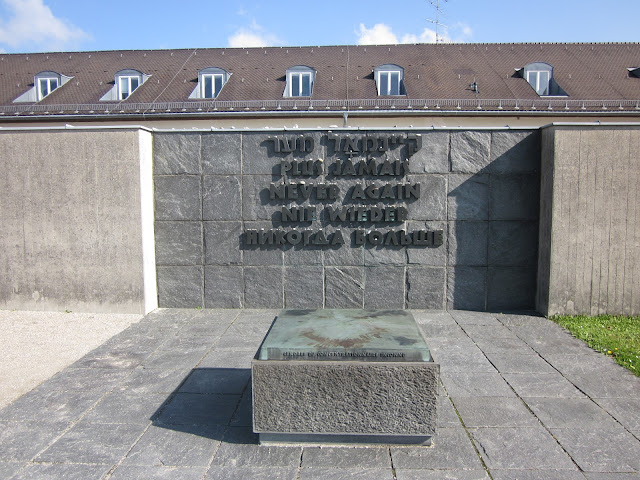
An estimated 41,500 people died at Dachau, many of their ashes dumped into pits at the back of the site, now marked as the graves of many unknown thousands. The message on the memorial walls is a sentiment we can all agree with:


Olympic Stadium

In 1972, Munich hosted the Summer Olympic Games, an event overshadowed massively by the terrorist attack against Israeli athletes. The games are notable for their introduction of the standard icons for the different sports, Mark Spitz winning seven gold medals and Olga Korbut winning three. In a way, this was very much the moment West Germany restored the damage done to Germany's reputation by the war.

The Olympic Park and Village built for the competitors both remain very much in situ. You can walk around the outside of the glass and wire stadium (a bit vertigo inducing at some points) or zipline down from the roof if that's what you enjoy. Much of the stadium was closed off for the Munich marathon due to take place the following day, while the main memorial to the massacre was also shut due to the site needing repairs. There is also a long series of panels detailing the history of those games.

This is a big site and it's quite a walk from the U-Bahn station that serves it. Something true of the London Stadium too, but fortunately, I like a good walk.

Bavarian Railway Museum

Having done the Buckow Light Railway in 2016, which is electric, I wanted to do a steam line this time around. The Bavarian Railway Museum, consisting of a former steam shed linked to an exceptionally long (by heritage standards) single-track line used by freight during the week, is a bit of a trek from Munich, involving three trains to get to the northern end at Gunzenhausen.

Waiting there was a 1939-vintage steam locomotive hauling a series of mostly six-wheeled coaches, which I learned had bodies from the 1950s and underframes from the 1910s - they had to do a lot of recycling in the aftermath of the war. I look a fair bit younger than I am - I get asked to prove my age in pubs! So, it's not that surprising in retrospect that I was mistakenly sold a child's ticket. Not the ticket collector's fault though.


The 'Rekowagens', which stayed into service until the 1980s and had a memorable career end running extra services that had to be put on after the fall of the Berlin Wall, are very pleasant vehicles, although lack air conditioning, so probably aren't great on a balmy day when stationary.

After arriving at the other end of the line in Nördlingen, I made another ride up most of the length of the line, this time riding on a pair of diesel railcars from the 1950s that helped keep branch lines open. This consisted of a noisy powered vehicle where you could see out of the front and a quiet trailer with a guard's section blocking the view that way. It was a pleasant ride and gave me a different perspective on German railway history, although I still hope to ride an old long-distance type at some point.


I was hoping to get off midway and get some lunch, but the train did not in fact stop either way and there was nothing open within easy reach of the other intermediate station, I had to get a late lunch in Nördlingen itself before walking to the main museum itself. The museum is right next to the station, but there is no direct connection, and you need to walk through a housing estate. This limited my time in the museum to just over an hour as I had to get back to the main station for my train; otherwise, I would have needed to wait a further two hours.

The Bavarian Railway Museum does have a very extensive collection of locomotives and rolling stock, these are in fact on both sides of the mainline track. If you like your locomotives big, black and steam, you'll be happy, but there are also diesel and electric locos, some of which are main-line registered. There is also a large model railway display and an exhibition detailing the history of the station. Unfortunately, I didn't find anything to buy in the shop.

I headed back to Munich via a branch line where the platforms were just gravel and a line of bricks, then riding on a locomotive hauled EuroCity train bound for Klagenfurt in Austria.

A good day out, although chilly - Bavaria in October is not a warm place and, on a Sunday, there aren't many shops open in this more conservative part of Germany.

Salzburg

One of the trains that I most definitely wanted to do on this visit was the Railjet high-speed loco hauled service, having seen them on a previous visit to Vienna but not gone on one. At full speed, the Taurus can operate at 230 km/h or 145 mph, which is faster than any British train except the Eurostar, although the relative lack of high-speed routes in Central Europe means that the Taurus cannot really go full power. They also possess a very musical start-up sound (not my video):


The Railjet network runs from Austria as far as Berlin in the north, Budapest in the east, Venice in the south and Zurich in the west, using fixed formations of seven coaches with a driving trailer at the non-loco end in a similar style to the Taurus. Some services operate in pairs to head for different destinations, splitting on route. There are three classes of accommodation, Second, First and Business, the last with three-seater compartments.

Some of the sets and locos are operated by the Czechia state operator, being painted in their blue-and-white colours.

The service I got was Railjet Express 63, ultimate destination Budapest in Hungary. I can safely say that the Railjet is as good as I thought it would be. I had an excellent schnitzel from the buffet car and admired the scenery, even if the issues with the Wi-Fi caused problems getting my pass QR code up for the ticket inspector.

We were about ten minutes late and I was barely able to make a suburban train to Salzburg South, where I got an InterCity train back. I do trips like this just to say I have done those types.

On my return, I saw a locomotive and single carriage, both in Nightjet livery. On investigation, it was a press launch for some 'new' couchette carriages, being converted from surplus seated carriages. They will have Wi-Fi and a dedicated compartment for those with disabilities. I took one photo and left them to it.

I walked through Salzburg, a city which has a lot of Alpine charm and is famous for The Sound of Music - a stage production was due for 22 October.

I went up to the fortress there, which you access by a funicular, or you can walk to it. There are a few museums up there, including one for a military regiment that fought in the First World War, which gives you a different perspective to the British one I'm used to - Austria-Hungary's conflict against Italy was in an environment even less pleasant than the Western Front.

An interesting place with splendid views, although pricey. Such as the way of the world today.


It was also cold up and a bit windy up there - I ended up buying gloves as my hands were getting chapped.

After heading back down, I got a trolleybus back to the station and then a regional train back to Munich, with the German border police boarding at Freilassing, having a chat with someone, and then leaving. I had to put a specific train down for the entry form; if I hadn't, I might have decided to get something different back, but the Stadler Flirt in Germany is just as good as the British version used by Greater Anglia.

Heading back

I had considered getting day trains back but couldn't make the timings work. One advantage of sleepers is that you can of course sleep in them - far more comfortably than if you're sitting in a seat - but I didn't fancy running the risk of a second night of lost sleep.

So, I flew back on Tuesday afternoon (after a final morning walk through the city centre) - and not by the one of the budget airlines, instead taking Lufthansa from Munich airport. The German police officer at passport control was a bit confused as to where I had entered the Schengen Area; not realising that the French stamp your passport at St Pancras. Fortunately, I was stamped out once I explained.

This then a bit farcy as there was a long wait at the gate for our Covid documents to be checked. Why they couldn't have been checked earlier isn't entirely clear. Then the bus to the airport took us all the way around the proverbial houses to our plane, which was parked at the other (closed) terminal. The crew were half an hour late as well.

We flew back on your standard plane ride, made worse by the FFP2 mask, which I binned on landing as I'd worn it all day. Then a long wait to go through the e-gates at Heathrow, which was balanced by my luggage being on the belt when I arrived. Through customs and a long wait on the lift before First Class (an extra seven pound over the regular cost) on Heathrow Express to Paddington - they've recently got 'new' trains - and the Tube home.

Then a day off to recover before returning to the 'real world' of my job that pays for trips like this... trips that I am planning more of.

[1] Does not contain actual jazz. Midnight Trains probably will, if it actually starts.
[2] Munich was subjected to heavy bombing by the Americans and British during the war; it isn't that hard a city to find with the Alps in proximity. Two months after my visit, an unexploded bomb from the war went off during construction work of a new railway tunnel, injuring four people. The city itself fell with not much actual resistance to the Americans in the closing days of the war.

02 October 2021

Upcoming posts

I plan to see No Time To Die next week and then I am taking an overseas trip for the first time in two years. Expect posts on both to follow.

17 February 2020

Armchair Time Traveller #4 LNER Continental Timetable October 1935 to May 1936

Playing all the right notes, but not necessarily in the right order, I'm now jumping back almost 30 years to a vintage timetable that I picked up for Christmas in 2018.

Going back to the Grouping Era, it's time for this bad boy:


OK, it's not a man or a woman, but there's plenty of Bad in it... as in towns called 'Bad something'.

With a momentary pause in the bad puns, let's go...

The context

1935 was a year when the international situation very much began its slide down the slope to the depths of the Second World War. The Luftwaffe was formed and conscription was introduced in Nazi Germany as Hitler openly went against the Treaty of Versailles; the Nuremberg Laws were introduced that stripped citizenship from non-Aryans. Mussolini invaded what is now Ethiopia in a quest for imperial glory that was a brutal campaign from the outset.

On the other side of the coin, canned beer was invented.

The popular conception of railways before the war is of a world full of steam locomotives. Certainly steam engines were the norm in most places. Electrification was the norm on tram networks and it was starting to spread to railway ones as well, who wanted to compete with them and increasing numbers of coaches as roads improved. Steam locomotives aren't the cleanest of things and they're not the fastest either. The 'sparks effect' of electrification increased passenger numbers and helped develop suburbs as people moved to cleaner areas away from city centres, commuting into work on electric trains.

The timetable itself notes that an Italian line is being electrified, while Germany, the Netherlands and Italy were starting to wire up main lines.

In the UK, the Southern Railway had pretty much done its suburban network in 1930, with mainline services next, using the third rail system. Brighton, Worthing, Eastbourne and Hastings were already connected, with Portsmouth being worked on.

The LNER itself had taken over electric suburban services in Tyneside and would start on wiring the line from Liverpool Street to Shenfield, although this was suspended with the outbreak of the war - British Railways would finish it off.

Europe had different political boundaries in 1935 - especially in the east of Europe, where the USSR was much smaller than it would become after the war and Poland was over to the east, including big parts of what is today Belarus, Ukraine and Lithuania. Lithuania in 1935 used standard gauge for its network, a result of the German occupation in the First World War so it had a direct connection to the network of most of Europe; there also appears to have been a standard gauge line to Riga, Latvia.

The contents

There is a lot packaged into this 185-page affair, certainly far more than you'd get in any modern timetable. To give you some of the highlights:
  • Plenty of terms and conditions stuff, including a statement that LNER will not be liable for any loss or damage at Sea (their capitalisation) due to, for example (and I actually quote):
    • The King's enemies
    • Accidents from machinery, boilers and steam
    • Accidents of the seas, rivers and navigation of whatever nature or kind soever
  • An eight-page index of continental stations
  • No less than 45 pages of fare listings, including fares from London via Harwich to many European cities, fares from 'provincial stations' of the Big Four to Harwich and fares from Harwich to European cities. All of these are in £.s.d. so you might have a fair bit of complex adding up to do.
  • Rates for a wide variety of luggage including:
    • Motorcycles
    • Cars
    • Typewriters
    • Sewing machines
    • Nautical Instruments (15 shillings to the Continental ports)
    • How to send telegrams from ships
    • Information on sending goods and parcels via train and ship (a train ferry service for freight was also around) 
    • A long list of agencies through which LNER sold tickets in both Europe and the US
    The actual timetables themselves take up a minority of the book and employ the standard format for the international timetables I have in my collection; you read the times down on the left hand side for services going away from London and up on the right hand side for coming back - this means you only have the station names one i.e. in the middle. The details of the through carriages available and any variations are at the bottom. One thing that is obvious is that the icons are a good deal more detailed than you would find in a modern publication. An example of the timetables can be seen below. I couldn't scan from this book without risking damaging it:


    There are also three fold out maps at the rear of the book, one of Belgium, one of the Netherlands and the one below:


    These schematic style, not quite geographically accurate maps for the LNER and LMS were created by George Dow and in fact were the inspiration for Harry Beck's world-famous London Underground Map. More information and history of these can be found here. 

    The fares 

    International travel was not exactly cheap at this time. £1 in 1935 was equivalent to £70 now. If you wanted to go to Amsterdam to partake of the red light district (it existed, but was a lot less in your face than today), you were looking at £4 17s 10d each for a Third Class Return via "Flushing" (Vlissingen, which no longer has any ferry services to the UK since the Sheerness service was terminated in 1994). That's over £300 each before luggage, hotels and meals were included. You were able to get special weekend tickets that allowed you to travel without a passport, but the precise information on these is not provided in this timetable. 

    (Yes, bachelor parties were around back then). 

    If your stag do inclinations stretched further afield to the Estonian capital of Tallinn, you were looking at £12 1s 9d for a Second Class Single; a visa was also required from the Estonian Embassy at 167 Queen's Gate, SW7 - open only between 10am and 1pm. This said, at least you could get a through ticket all the way there - you can only get a through ticket to Warsaw from the UK now, with the need to buy further tickets in Vilnius and Riga. Interrail is a thing for the whole Baltics now, but the cross-border connections are limited as you get further east and you might be better to get a coach.

    The travel times

    London to Tallinn was possible with four trains and a ferry. Departing at 0930 GMT on Day 1, you'd be at Berlin Schlesischer Bahnhof, in English "Berlin Silesian Station" at 0733 the following morning, a journey time of 19 hours and 13 minutes, via the Harwich-Flushing ferry. This is now, after two rebuilds by East Germany, Berlin Ostbahnhof and remains a major starting point for international services, like the EuroNight Talgo sleeper to Moscow-Belorusskaya. 

    Departing there 19 minutes later, you'd be in Riga at 0648 Eastern European Time on Day 3, with a two hour wait for a 2nd and 3rd Class only service to Tallinn, arriving at 1856. That's a 55 hour and 26 minutes journey.

    In 2020, there is no overland route shorter than three nights... Driving takes 28 hours straight; something impractical with the need to refuel, go to the toilet and sleep.

    London to Berlin was a 20 to 21 hour journey with a sleep either on the ferry or the train; although the former involved having to pay a supplement on the express train in Germany. Avoiding that would add another five hours to your journey as you had to wait for a later slower train,.

    Other fun stuff


    As mentioned earlier, this timetable has a large array of information on those wishing to ship goods via rail; as the railways were a 'common carrier', they were required to take nearly anything that was offered to them, no matter how profitable the market was. The exceptions were manure and stuff like lime that could damage their stock. So you could get ship propellers put on a flatbed.


    Full details of the rates available required you to contact one of the Goods Managers or a freight forwarding agent; since this would entail me doing a seance, I can't provide them to you. There were special inclusive rates for express goods at 805 Belgian francs per metric tonne to Antwerp, which was just under £6 - although this did not apply to perishables. These had to be delivered to Bishopsgate Goods Station before 3pm on any weekday.

    The most common freight wagons at this were 20-foot boxcars and those could be shipped to the continent without the need to tranship via the Harwich-Zeebrugge train ferry that ran from 1924 until 1987; these wagons could be sent as far as Poland and 'Roumania' (the spelling in English didn't standardise until 1975). LNER also advertised a through shipment company called All Rapid Transport Service, who said they could ship goods to Palestine (the British Mandate) in 9 days, China in 27 days "&c &c".

    Rather relevant in today's day and age were Customs regulations. At time where the European Union was over twenty years from creation, every frontier required some form of customs examination and the items that were subject to duty, restriction or outright prohibition ranged from the normal to the downright bizarre, like:

    • Tobacco
    • Hats
    • Field and Opera Glasses (there is a difference between field glasses and binoculars; the former lack internal prisms that can jolted out of alignment via rough handling)
    • Gramophones and Gramophone Records
    • Plumage
    • Handkerchiefs

    Also, don't try to bribe a Customs Officer or you could be fined £200. Also, you won't be allowed to pass Go.

    Conclusion

    The inter-war years are considered a golden age for the railways and to an extent that's true, with the sheer array of international services, along with some very snazzy rolling stock. However, it wasn't exactly the fastest of services and international travel could be quite bureaucratic, especially if you wanted to bring home some hats.

    I'd go for a visit, but I wouldn't like to live there.

    02 March 2019

    Armchair Time Traveller #3: BR London Midland Region Timetable, June to September 1964

    So, back to Britain for the third part of this ongoing series, in which I look at old train timetables.


    I acquired this tome (it's so big that 'tome' is the only word one can really use to describe it[1]) via eBay, which is the go to source for historical train timetables of all eras and countries. When I shuffle off this mortal coil, then someone is going to be selling my small collection on a future version of this site, I'd imagine/hope...

    Anyway, an explanation. BR for most of its history was split into a number of regions, largely aligned with the boundaries of the pre-nationalisation Big Four, although there were differences and changes over time. The London Midland Region or LMR for short was based around the boundaries of the London, Midland and Scottish Railway (LMS - interestingly, these initials are trademarked by the Government so we might get a return of this to join the other three Big Four companies). In practice, this meant services from the four London termini in the picture in a generally NW direction, although the now closed and demolished Broad Street connected to the now London Overground line to Richmond. Services crossing the Pennines also came partly under LMR's aegis.

    The historical context

    While not the first electrification project carried out by BR, the West Coast Main Line electrification from London to Glasgow, opened in stages from 1959 to 1974, was arguably the most major event of the first half of the near 50-year existence of the organisation. Locomotives constructed for this operation, namely the AL6/Class 86, still ply our rails on freight operations to this day, with some now earning their keep in Bulgaria.

    As a result, steam haulage continued on the London Midland at this time, with a major presence for the LMS Stanier Class 5 4-6-0 mixed traffic engine, colloquially known as the "Black Five", along with the BR Standard Class 5, its post-war development. 

    However, diesel and electric stock was well established. 

    On the Chiltern Main Line out of  London Marylebone, the four-car diesel units later known as Class 115 were in operation. Their interiors were a good deal more luxurious than the more bus-like ones of other Mark 1 based units, to serve the better off commuters of Buckinghamshire. St Pancras had the Class 127, also a four-car unit. Both had the capacity for passengers to see out through the front window and watch the driver at work, although some would pull the blinds down.

    The Sulzer Type 2 (Class 25) became so common on the LMR and elsewhere that enthusiasts nicknamed them "Rats", the standard term for them today, but plenty of other types were around.

    Electrification from Crewe to Liverpool, as well as in the Birmingham and Manchester areas had resulted in the introduction of the Class 304, with a rather distinctive compressor noise.

    However, 25kV was by no means the only spark game in town. The iconic Woodhead Line from Manchester to Sheffield has 1500V DC overhead with units and locomotives to match, some of which ended up in the Netherlands. 

    The Bury Line, later converted to a tram line had 1200V DC side contact rail from its World War One era conversion and the Class 504. 

    The Watford DC Line, operating from Euston to Watford Junction, shared with the Bakerloo Line (which also ran to the latter at this point) and now part of London Overground, had also been done at the same time, with 750V DC third rail; Class 501 units with bars on the windows to prevent passengers from leaning out were used here as well as to Broad Street and Richmond.

    Now about Broad Street. This station, situated next to Liverpool Street, had been severely damaged in air raids in the Second World War and was progressively being run down over this time - the route had limited appeal for those going to central London as faster alternatives were available. It would finally shut entirely in 1986 and be replaced by the Broadgate shopping centre.

    Speaking of closures, Richard Beeching was Chairman of British Railways at this time. This is of course a name very familiar to any British rail enthusiast for the wrong reasons. The Great Central Railway, while closed after his return to ICI, would lose its through services to London in 1966 and close entirely in 1969. It has services here in the London St. Pancras to Sheffield line, although many of the intermediate stations had closed in 1963.

    Also noted are the closure of Normacot and Cheadle stations on the Crewe-Derby Line (today served by East Midlands Trains) and the closed Cheadle branch line off that respectively; the former had closed in March 1964 and no trace remains, while the latter went the year before with only the station master's house surviving. A proposal to run charter trains to Cheadle for Alton Towers in the 1980s did not come to fruition and the track has since been lifted.

    The contents

    After a couple of full page notices advertising freight services and warning about engineering work for the WCML electrification, we then have a 13 page index of stations, followed shortly after by 16 pages on seat reservations (2 shillings each) and Regulation Tickets (to enable you to ride at all on a particular service, no charge). A long list of trains that could have been much more simply with a symbol above the appropriate service in the main timetable, where people are going to look anyway!

    We then have the sleeper services, which were much more extensive back in 1964, also operating out of St Pancras, Marylebone and Kensington Olympia, the last being an arrival point only for some reason. With many terminus stations being reached in the wee hours, BR helpfully would shunt the sleepers to one side so you could get a longer kip. Also, I have to love this line (emphasis mine):

    Dogs or other livestock are not allowed to be taken into the sleeping cars.

    This sort of line begs the question of just what someone took on a sleeper train to result in the need to specify that. I'm imagine a chicken clucking all the way down Shap...

    We then have the boat train services to the island of Ireland, which has the option on the ferry from Holyhead to Dun Laoghaire to have an "open berth" with either a made-up bed for 8 shillings or "rug and pillow only" for 7 shillings. So, a big dormitory with a rug and pillow on some bunk? Who is running this ferry service? Ryanair?

    The summary tables for key routes take us up to page 110 and then we get to a whole string of passenger information, including "Specimen single fares between principal stations", which like Ronseal, does pretty much exactly what it says on the tin, giving a table of second class fares between the key station. Euston to Glasgow will set you visitors in 1964 back 84 shillings exactly i.e. £4 4s.

    (For ease of use, prices were often displayed in shillings and pence only).

    This is a walk up flat fare - discounted advance tickets were not a general thing in 1964. Basically around £80 at today's prices. You can get an Advance Single on Virgin Trains today for £65, but you're looking at £141.50 for the any off peak train variety.

    However, discounts were available including:
    • Mid-Week Period Return: Go out on Tuesday, Wednesday and Thursday, return on those same days in one of the following weeks within one month.
    • Excursion tickets: To go to principal towns, holiday resorts and for special events.
    • Holiday Runabout Tickets: A rover ticket
    • Circular Tour Tickets: For when you want to take a more indirect route.
    • Ramblers' Tickets: Travel to one station, come back from another
    The vintage terms of the 1960s appear as we work our way through the rest of the passenger information. There are a list of charges for bicycles, perambulators ("prams" being the contraction from the 19th century that has superseded this word[2]) and humanity's best friend, Canis familiaris i.e. the dog. Dogs at the time had to be tied up or caged in the guard's van in many cases - they also needed to be "efficiently muzzled" to prevent them from barking or requesting other stations on the LTS line[4].

    It was common at the time to send luggage you didn't need on the trip ahead of you when going on holiday or up to university (or public school!). This cost 2/9 for each package to be collected and conveyed or conveyed and delivered within Great Britain i.e. part of the road journey being included. For the whole trip, you'd pay 5/6.

    Finally, we have a quick section on London Underground services with a tube map.

    The rest is timetables with adverts for various services repeated throughout to save space.

    The travel times

    So, how long is it going to take you to travel through the London Midland Region of British Railways?

    I'll cover three types of services here: a London region commuter service, a London to Scotland journey and a 'Regional Railways' service in North Wales.

    London commuter service

    The Chiltern service from London to Aylesbury Town in 1964, using Class 115 DMUs, took 58 minutes in the peak times, stopping at all the stations on the route - the service frequency was every 15 minutes. For example, 5.57pm departure would get you to Amersham at 6.55pm.

    Today, you can do that journey in 54 minutes; the service also goes on for a further nine minutes to the 2008 opened Aylesbury Vale Parkway. Not really a huge difference, but remember that the 115s had a lot more doors.


    Long distance

    One of the key railway journeys in the UK is from London to Glasgow; the Lowland Sleeper goes there and it is the limit of long distance electrification on the West Coast Main Line. There were in fact three main stations in Glasgow at this point in time - Central, Queen Street and St Enoch. The last of these was closed in 1966 and the site demolished; it is now home to a shopping centre.

    The Royal Scot, the 10am departure from Euston to Glasgow Central, arrived after a stop at Carlisle at 5.10pm, a journey time of 7 hours and 10 minutes. Today you can do the journey in 4 hours and 29 minutes on a Pendolino, which is of course considerably shorter.

    Regional Railways

    Liverpool to Manchester is the oldest inter-city railway route recognisable as a railway in the world (opened in 1830) and can be done in under 40 minutes today depending on what train you get, although the average is around 54 minutes.

    In 1964, the journey lengths were about the same, but with a much lower overall service frequency. Today I believe the actual issue is congestion...

    An important note - Manchester Piccadilly was not the main station at this time (for one thing undergoing rebuilding as part of electrification), with Manchester Exchange being one of the main calling points. This was closed in 1969 and is now home to the Manchester Central Convention Centre, connected to the Metrolink tram network.


    Conclusion

    The long distance times here show much electrification sped up journey times nearlywherever it was introduced. I've been on steam hauled rail tours and while they are limited by the need to fit in with other traffic, they're not exactly very fast affairs. And you might only have one book to keep you entertained; for many members of the public, steam only became glamorous once it had disappeared.

    1964 would be the end of an era for British Railways; for one thing, it would be British Rail from 1965 onwards...


    [1] It weighs 868 grammes or 1lb 14.6 ozs in old money.
    [2] Not the only contraction superseding the original world. You have a (tele)phone, women generally wear bra(ssiere)s[3] and many fly on a (aero)plane.
    [3]Be careful not to mix that word up with brasserie.
    [4]Thank you, I'm here all night.

    03 September 2018

    Armchair Time Traveller #2: 1963 East German International Timetable


    The Electronic Reading Room of the Central Intelligence Agency's Freedom of Information Act wing is a source for a lot of very interesting data from the Cold War era. What I was not expecting when I was doing research for my 1960s set spy RP game Secret '67 was to find a number of train timetables scanned and uploaded within the archives.

    Anyway, I managed to find a particular gem that has become a useful resource for the game; the Summer 1963 International and Domestic Timetable for Deutsche Reichsbahn, the East German state operator.

    (Reich is a German word literally meaning 'realm' or more figuratively meaning 'nation'. While most English speakers would automatically associate the word with Hitler and the Third Reich, it is not in itself a negative term, but Germany does not use the term any more for official use. Therefore the name of the company is 'German National Railways')

    The document, declassified in 2011 and uploaded in 2016 only ever bore a CONFIDENTIAL classification due to the (redacted) information on the front as to the sourcing of the document. The main timetable contains nothing at all secret; being a publicly purchasable document that would have been obtained from the DR ticket office at Berlin Zoologischer Garten station in West Berlin. That's right, you didn't even need to cross over the Berlin Wall to get one.

    I will be focussing solely on the international timetable for the purpose of this article.

    The historical context

    The idea of the Iron Curtain being some fortified barrier that one tried to cross only at one's mortal peril was true... but mostly for the people who lived on the eastern side of it. The communist governments over time became increasingly keen for the tourist dollar - and I mean the tourist dollar. Certain goods needed for their economies - and their leadership - had to be imported from the West; with Western businesses not exactly keen on taking East German marks or Soviet roubles, actual dollars or pounds were needed.

    So, they were keen to advertise their nation to Western tourists who could see the socialist system in action - the parts of it that they wanted them to see at any rate. With air travel still very expensive for most, long distance train travel or driving were the common ways to get between European nations. Western tourists and visitors would need to apply for a visa of course, although you could get a day permit for East Berlin just by turning up at one of the appropriate checkpoints, such as the one at Berlin Friedrichstrasse station - more on that later.

    Furthermore, Eastern Europeans could, after applying for permission, go on vacation to other countries in the Soviet bloc. A popular destination for East Germans was Czechoslovakia, which happened to be next door for one thing...

    ****
    East Germany itself was still very much a land of steam. The Soviet Union had taken much of the pre-war electrification equipment and rolling stock back home as war reparations, leaving a war-battered East Germany (there were still uncleared ruins in East Berlin) reliant on rolling stock dating back to the 1920s and beyond. Track maintenance increasingly fell by the wayside, speed restrictions popped up all over the system and with a literally captive passenger base (car ownership not exactly being very high in the GDR), there was little incentive to improve.

    The contents

    After a cover, literally the first thing you encounter is an advert for the German Hygiene Museum in Dresden. Founded in 1912 and still open today, it served at the time as much as a propaganda vehicle for the GDR as it did for health education; it had earlier done the same thing for the Nazis.


    Other adverts for East German places to visit or things to buy also appear.

    Handily enough, the explanatory notes on the timetables that follow are written in German, Russian, French and English, although the main timetables themselves are in the first language. The first part of these are bulk timetables for a particular cross-GDR route, followed by key routes in three other socialist states (Poland, Czechoslovakia and Hungary) and finally by individual timetables for the key trains running through East Germany.

    The symbols are very similar to the ones found in modern international timetables, although notable standouts for this period include designations on a coach diagram for a mail carriage and a railcar.

    In an age where far more correspondence went by post, railways were often the fastest means to transport letters and so it was entirely normal to add a mail carriage to the consist of an express train that was going that direction anyway; indeed, that carriage might have a letterbox for passengers to add items of their own. Indeed, British rail operators were legally obliged to take mail as required by the Postmaster General. There were dedicated mail trains as well.

    Then there are "railcars" or as most people tend to call them these days "multiple units", whose main distinction was a more limited space for luggage if there was any at all. Mainline multi-carriage multiple units really started getting going in the 1930s, with the beautiful SVT 137 coming into service in 1935 running at speeds of up to 100mph. East Germany had produced a prototype version of its most famous DMU, the VT 18.16, later the Class 175, although series production would not begin until 1965.

    Through coaches were very much the thing on international expresses. There was not exactly the demand for an entire twelve-carriage train from Paris to Moscow on a daily basis (there still isn't, hence why it only runs once a week), so you would have one carriage for the Soviet capital from Paris, another from Ostend and another connecting from Hoek van Holland, all part of a train mostly running between Paris and Warsaw.

    This needs diagrams or a list to be fully understood and we have plenty of examples like below.


    The travel times 

    International train travel took a lot longer back then. One particular reason was border controls; while in-journey passport checking was common on sleepers and Trans Europe Express services, you'd still have checks when travelling within the EEC, let alone outside it. A 40-minute-plus layover when entering or exiting East Germany was not unheard as the Border Troops thoroughly checked papers and the carriages to make sure things that weren't supposed to cross the border were not present. This even applied to trips to fellow socialist countries like Poland and Czechoslovakia; remember permission was needed for East Germans to even go there for a holiday.

    To take a similar route to my 2016 trip from London to Berlin, I would need to depart from London Victoria at 10am on one of the boat trains that connected with the ferry from Dover to Ostend in Belgium, arriving at the latter at 3.20pm; no need to change my watch as the mainland of Europe was not using Daylight Savings Time, while we were. A 4pm train, designated F 52 or the Oostende-Wien Express, depositing me at Cologne at 9.18pm. I would then have to wait for an hour to pick up D 105 as shown above, the famous Paris-Moscow service, where I could end up in one of three sleeper carriages heading for Berlin; one operated by Mitropa, the East German sleeper and restaurant car provider or the other two operated by Soviet Railways. The other option was a DR couchette car; Mitropa did not lower itself to those. Apparently the Soviet sleepers had net curtains...

    Helmstedt on the West German side of the border would have been reached at 3.48am for a twelve minute stop to swap the locomotives. Then a 16 minute stop at 4.14am to 4.30am. The passport checks for the GDR would have done on route, but the need to get and pay for the transit visa would have probably meant I'd have been woken up... Hence why the Thomas Cook advice was to fly to West Berlin.

    After taking 3 hours and 3 minutes (!) to travel the 118 kilometres to Berlin Zoo, I'd have arrived bright-eyed and bushy-tailed, I hope, at 7.33am. Journey time, 21 hours and 33 minutes. This has been much accelerated of course since then.

    Going east, a whole string of long distance expresses operated. Some have disappeared into railway history, others have been contracted but one that definitely survives is Hungaria (EC 173); which has indeed expanded from Berlin-Budapest to Hamburg-Budapest with only one loco change at Prague. A 1963 journey time of 14 hours and 33 minutes for the former has now been reduced to 11 hours and 2 minutes, with the whole route taking under 14 hours.

    Ex 154 from 1963 is described as a 'Triebwagen... mit Speiseabteil' i.e. a multiple unit with catering; the 1969 data from VagonWEB is for two Czechoslovak M 298.0 four-car DMUs, which were built from 1962-64, so one may well have run this service at the time. Today it's a locomotive hauled service using modern electric traction.

    Conclusion

    Train travel between countries in the communist bloc of the 1960s could be slow, bureaucratic and unreliable, unlike today's world of open borders and high speed trains. That said, the trains looked good (mostly) and you'd have been able to see steam engines in their natural element instead of pottering about on heritage lines. Just bring a good non-offensive book to read.

    Can I recommend Sherlock Holmes?